- Location
- Tennessee NEC:2017
- Occupation
- Semi-Retired Electrician
I was replacing 3-way switches in an old house that is getting remodeled. Some of them were back stabbed so I just cut the wires. Came upon one that was both back stabbed and used the side screws. I had seen some before and they were just using both the screw and back hole instead of a wire nut, so I just cut the wires without looking where they were placed on the switch.
When I was trying to find the hot common and load common, nothing came out right using my toner. The wires actually changed colors as to the normal way when checking at the light and 2nd 3-way. The light box just had a 2-wire cable, and the other 3-way just had the 3-wire cable, like a dead end 3-way. Since the colors didn't match (I could see the insulation on the old 3-way to see what color went where), I determined there must be a junction box somewhere. I cut out a section of the ceiling and found the junction box.
What I found in the junction box confused the heck out of me. There was a 3-wire cable that brought the hot and neutral from the 1st 3-way box. Then a 2-wire cable to the light. Then there was a 2-wire cable to a receptacle in the room. Then a 3-wire cable to the 2nd 3-way. But at the 2nd 3-way there was also a single pole switch for an outside light. The hot was sent down to the box, and a neutral for the outside light. What was confusing was there was only a 3-wire cable and not enough conductors for a hot, neutral, and 2 travelers.
I could not see how this was possible, so I just left it for my next visit. This was praying on my mind while at home so I started thinking about it more. Then it hit me that it must be an old, not allowed anymore, wiring method.
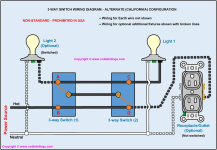
I looked up some old diagrams and first thought it was a California 3-way wiring, but saw that takes 4 conductors, and I only had 3. Then I found what is called a Carter 3-way. It only uses 3 conductors.
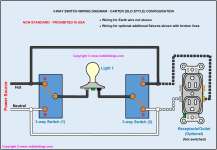
This was exactly what I had. The way these wire is one common is tied to the hot terminal of the light, and the other common is tied to the neutral of the light Then one traveler is tied to the respective traveler at the other switch, along with the hot conductor. The other travelers from each switch are tied together along with the neutral. If a receptacle is wanted at the 2nd 3-way, it is available, same with the neutral. Could also add a light with a single pole switch. This is what they done at this house and why I couldn't see how they got a neutral with not enough wires.
This allows the 3-ways to work one light, an added receptacle, and an additional switch for a different light. Only thing I see unsafe is in one position of the 3-way, one terminal of the light would be hot, but the bulb wouldn't be lit. This could cause someone to think no power at the light since it wasn't lit and get a shock.
I've heard of these old wiring schemes, but never encountered one. Thought it was interesting and wanted to share.
I do plan on running another cable from another source for the outside light, and just have a dead end 3-way.
Here is the wiring diagram.
When I was trying to find the hot common and load common, nothing came out right using my toner. The wires actually changed colors as to the normal way when checking at the light and 2nd 3-way. The light box just had a 2-wire cable, and the other 3-way just had the 3-wire cable, like a dead end 3-way. Since the colors didn't match (I could see the insulation on the old 3-way to see what color went where), I determined there must be a junction box somewhere. I cut out a section of the ceiling and found the junction box.
What I found in the junction box confused the heck out of me. There was a 3-wire cable that brought the hot and neutral from the 1st 3-way box. Then a 2-wire cable to the light. Then there was a 2-wire cable to a receptacle in the room. Then a 3-wire cable to the 2nd 3-way. But at the 2nd 3-way there was also a single pole switch for an outside light. The hot was sent down to the box, and a neutral for the outside light. What was confusing was there was only a 3-wire cable and not enough conductors for a hot, neutral, and 2 travelers.
I could not see how this was possible, so I just left it for my next visit. This was praying on my mind while at home so I started thinking about it more. Then it hit me that it must be an old, not allowed anymore, wiring method.
I looked up some old diagrams and first thought it was a California 3-way wiring, but saw that takes 4 conductors, and I only had 3. Then I found what is called a Carter 3-way. It only uses 3 conductors.
This was exactly what I had. The way these wire is one common is tied to the hot terminal of the light, and the other common is tied to the neutral of the light Then one traveler is tied to the respective traveler at the other switch, along with the hot conductor. The other travelers from each switch are tied together along with the neutral. If a receptacle is wanted at the 2nd 3-way, it is available, same with the neutral. Could also add a light with a single pole switch. This is what they done at this house and why I couldn't see how they got a neutral with not enough wires.
This allows the 3-ways to work one light, an added receptacle, and an additional switch for a different light. Only thing I see unsafe is in one position of the 3-way, one terminal of the light would be hot, but the bulb wouldn't be lit. This could cause someone to think no power at the light since it wasn't lit and get a shock.
I've heard of these old wiring schemes, but never encountered one. Thought it was interesting and wanted to share.
I do plan on running another cable from another source for the outside light, and just have a dead end 3-way.
Here is the wiring diagram.
Last edited: