Fused Disconnect

Status
Not open for further replies.

dayradebaugh

Member
Location
El Dorado, KS
Occupation
Farmer
I have a farm with a house, a separate house we rent to a family, and various outbuildings. I'm having a contractor install 2 ATS's and 2 fused disconnects to set up separate emergency generator feeds to a) the farm and outbuildings and b) the rental house. The utility power for both feeds come to a central point (a garage) in which all this equipment is going to be housed.

The problem I'm having is that 2 ATS's, plus 2 fused disconnects, plus 2 power panels to for each location is turning into a wiring nightmare. A further fact is that the cost of the fused disconnects are a significant portion of the cost of the ATS itself. The need for the ATS has been explained to me as a circuit breaker which will protect the ATS in the case of a massive power surge.

Here's my question: For a non-commercial application, does it make sense to have a fused disconnect? In general, I'm beginning to question the need for a circuit protection device which whose cost (in one case at least) is almost as much as the thing it's protecting.

Thanks for your help.
 
Your situation is not unusual. It is often painful to meet the letter of the code when putting in generators for backup power.

However I don't understand why the fuse disconnects are so expensive. If this is regular residential 240/120 single phase, the disconnect itself is not real pricy. The labor to put it in probably is 10 or 20 times what the cost of the hardware is. A $50 disconnect that takes 3 or 4 hours to install does not seem unreasonable for an existing installation.
 
I don't think it's a code issue, at least as it's been explained to me. It's been my understanding that I can install a fused disconnect or not, and it's my choice.
 
Here are costs:
Farm: ATS--3736, FD--2019
Rental: ATS--3006, FD--684

For the farm at least, if the FD is simply an insurance policy, it does not seem to be good value. Plus the complication factor on the wiring makes the total cost much larger--in both cases--than the component cost.
 
I don't think it's a code issue, at least as it's been explained to me. It's been my understanding that I can install a fused disconnect or not, and it's my choice.
If you don't want to pay for it then don't have the electrician install a fused disconnect, if it is not required.
 
Thanks. Am I right in supposing it to be simply a "circuit breaker" protecting the ATS? Are they typically included in non-commercial installations?
 
Does your ATS' not have integral circuit breakers in them? The Generac ones I have at my place do. I don't understand the need for the fused disconnect at all.
 
I have sat in training classes given by generator technicians (not electricians), and they've recommended installing a disconnect between the utility and the ATS. The reasoning is that it is easier to service the ATS without calling for a POCO disconnect.
 
I have sat in training classes given by generator technicians (not electricians), and they've recommended installing a disconnect between the utility and the ATS. The reasoning is that it is easier to service the ATS without calling for a POCO disconnect.
That makes perfect sense. Most rural applications around here (like my current setup) has a 200A breaker below the meter on the pole so there is a means for that already. However, they are getting ready to pull the meter and run HV over to a pad xfrmr and meter with CT's. That would make it impossible to remove service to ATS without POCO. (y)
 
I have sat in training classes given by generator technicians (not electricians), and they've recommended installing a disconnect between the utility and the ATS. The reasoning is that it is easier to service the ATS without calling for a POCO disconnect.
Does your ATS' not have integral circuit breakers in them? The Generac ones I have at my place do. I don't understand the need for the fused disconnect at all.
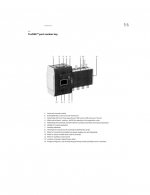
Here is a pic of the guts of the ATS being proposed, which is a Zenith TruOne 260A ATS. I do not see a circuit breaker here.


Doc1.jpeg
 
This site is designed for:
  • Contractors
  • Electricians
  • Engineers
  • Inspectors
  • Instructors
  • Other electrically related individuals
This NEC® Forum is for those in the electrical and related industries. Questions of a "How-To" nature by persons not involved in the electrical industry will be removed without notice.

Knowledge and the practical application of the National Electrical Code is an essential part of all electrical installations. If it's important for you to understand the National Electrical Code, then look no further.

To better help us serve you, please be sure to update your account details with your occupation field and location if you have not done so already. You can access your account details by clicking on your account name at the top right of the page when on the forums.
 
Status
Not open for further replies.
Top