
You are using an out of date browser. It may not display this or other websites correctly.
You should upgrade or use an alternative browser.
You should upgrade or use an alternative browser.
Fused switch on residential gas furnaces
- Thread starter nizak
- Start date

- Location
- New Jersey
- Occupation
- Journeyman Electrician (retired)
I've never done that although I have seem some ancient systems where they had an SOY box with a switch and fuse at the unit.
I believe the intent of the fuse is to protect the motor in case of a problem.I've never done that although I have seem some ancient systems where they had an SOY box with a switch and fuse at the unit.
I’ve seen many of furnaces 40/ 50 years old with them but haven’t seen them installed in at least 25 years.
Common ones I see are Bussman with a 6
1/4A fuse.
Is it because newer blower motors have built in thermal protection as opposed to older ones?

James L
Senior Member
- Location
- Kansas Cty, Mo, USA
- Occupation
- Electrician
From what I've seen of their use, originally the furnace would not have been on a dedicated circuit. It would be on the same circuit as the basement lights.
So it seems that rather than blowing the fuse for the entire basement, and ending up in the dark if there was a problem with the furnace, it would just blow the fuse that's on the unit
So it seems that rather than blowing the fuse for the entire basement, and ending up in the dark if there was a problem with the furnace, it would just blow the fuse that's on the unit

But a 1/2 HP motor (which doesn't seem uncommon for a furnace) draws 9.8 amps?I believe the intent of the fuse is to protect the motor in case of a problem.
I’ve seen many of furnaces 40/ 50 years old with them but haven’t seen them installed in at least 25 years.
Common ones I see are Bussman with a 6
1/4A fuse.
Is it because newer blower motors have built in thermal protection as opposed to older ones?
I usually assume all furnaces have built in overload protection of some sort, and only need a properly sized branch circuit breaker for compliance.
I believe that is generally the case for almost all "packaged" HVAC equipment including things like RTU's and condensing units, with the one general exception being items that require fuse protection.
In other words, I assume most packaged equipment already has the motor starter and thermal motor protection built into the unit.


DooWop
Member
- Location
- Corrales NM
- Occupation
- Hvac contractor
They were a common install when I worked in another state. Most furnaces weren't on a dedicated circuit.
ramsy
NoFixNoPay Electric
- Location
- LA basin, CA
- Occupation
- Service Electrician
I thought plumber was looking for disconnect switch, for the MC Cable box extension, when using this on existing 20A FAU outlet...most packaged equipment already has the motor starter and thermal motor protection built into the unit.
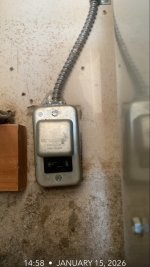
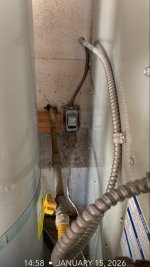
Here is my take on those Edison fuses,
In all furnace designs if the blower goes out you'd also want to shut off the furnace / turn off the fuel source, (gas / oil valve).
On a new gas/oil furnace there is a 'mother board' and sensors that provides safety controls and the motor is a hi efficiency electronically commutated motor (ECM).
On old furnace designs (but may still be in service) the 'motor overload' is moved exterior to the unit so it can turn the entire furnace off if the motor overloads.
While many appliance small factional HP motors are 'shaded pole' and thus 'impedance protected', I'd say most a older oil/coal/gas furnace blower motors would typically be Permanent Split Capacitor (PSC), and thus *not* impedance protected (I am generalizing)
If the capacitor fails it sits there trying to start but can't due to the failed capacitor.
The windings basically turn into a heating element when there’s no electromagnetic resistance from the rotor spinning.
Without the Edison fuse obviously a 15A inverse time breaker (or fuse) would never trip, much less a 20A, so if sits like that long enough eventually it damages the windings.
Fractional HP PSC Motors have had a temperature overload that melts for a long time (not sure when that was invented), but that is embedded in the windings and not typically user serviceable, and it would not shut off the entire furnace.
So my guess is the Edison fuse is set to trip before the motor overload so the entire furnace / fuel is cut off
In all furnace designs if the blower goes out you'd also want to shut off the furnace / turn off the fuel source, (gas / oil valve).
On a new gas/oil furnace there is a 'mother board' and sensors that provides safety controls and the motor is a hi efficiency electronically commutated motor (ECM).
On old furnace designs (but may still be in service) the 'motor overload' is moved exterior to the unit so it can turn the entire furnace off if the motor overloads.
While many appliance small factional HP motors are 'shaded pole' and thus 'impedance protected', I'd say most a older oil/coal/gas furnace blower motors would typically be Permanent Split Capacitor (PSC), and thus *not* impedance protected (I am generalizing)
If the capacitor fails it sits there trying to start but can't due to the failed capacitor.
The windings basically turn into a heating element when there’s no electromagnetic resistance from the rotor spinning.
Without the Edison fuse obviously a 15A inverse time breaker (or fuse) would never trip, much less a 20A, so if sits like that long enough eventually it damages the windings.
Fractional HP PSC Motors have had a temperature overload that melts for a long time (not sure when that was invented), but that is embedded in the windings and not typically user serviceable, and it would not shut off the entire furnace.
So my guess is the Edison fuse is set to trip before the motor overload so the entire furnace / fuel is cut off
DooWop
Member
- Location
- Corrales NM
- Occupation
- Hvac contractor
We added the fused switch to cut power. It had a dual element fuse but was more of a shutoff for emergencies or service.
Eddie702
Licensed Electrician
- Location
- Western Massachusetts
- Occupation
- Electrician
I don't know why they used them in the past I never saw them used on furnaces around here.
All furnaces now require a dedicated branch circuit and the blower motors have thermal protection.
All furnaces now require a dedicated branch circuit and the blower motors have thermal protection.
Thats interesting you never saw them.I don't know why they used them in the past I never saw them used on furnaces around here.
All furnaces now require a dedicated branch circuit and the blower motors have thermal protection.
I *think* the early internal motor thermal protectors were a one and done, not resettable / replacable, so you'd want that Edison fuse to be a very exact amprage (like 6.25) amps so you blow the fuse with a locked rotor not melt the thermal link in the winding.
On those early systems I suspect they wanted to shut fuel source down if the motor locked up, so another reason to use the external fuse.
I think today's 'forced air' blower fans in furnaces came out around 1935, before that for ducted air type furnaces were not that good, it was natural convection only.
It seems in northern climates boilers and a hydronic hot water or steam to radiators systems were more popular until A/C came down in price and people wanted a dual system, hence central air took over, it cools in the summer heats in the winter, so many homes may have been converted from hydronic boilers to forced air. Boiler systems would also want to cut the fuel on motor overload so I'd guess external fuse, but perhaps they used relays?
It was probably not uncommon to see Coal furnaces that had been converted to oil burning in service until recently in your part of the country?
Here in PNW it was logging / lumber mills everywhere and people actually had sawdust furnaces, not that much different than a pellet stove.
Last edited:
fastline
Senior Member
- Location
- midwest usa
- Occupation
- Engineer
Is anybody here still installing the comb switch/ Edison base 6.25A fuse on new installs?
Conversation came up with an HVAC installer today.
I've done several rezzy units, but more commercial. Whether code or not, it has always been my practice to install a fuse inside the units. I realize it is atypical, but it just roasts my azz to see the lack of protection that could prevent not only a "fuzz fire", but maybe save some gear. I have never once had to deal with an inspection so I can't speak to that.