GFI troubleshooting

JP23

Member
Location
California
An arena ebb and flow controller which feeds many sump pumps is tripping the integral
main GFI breaker intermittently. What is the quickest way to isolate the problem?
I started by disconnecting two of the main loads but it didn't resolve the issue.
Since it's intermittent it seems like I would have to return to the site many times
to check if the breaker tripped. It's not an overload and all the pumps are hard
wired so it's a pain to disconnect them. Time saving tool recommendations or troubleshooting
methods appreciated!
 
Had some trouble accessing the site earlier.
The system is 10 years old. There's 8 standard sump pumps and conductors that go to unknown loads.
Everything shoots off underground. The pumps are divided on 2 circuits. I have plenty of experience troubleshooting
GFI circuits but this is raw land splay of conductors and the other loads still need to be located. Haven't
spent much time on it except the start of a process of elimination and realizing that that is going to take forever
since the problem is intermittent.
Could be the breaker, wire, one of the pumps. I think a megger is a good bet as long as I verify it can't harm anything
on the circuits. Currently trying to get more info on the system from the installer. Thanks.
 
Is the integral main GFI breaker a 5mA GFCI or a GFPE with a 30mA or higher trip threshold?
Also, what is the voltage and current rating of this main breaker? Just asking to get a better understanding of the installation.
 
... I have plenty of experience troubleshooting
GFI circuits but this is raw land splay of conductors and the other loads still need to be located. ...

Do you have a leakage current clamp meter to help track down the location of current leakage?

For example:

Fluke meter:


A cheaper version:


Another thing you can do is apply just enough leakage current that it trips, and then back off slightly from that. This will make the circuit more sensitive to tripping so it should be easier to isolate the problem.

This is a tester that applies a variable leakage current:

You can also make your own much cheaper version with 4 switches controlling binary weighted resistances.
 
Last edited:
I don't know if the tool I'd want to use exists, but I can describe it:

A multi-channel recorder with a residual current sensor on each circuit.

A residual current sensor is just a current transformer with all of the circuit conductors going through the window, so you just measure any leakage. The sensor is optimized for low residual currents, rather than a current transformer used to measure circuit operating current. Then I'd set it up and see which circuits have leakage.

Very likely you have multiple pumps, each with some leakage, and the main only trips when two leaking pumps are on.

-Jonathan
 
I have always recommended the Fluke Leakage tester for anyone that needs to routinely diagnose GFCI issues. Worth the money if you need it often. For most too expensive for rare usage.
Years ago I created my own inexpensive GFCI-Leakage tester to diagnose Christmas light GFCI tripping issues.

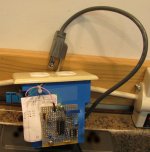
I used the sensing coil from a 7599 Leviton GFCI - followed by an amplifier/full wave rectifier/scaling . It produced a DC voltage output directly proportional to the leakage current in the range of 0.1 -5ma. Used a DVM to read that output.
Works quite well in limited applications. Nothing like the fluke meter of course but good enough for occasional use.
Here is a picture of that:
 

Attachments

  • 5ma leakage tester.jpg
    5ma leakage tester.jpg
    125.1 KB · Views: 10
In this previous post I showed a coil I made with 10 turns of a twisted pair that increased the sensitivity of a clamp meter 10X .

 
Hey guys, sorry for the delay in responding. I was leaving at dark and getting home at dark the last couple days.
I think I narrowed it down to the din rail mounted GFI breaker. I ended up disconnecting each of the
loads from the din rail terminal blocks one at a time and the GFI was still tripping with a slight lag. At first it took a long time
to trip but started tripping more quickly. I will try the new breaker and keep you posted. Lots of great input!!
 
Is the integral main GFI breaker a 5mA GFCI or a GFPE with a 30mA or higher trip threshold?
Also, what is the voltage and current rating of this main breaker? Just asking to get a better understanding of the installation.
Thanks for the question. I just found it you asked it and never thought to check the breaker for that info. Good advice! Thanks.
 
Do you have a leakage current clamp meter to help track down the location of current leakage?

For example:

Fluke meter:


A cheaper version:


Another thing you can do is apply just enough leakage current that it trips, and then back off slightly from that. This will make the circuit more sensitive to tripping so it should be easier to isolate the problem.

This is a tester that applies a variable leakage current:

You can also make your own much cheaper version with 4 switches controlling binary weighted resistances.
Thanks for the tips! I spent some time looking at different troubleshooting tools before finding your reply. I haven't had much of a need for
these type tools since most of the issues I've run across are fairly simple to solve. I have a nice underground tracer and a Fluke
T500 ammeter/multimeter and standard toner/tracer. I bought a megger on Ebay but it didn't work so it's buried in the landfill.
I don't do a ton of service troubleshooting but could see where knowing how to use these great tools could help branch
out into a specialty. There's have a wish list now!
 
Do you have a leakage current clamp meter to help track down the location of current leakage?

For example:

Fluke meter:


A cheaper version:


Another thing you can do is apply just enough leakage current that it trips, and then back off slightly from that. This will make the circuit more sensitive to tripping so it should be easier to isolate the problem.

This is a tester that applies a variable leakage current:

You can also make your own much cheaper version with 4 switches controlling binary weighted resistances.
I just have a Fluke T500. Not equipped the way I want yet. Definitely think that meter is something I should have on the truck.
Much appreciated.
 
Top