Grounding for outdoor light fixtures

Status
Not open for further replies.

tallgirl

Senior Member
Location
Glendale, WI
Occupation
Controls Systems firmware engineer
I've looked, and cannot find the answer to this because it frankly makes no sense at all and it never has.

When does an outdoor lighting fixture require a ground and when doesn't it? This afternoon I put up both a porch light and a flood light. The porch light had a ground lug for the bracket, and unless I missed something, I didn't see anything that insured the rest of the fixture wasn't grounded. The flood light did not (and they never have, and they drive me insane because they don't.) and one of the ECs who was kibitzing around me noticed my bogglement. The paddle fan was the same as the porch light -- connected to the EGC.

What is so special about flood lights?
 
Julie,
If the fixture has exposed conductive parts, then it must be bonded.
(2) Grounding of Electrical Equipment Non–current-carrying conductive materials enclosing electrical conductors or equipment, or forming part of such equipment, shall be connected to earth so as to limit the voltage to ground on these materials.
The code does not specify the method of bonding required for light fixtures...the mounting screws may be intended to serve as the bonding connection.
Don
 
Are you talking about these?

0896498.JPG
 
georgestolz said:
Are you talking about these?

0896498.JPG

Those are the ones. I hung one like that (except it was circular and not rectangular) and there was no screw for the ground. The junction box was 4" round plastic, so the mounting screws weren't doing anything.
 
You can't install a metallic fixture in a nometallic box unless the fixture has provisions for a bonding connection.
Don
 
Those "red dot" type par holders don't always have the green screw in them, but they always have the hole into which you can add the grounding screw. Inside the neck, where the wires come out, there is an area in the casting designed to accept the ground screw.
 
So ... net/net the next time I'm handed a metal fixture without the green screw I ask for one anyway? Am I going to piss someone off if I do that?

I first noticed this something like 30 years ago because other outdoor fixtures, such as porch lights, always have them. And never, in 30 years, have I seen someone add the missing green screw, nor has anyone handed me an extra screw if one didn't come in the package.

Y'all are going to get me in trouble. I can see it now ...
 
tallgirl said:
Y'all are going to get me in trouble. I can see it now ...

Naw... where you might get in trouble is if you ask for a #8 green screw, which is what they most often take. I keep a box of #8 green screws on my truck, because that's what the ground hole is tapped at in old-time boxes. You need a self tapping ground screw (tri-lobed or thread cutting) for most of those. They are most often salvaged from interior fixture straps.
 
In fairness, it's not very often you're installing metallic par holders on non-metallic cluster covers. It is with certain frequency that you will install a metallic cluster cover and metallic par holders on a non-metallic box. You'll need at least one equipment ground connection, in that case. It is preferrable to bond each par holder, as their individual connections to the cluster cover do not always remain tight.
 
mdshunk said:
In fairness, it's not very often you're installing metallic par holders on non-metallic cluster covers. It is with certain frequency that you will install a metallic cluster cover and metallic par holders on a non-metallic box. You'll need at least one equipment ground connection, in that case. It is preferrable to bond each par holder, as their individual connections to the cluster cover do not always remain tight.

These were metallic PAR holders in a metallic cluster cover. Only the box was non-metallic, but that's what I've seen since the 70's when I think most of the round junction boxes I ran into were brown bakelite rather than blue plastic.
 
Tall check out Part V of Article 410.

It makes it crystal clear that fixture parts must be grounded or made of insulating material.
 
After reading this I went out to the garage to look at a fixture I got last year.Still in the original box.2 par holders and a motion sensor with a 3 hole rd cover.To my surprise the cover is a fiber type/non metallic cover and the par holders are pot metal.No provision for grounding the par holders at all.But the box they came in has a UL listing ????
 
iwire said:
Tall check out Part V of Article 410.

It makes it crystal clear that fixture parts must be grounded or made of insulating material.

Well, you confirmed my intuition. You've also made this #2 on my personal list of "code violations I've seen over the years" just after box fill.

mdshunk said:
Inside the neck, where the wires come out, there is an area in the casting designed to accept the ground screw.

Marc, I don't understand your description of where the hole for the ground screw is located. To me it always looked like it was a round opening with no protrusions. I've been invited to do this all over again next weekend, so I'm sure I'll have the opportunity to check one of them out.

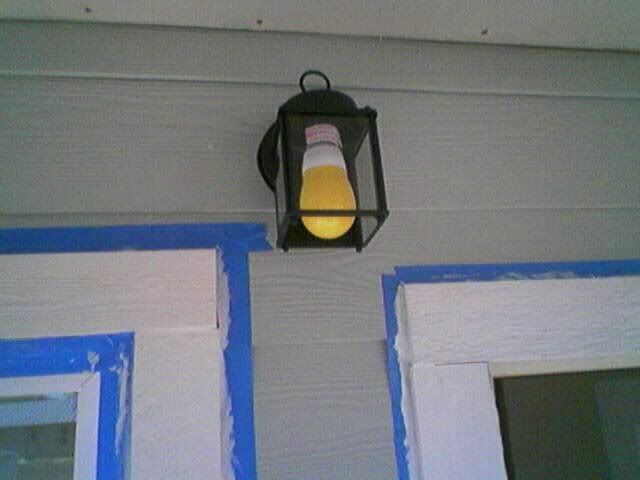
And I thought I had a piccie of said floodlight, but y'all will have to settle for a porch light --

PorchLight.jpg


Some of my other handiwork was either inside and it was dark, out of focus, or cluttered with scaffolding.
 
iwire said:
That type of wall sconce typically has a 16 AWG bare grounding whip hanging out of the fixture.

I was supposed to leave it hanging out of the fixture? You mean, I wasn't supposed to use one of those twistie things and connected it to the wire that didn't have the plastic stuff on it?
 
tallgirl....Nice looking light.
The location for the grounding screw on those flood holders is on the end of the stem where the locknut screws on, sorta between the conductors where they exit the stem. A small hole (probably not tapped) for a #8 grounding screw.
The (self tapping) grounding screws usually come with the fixture and it's really easy to strip the threads if you over tighten.
They're a PITA, especially if you're using multiple bulbs holders and #12 wire.
Hope this helps
steve
 
hillbilly said:
tallgirl....Nice looking light.
The location for the grounding screw on those flood holders is on the end of the stem where the locknut screws on, sorta between the conductors where they exit the stem. A small hole (probably not tapped) for a #8 grounding screw.
The (self tapping) grounding screws usually come with the fixture and it's really easy to strip the threads if you over tighten.
They're a PITA, especially if you're using multiple bulbs holders and #12 wire.
Hope this helps
steve

Thanks, Steve, I'll look for one the next time I have one to hang.

Is there a tip to threading the hole? Run the screw in part way, blow out the cuttings, run it back in? Lather, rinse, repeat? Or is it just that the PAR holder is made out of crappy metal?
 
tallgirl said:
"Is there a tip to threading the hole? Run the screw in part way, blow out the cuttings, run it back in? Lather, rinse, repeat? Or is it just that the PAR holder is made out of crappy metal?"

Yep...to all.

The holes are shallow and using a self tapping screw doesn't seem to make enough threads to tighten around a #12 solid without pulling the threads out.
These little items can eat a lot of time if you're not careful.
One solution that I've seen used involves some small "Stacon" connectors and (small and flexible) stranded copper wire that's used to make a grounding pigtail. Stacons are daisy chained together as needed to hit all of the PAR holders and one end of the chain (wire) is used to connect to the branch circuit ground. That way, the ground screw can be run deeper into the screw hole for a good connection.
The design of these fixtures is not that good, especially the grounding part.
Even if you manage to get a grounding connection on every PAR holder and get it all into the box, the first time you adjust the light holder, you will be putting stress on this connection. If it's a solid ground wire, something's gonna move and more than likelly it'll be the grounding screw. Either pulled loose or the wire pulled off the screw.
It's a small thing, but it can be a problem, especially if you're like me and try to make sure that all of your grounding connections are solid. I've seen more than one electrician say "the heck with it", and just bond the box.
steve
 
Steve,

"Stacon" connector? Wuzat? Is that a U- or O-shaped crimp-on connector?

So, I assume what you're describing would be take a piece of #16 or #14 (or #something) stranded, strip both ends, crimp one, put under the bonding screw, wirenut all the loose ends to the ground wire? Leave enough slack to deal with being adjusted, etc? Pray they don't get adjusted too much?
 
Status
Not open for further replies.
Top