Grounding Question

Status
Not open for further replies.

deckscrew

Member
I'm a GC in California, and a new member. We are building a seperate guest house behind an existing house. We are powering the new guest house with a subpanel located in the new guest and taking power from the existing house. Per the drawings we ran a 20+ feet of ground wire in the new foundation.

Our electrician ran #4-3 romex to the new subpanel. He then taped off the ground at both ends saying that the new subpanel was already grounded so he did not want ground the new house back to the old house. Our building inspector says he is wrong and that we have to ground the subpanel to the new wire, and will not pass the electrical portion.

I am totally confused, but am trying to learn what kind of a situation I am dealing with. I am meeting the inspector's supervisor next week and would like to know what I'm talking about.

I've never worked with this inspector before, but my electrician has been in business for years, so I tend to believe him, but everyone makes mistakes.
 
I'm unsure if Forum rules will permit a direct answer. I will say that your electrician is mistaken and nothing further unless a Forum moderator permits it.
 
Youre not trying to do the work, only understand whats been done.
At the new building, a grounding system was installed, what we call a ufer ground. However, that's for lightning protection.
The ground wire from the source, or what is the equipment grounding conductor, or bond, serves to return the fault current to the source in the event of a line to case bond.
And the neutral at the new building is not bonded to the case of the subpanel.
The bond wire must be connected at the new building.
We get confused on grounding and bonding because the code is confusing and is calls grounding when its really bonding.
 
I agree with Trevor in that the EC is mistaken and will add that you should consult with another EC in your area.

I don't understand why you would want to take on an AHJ or Inspector in an issue outside of your expertise, let an Electrical person do it.

Roger
 
Concur with Tom:

As with any sub-panel, grounding conductor must be used (along with the foundation ground), neutrals and grounds must be kept separate, and if there are more than 6 breaker handles, this sub-panel requires its own main breaker.

The inspector is correct.
 
Your electrician is mistaken.Let him straighten this out with the inspector as its part of his job.If he refuses then hire another electrician.Number of years in buisness does not make someone right.Invite him to this forum and perhaps he will learn.
 
LarryFine said:
Concur with Tom:

As with any sub-panel, grounding conductor must be used (along with the foundation ground), neutrals and grounds must be kept separate, and if there are more than 6 breaker handles, this sub-panel requires its own main breaker.

The inspector is correct.


Larry, I thought the 6 throw rule was for Service Equipment 230.71(A) or am I mistaken ?
 
Given that this is a guest house, there will likely be metallic connctions between the main and guest house and that will require the use of the EGC between the two buildings as well as the grounding electrode at the guest house.
Don
 
deckscrew said:
Our electrician ran #4-3 romex to the new subpanel.
Was it really romex? Romex is not supposed to run underground (even inside conduit) between buildings.

I agree with Jim Walker, please send this electrician our way, it seems like there are a lot of things he can learn (for free!) here, provided your understanding and what you've described is correct.

I am totally confused, but am trying to learn what kind of a situation I am dealing with. I am meeting the inspector's supervisor next week and would like to know what I'm talking about.
I agree with the others, it would always be best for the electrician to deal with the electrical inspector.
 
Jim W in Tampa said:
Your electrician is mistaken.Let him straighten this out with the inspector as its part of his job.If he refuses then hire another electrician.Number of years in buisness does not make someone right.Invite him to this forum and perhaps he will learn.

It is would be a good idea for him to be dealing directly with the inspector for two reasons,1) he may learn something 2)He won't have his costumers second quessing if he is quallified. This is what leads to a GC looking for a new electician.
 
We get confused on grounding and bonding because the code is confusing and is calls grounding when its really bonding.

Thanks for all the information. I'm going to get a copy of the electrical code and try to learn more.

Actually the electrician got it right, he did ground the subpanel back to the main. The electrical inspector told my foreman to make sure the "neutral wasn't bonded to the ground" (don't really know what that means, but he signed off on the job). My foreman got the message confused, but everything turned out OK.

However, the romex is being run in the crawl space of both building, but it runs between the building through the foundations in about 4' of 1-1/2 sch. 40 pipe covered in 6" of concrete. I'll have to ask my EC about this.

Thanks again
 
deckscrew said:
Actually the electrician got it right, he did ground the subpanel back to the main. The electrical inspector told my foreman to make sure the "neutral wasn't bonded to the ground" (don't really know what that means, but he signed off on the job).
If the neutral and grounding conductor are connected at the service and again at the detached building, current will flow over both neutral and ground under normal operation. This is bad.

However, the romex is being run in the crawl space of both building, but it runs between the building through the foundations in about 4' of 1-1/2 sch. 40 pipe covered in 6" of concrete. I'll have to ask my EC about this.
Have him take a look at 300.5(B) in the 2005 NEC, or 300.5(D)(5) in the 2002 NEC. It catches all of us by surprise when we first learn it. :)
 
He told me the panel he got did not have the neutral "bonded" to the box. He said the neutal is mounted on plastic backing (?).

I'm sure learning alot

Thanks
 
deckscrew said:
He told me the panel he got did not have the neutral "bonded" to the box. He said the neutal is mounted on plastic backing (?).
That's exactly the way it should be, if a grounding conductor was used, as it was in this case.

To explain, currently under the 2005 code, it's permissible to not run a grounding conductor at all to a second (detached) building in certain circumstances. Ordinarily, we always have to include a grounding conductor for everything we do (lights, receptacles, pumps, everything), this is one of the very few exceptions.

In that circumstance, the neutral is bonded to the grounding system created at the second building, so that connection is what kicks breakers when there is a ground fault (a hot wire touching normally exposed metal connected to the electrical system).

racerdave.jpg

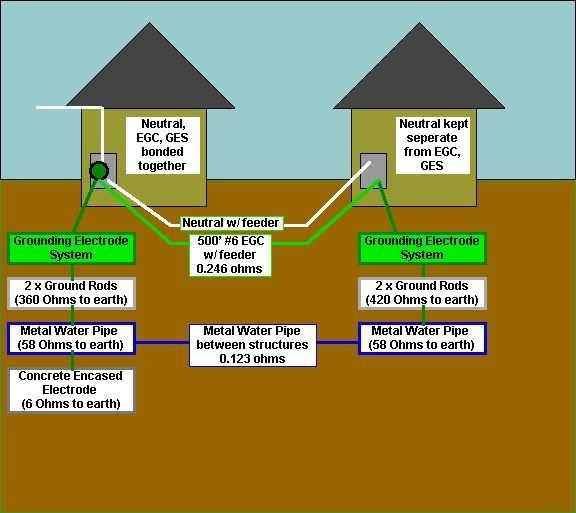
In this picture, there is a water piping system connecting the electrical systems of the two buildings, so a grounding conductor must be used with the supply to the second building. (The rare exception to the rule cannot be used in this case.) It is likely that this is very similar to the setup of the lot in question.
 
georgestolz said:
Have him take a look at 300.5(B) in the 2005 NEC, or 300.5(D)(5) in the 2002 NEC. It catches all of us by surprise when we first learn it. :)

Hey, thanks for the code reference -- I was too lazy to look this one up on Saturday :)
 
Status
Not open for further replies.
Top