Help, need advice please 400 amp house

Stevenfyeager

Senior Member
Location
United States, Indiana
Occupation
electrical contractor
Strange: I have to replace a service because of excessive corrosion. On the utility pole is a 400 amp meter (extremely corroded) and two 200 amp disconnects feeding two panels in a house. One 200 amp disconnect feeds the original house, the other 200 amp feeds a two story room addition. So I bought 400 amp meter, disconnect combo, getting ready for the changeout day. But today, I noticed the wires coming out of the weatherhead at the top of the pole looked like only 4/0 Al.
one single set. Sure enough 4/0. Not 400 amp. I asked the POCO what size service is it? He came out and said 200 amp. I happily told the homeowner that we can save him some hundreds of $. I was going to return the meter combo and buy a 200 a combo, saving $400. I could send 100 amps to each 200 amp panel, and save some money in wires, labor, etc.But then, I asked about the inside panels. Each 200 amp panel inside has an elec furnace, and all electric.
Oh. shoot! I never install a 100 amp panel that is going to power an electric furnace with other house hold loads. Never. Furnaces or heat pumps seem to always need a 60amp breaker and a 30 amp breaker or more. 100 amp is too small I've always believed.
My question is: could this system be pulling more than 200 amps ? Do I need to replace with a 400 amp set up in case the system needs, say, 250 amps? (and bring the wires in the riser up to size?)
I have asked for the elec bill for the last 6 months. I've never hardly seen elec bills, I think they are in KW hours, and I wouldn't know how to interpret amps used. But maybe there is a way. (Googling it tells me divide the kwh by 720 hours, then divide by 240 v)
I don't feel comfortable replacing the two 200 amp outside disconnects with two 100 amp ones. I was all set to save the customer some money. Advice please ?
 
Common service conductor supplying multiple service disconnecting means has minimum ampacity requirement of no less than the calculated load. This sounds like it could possibly be undersized now but maybe was not when it was first installed?

At very least can you get any demand data from the POCO?

Maybe the "extremely corroded" that you mentioned was due to overloading?
 
I always get annoyed when someone looks at something that has been fine for 50 years and says, "whoa, you need to upgrade that, its undersized." That said, it might not pass an article 220 load calc, but could be ok via 220.87 (demand meaasurement).

Something else to think about: really how much is the cost savings? You will need a box and connectors to get 2 200 amp sets onto a single meter. That will eat up a chunk of the savings.
 
Something else to think about: really how much is the cost savings? You will need a box and connectors to get 2 200 amp sets onto a single meter. That will eat up a chunk of the savings.
Yes. I've used a 320 meter socket before for say a 200 amp feed to a dwelling and 200 feed to a detached structure when the load calculation between them was 200 or less. simpler and possibly similar cost to other methods of dealing with that situation.
 
I always get annoyed when someone looks at something that has been fine for 50 years and says, "whoa, you need to upgrade that, its undersized." That said, it might not pass an article 220 load calc, but could be ok via 220.87 (demand meaasurement).

Something else to think about: really how much is the cost savings? You will need a box and connectors to get 2 200 amp sets onto a single meter. That will eat up a chunk of the savings.
Only saving is little bit of wire and like 300 bucks difference between 200 and 320 meter-
You only saving maybe 1k with the little bit of added labor
 
Only saving is little bit of wire and like 300 bucks difference between 200 and 320 meter-
You only saving maybe 1k with the little bit of added labor
And you will spend most, all or even more than $300 for junction box and splicing methods or pre configured terminal box to land the outgoing conductors in if you go with some the most common 200 amp meter cans. Where there is already room in the 320 meter can and it takes up less space on the side of a building or even on a pole and just looks less cobbled together.
 
Thank you all. I didn’t have time to describe the whole set up. Everything (a 400 amp meter, and two 200 amp is outside on a pole so I bought a 400 amp meter combo. I think that’s twice the cost of a 200 m combo maybe $400 difference? I haven’t checked with my supplier yet. I told him to hold a 200 amp meter combo for me. It was about $400. I think the 400 amp one was about 800 if I’m not mistaken.
Right now there’s a lot of corrosionin the meter and one of the 200 amp breakers in one of the disconnects doesn’t work and plus it’s really trashy looking the customer wants it all cleaned up looking better that’s why I bought a combo. This last month was the heaviest month of the year and the homeowner used 5300 kWh.
If I did my math right, that’s only 32 amps usage. But that’s just an average over a whole month, right? So it could be days using a lot more than that obviously, we had a cold spell in February, I believe here..
kWh x 1000/ 240v x 28 days x 24 hrs
Thank you so much. I’m still open to advice.
I’m thinking on going head with a 400 service, enlarging the 2 inch riser to 2 1/2 inch and enlarging the 4/0 to 350.
 
Thank you all. I didn’t have time to describe the whole set up. Everything (a 400 amp meter, and two 200 amp is outside on a pole so I bought a 400 amp meter combo. I think that’s twice the cost of a 200 m combo maybe $400 difference? I haven’t checked with my supplier yet. I told him to hold a 200 amp meter combo for me. It was about $400. I think the 400 amp one was about 800 if I’m not mistaken.
Right now there’s a lot of corrosionin the meter and one of the 200 amp breakers in one of the disconnects doesn’t work and plus it’s really trashy looking the customer wants it all cleaned up looking better that’s why I bought a combo. This last month was the heaviest month of the year and the homeowner used 5300 kWh.
If I did my math right, that’s only 32 amps usage. But that’s just an average over a whole month, right? So it could be days using a lot more than that obviously, we had a cold spell in February, I believe here..
kWh x 1000/ 240v x 28 days x 24 hrs
Thank you so much. I’m still open to advice.
I’m thinking on going head with a 400 service, enlarging the 2 inch riser to 2 1/2 inch and enlarging the 4/0 to 350.
You really need to do a load calculation, as required by the NEC for service sizing. The electric bill tells you nothing about peak demand.

Mark
 
This last month was the heaviest month of the year and the homeowner used 5300 kWh.
If I did my math right, that’s only 32 amps usage. But that’s just an average over a whole month, right? So it could be days using a lot more than that obviously, we had a cold spell in February, I believe here..
kWh x 1000/ 240v x 28 days x 24 hrs
Need to ask POCO if they have demand data available. Most smart metering systems are capable of this. That will tell you what peak demands were and even the duration. Going off monthly consumption may give you some clue as to whether it is heavily loaded or not but still won't tell you those peak demands. What you don't know is whether the demand was somewhat averaged over the billing period or if there was a shorter time period in there with a high usage rate.

POCO may not put demand data on your billing unless you have some rate structure that is dependent on demand levels. Many areas that only applies to commercial/industrial or other higher usage level customers, but there are some areas that have been factoring it in on residential services as well. They still likely do have your usage data on file though, as it can be used for studies on their part on determining other aspects in managing their distribution system.
 
For a single family dwelling I can do a quick load calculation faster than trying to get information from the utility.

Just do a quick walk through and note the major loads. I can guess nameplates of most items close enough to do a basic calc.
 
You most likely need larger wires going up the mast. I ran 400 kcmil copper up the mast on my last house that had a 400A service. Poco then attached their 1/0 Al service drop to it...

Different rules for you and them, and that size discrepancy is not covered by the poco use of 90C terminations and conductors in free air.

Isnt it rather cheap and easy to drop another set of 4/0 down the mast? You could do a load calc or even get meter demand data, but I doubt you are going to fit all this in a 200A service.
 
My question is: could this system be pulling more than 200 amps ? Do I need to replace with a 400 amp set up in case the system needs, say, 250 amps? (and bring the wires in the riser up to size?)
I have asked for the elec bill for the last 6 months. I've never hardly seen elec bills, I think they are in KW hours, and I wouldn't know how to interpret amps used. But maybe there is a way. (Googling it tells me divide the kwh by 720 hours, then divide by 240 v)
I don't feel comfortable replacing the two 200 amp outside disconnects with two 100 amp ones. I was all set to save the customer some money. Advice please ?
@Stevenfyeager

POCO wire sizes use fairy magic, not the NEC rules.
You can't tell much of anything from the POCO wire size.

----------------------------------
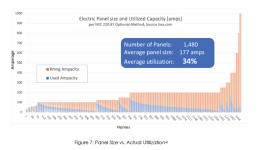
The POWER working group and Lawrence Berkeley National Lab have instrumented tens of thousands of homes,
and analyzed large volumes of utility data. The number of homes that require 400A service is tiny.

1775799863567.png
What I recommend is:
1. Tell us your POCO and area
2. See if you can get "15 minute" load data for the last two years
3. Invest in a CT clamp meter, turn on everything you can in the house and measure
4. Invest in a recording CT clamp meter and take your own data


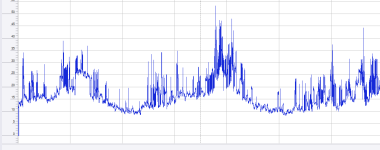
I've got reams of data. One of my favorites is a 20 unit building with 400A service, and all electric heat.
The AHJ was worried that the 50A unit breakers would be insufficient due to the load calculations.
So we measured:
1775800162114.png

And indeed see that peak above 50A for a 1 minute sample?
That could be bad, except the chart above was for the whole freaking building --- all 20 units.


-------------------------------------------
Your utility data may be in kwH -- Kilowatt Hours.
That is of almost no use to you, except to measure seasonable variation.
What you want is the demand load, peak load, or capacity charge for each month.
 
Top