How important is 300-3?

Status
Not open for further replies.

peter

Senior Member
Location
San Diego
I am pretty sure that I understand 300-3; namely that all conductors in a circuit must be in the same conduit.
This instance involves a control panel with three conduits leading to it. What has happened is another {so-called} "electrician" or, more likely, mechanic, installed all the line side wires in one conduit and all the load side wires in another conduit.
I told him this was wrong but he ignored me.
So now what? What are the consequences? Is this a serious violation?
~Peter
 
2 reasons for this, related to magnetic fields of the conductors not balancing if all circuit conductors are not grouped.

1. In case of a fault, the impedance will rise a lot, and delay tripping

2. Unbalanced current will affect surrounding materials (like metal conduit) and there can be physiological effects in people caused by EMF, tho this is a matter of some debate.

Sounds like the installation is correct, in that all the line and all the load conductors are grouped.

Not real practical to have the line and load in the same pipe the whole way :)
 
Perhaps I wasn't clear.
The way they were installed was all of the line conductors were in one conduit and all of the load side conductors were in a different conduit.

Is this a violation or not?

~Peter
 
And here is another situation I noticed:
There is a gutter and four conduits going down about four feet to the panel.
The apprentice neatly ran all the phase A conductors in one tube, all the phase B in the second tube, all the phase C conductors in the third tube and all the neutrals in the fourth tube.
Was there anything wrong with this?
~Peter
 
I'm confused (easily done). Line in to control panel, all conductors in one pipe, go thru some type of switch or somthing and leave in another conduit to a motor or somthing. What's the problem?
 
Peter,
There is a gutter and four conduits going down about four feet to the panel.
The apprentice neatly ran all the phase A conductors in one tube, all the phase B in the second tube, all the phase C conductors in the third tube and all the neutrals in the fourth tube.
Was there anything wrong with this?
The only way this will work without burning up is if the gutter and the conduits are nonferrous.
Don
 
peter said:
Perhaps I wasn't clear.
The way they were installed was all of the line conductors were in one conduit and all of the load side conductors were in a different conduit.

Is this a violation or not?

No. When it says all conductors of a circuit, it means grounded, grounding, and ungrounded wires of a given circuit segment. If all circuit segments (line, load, or otherwise) had to be in the same conduit, you could never branch at a J box because some parts of the circuit may need to left and others may need to go right in a different conduit. Obviously, we need to be able to do that.

Now if by line/load you mean service conductors (NEC 230) and non-service conductors, that would be a problem. But line and load can occur in a lot of places (such as at a GFCI receptacle or a panelboard or even a switch). I know of no line-load separation rules in the NEC except for service and non-service. But there may be industrial conventions (which are non standard and not part of the NEC) for line on top, line and load separated, etc.
 
Cavie,
Quote "Line in to control panel, all conductors in one pipe, go thru some type of switch or somthing and leave in another conduit to a motor or somthing. What's the problem?"
The problem is that not all the conductors are in one pope. All the line conductors are in one pipe and all of the load conuctors are in another pipe. Is this a violation of 300-3?
~Peter
 
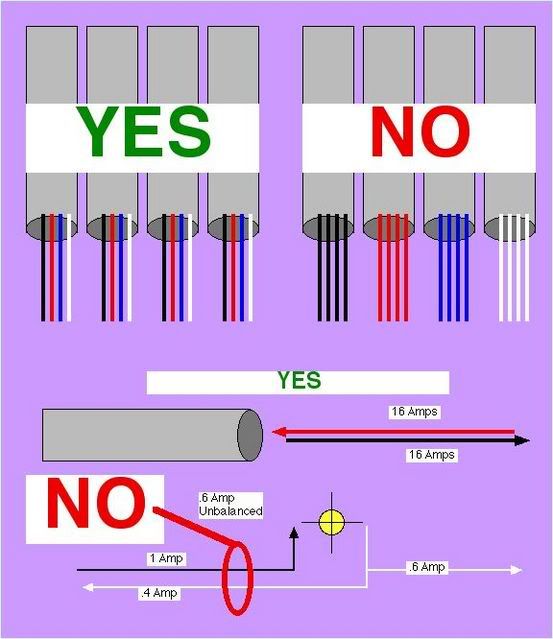
I just whipped this together in 10 minutes - now I'm late for bed, so no explanations. :)

3003.jpg

Essentially, "what comes in" - "must go out" of the same cable or raceway, or EMF will be there.

EMF in ferrous methods create heat in the pipe itself.

Night! :)
 
peter said:
And here is another situation I noticed:
There is a gutter and four conduits going down about four feet to the panel.
The apprentice neatly ran all the phase A conductors in one tube, all the phase B in the second tube, all the phase C conductors in the third tube and all the neutrals in the fourth tube.
Was there anything wrong with this?
~Peter

yep, thats a problem that needs to be fixed.
 
Bshep and Ray, let's go back to Don's post, if the raceways are nonferrous and the conditions of 300.20 are met, nothing would need to be changed?

Roger
 
roger said:
Bshep and Ray, let's go back to Don's post, if the raceways are nonferrous and the conditions of 300.20 are met, nothing would need to be changed?

Roger


Follow what Don said and just break out the sawzall and cut slots between the conduits. This is permitted by 300.20(B).
 
roger said:
Bshep and Ray, let's go back to Don's post, if the raceways are nonferrous and the conditions of 300.20 are met, nothing would need to be changed?

Roger

I'd still like to see them grouped. I know there will be less radiated field, which may not be an issue, and there would probably still be faster fault clearing.

edit to add info- i looked up some more info in the 2002 version I've got here. There's an FPN under 310.20 (B) that says for an aluminum enclosure, the effect is not sufficient to require grouping. So for the enclosure itself, it may be ok if non-metallic, non-ferrous or slotted. I still think the seperate conduits for each phase are a violation of 300.5 (I), 2 exceptions notwithstanding.
 
Last edited:
Perhaps it would clarify the original situation by noting that there are no neutrals involved. The way the night crew did it was to run circuits #1, 2, 3 &4 from the breaker through conduit A to the control panel [contactors] and then the switched #1, 2, 3 & 4 through conduit B back to the panel where they join their neutrals and head towards their loads.
 
peter said:
Perhaps it would clarify the original situation by noting that there are no neutrals involved. The way the night crew did it was to run circuits #1, 2, 3 &4 from the breaker through conduit A to the control panel [contactors] and then the switched #1, 2, 3 & 4 through conduit B back to the panel where they join their neutrals and head towards their loads.

So neutrals are involved with the circuit loads, they are just not run to the contactors.

Two ways to fix this (IMO). Run the hot and switch leg in the same conduit, or run the neutral in the line side to the contactor enclosure and then in the switched wire conduit to the loads.

Edit: Since you are running from the panel to the contactors and back to the panel I would presume the distance is not that far. This should be an easy fix. Pull the hots for #1 & 2 from that conduit and install them in the "switched" conduit and pull the switched wires for #3 & 4 and install them in the "hot" conduit.
 
Last edited:
Status
Not open for further replies.
Top