HVAC replacement

tom baker

First Chief Moderator & NEC Expert
Staff member
Location
Bremerton, Washington
Occupation
Master Electrician
I have an existing 20 year old HVAC/heat pump that will be replaced soon. Any recommendations on manufacturer? How does Goodman rate?
Do HVAC contractors get a better wholesale price if they stay with or promote one brand?
 
I've had a Goodman AC system for the past 7 years without any issues. My BIL who installed the system (he's an HVAC and electrcial contractor) said that spending the extra money on something like a Lennox system wasn’t worth it. IMO it's a crap shoot. If you read reviews of the high end systems there still are problems. For me if it lasts 10 years with all of the money I saved I can just replace it and have a brand new system.
 
A few comments peripheral to your question, which I can't answer directly.

This would be a good time to do any desired additional air sealing and insulating, so that the equipment can be right-sized for the new conditions.

If you have any information on how the existing system was performing, it will be helpful in sizing the new system. For example, if when running properly (e.g. new), the system was not running flat out on your hottest/coldest days of the year, then it was oversized. E.g. if it's a 3 ton single stage, and on the extreme days of the year it never ran more than 2/3 of the time, then a 2 ton single stage would be adequate.

Lastly, as far as I know the principal difference these days between a central system and a "mini-split" is the exhaust airflow direction of the outdoor unit. Central systems generally pull in from all sides and exhaust upwards, while mini-splits exhaust sideways. That is, all the big mini-split brands offer "high-static" indoor air handlers that can be used to feed existing ductwork, rather than install individual heads in each room.

Cheers, Wayne

 
A few comments peripheral to your question, which I can't answer directly.

This would be a good time to do any desired additional air sealing and insulating, so that the equipment can be right-sized for the new conditions.

If you have any information on how the existing system was performing, it will be helpful in sizing the new system. For example, if when running properly (e.g. new), the system was not running flat out on your hottest/coldest days of the year, then it was oversized. E.g. if it's a 3 ton single stage, and on the extreme days of the year it never ran more than 2/3 of the time, then a 2 ton single stage would be adequate.

Lastly, as far as I know the principal difference these days between a central system and a "mini-split" is the exhaust airflow direction of the outdoor unit. Central systems generally pull in from all sides and exhaust upwards, while mini-splits exhaust sideways. That is, all the big mini-split brands offer "high-static" indoor air handlers that can be used to feed existing ductwork, rather than install individual heads in each room.

Cheers, Wayne
Good comment on sizing. The house insulation in added in attic from R13 to R30, sidewalls have blown inn. It’s 950 Sq ft
Installation was on the low end, in attic with flex duct. What I see is the compressor does not run very long on cold days
I look at air sealing and variable speed as an option
 
Duct work matters too. All new HVAC systems have ECM motors, and they don't like high static pressure. You should shop for a very knowledgeable HVAC guy. You would be much better off with an expensive contractor and a cheap unit than a cheap contractor and an expensive unit.
 
The rest of the installation can be a big factor in how well the unit performs as well as how long it may last.

Sufficient air flow through the unit is first major factor in how long a heat exchanger and/or compressor unit may last. Not enough return air can be somewhat common issue that should be evaluated when replacing an existing unit. Over time people either block them off or even totally eliminate a return inlet not realizing how much impact it may have on the system. On the other side, people may shut supply dampers in several rooms and think they are saving energy by only heating/cooling specific parts of the house. In meantime they may be limiting enough air flow through the heat exchanger they are actually creating problems with the system.

I don't think the quality difference between Goodman and say Trane or Lennox is as wide as it once maybe was either. They all seem to have cheapened their products over the years to remain competitive.
 
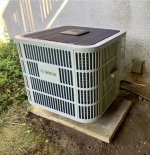
Fwiw - I replaced 2 heat pumps at my house late last year and went with Bosch Inverter 20 SEER R454B outdoor heat pumps and indoor air handlers. Both with 8kW heat strips.

I have an HVAC guy – 70 years old and retired, but still works for customers he knows. He liked the Bosch and we looked also at Rheem, Fujitsu (made by Rheem), and Broan equipment. I've never heard of Goodman. Was looking to do this about a year ago and trying to get the last of the old 410A equipment, but missed that by a few months cuz I was too slow. So had to go with the latest R454B stuff, and that’s OK.

Have had 1 winter season with them and all is good so far. The 20 SEER units are rated to work down to -4F. I saw register temps of ~90F, even on cold nights (Maryland had its fair share of single digit temps this winter), and those register temps are about 8 to 10 degrees warmer than the 20+ year old heat pumps I had been running (R410A).

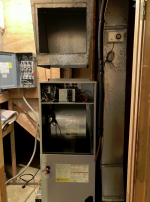
The Bosch stuff is interesting, I bought a 3 ton and a 2 ton air handler for the house and addition respectively – but the heat pumps are both 3 ton. There are dip switch settings for matching the 3 ton outdoor unit with the 2 ton air handler. Really quiet, both the outdoor unit and indoor fan when it runs at the slow speed.

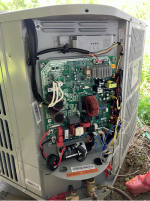
The inverter equipment is, naturally, much more complicated than the old single speed scroll compressors I was running (a Rheem and a Ruud). Looking at the control board below makes me nervous about anything going wrong, but in for a penny, in for a pound. Both the old units were running "OK" (the addition HP would fault 3x each winter with an annoying bogus Low Pressure fault) and were 18 and 25 years old. And still running!! But I decided to bite the bullet and replace them before they broke (a luxury) and while the tax rebates are still a thing.

1773189231192.png

1773189303343.png

1773189428958.png

Happy so far and fingers crossed I get anything close to the life those old units gave me.

Good luck with whatever you decide.
 
I saw register temps of ~90F, even on cold nights (Maryland had its fair share of single digit temps this winter), and those register temps are about 8 to 10 degrees warmer than the 20+ year old heat pumps I had been running (R410A).
I will say register temp doesn't mean a lot if you don't also know whether you were delivering same CFM.

If you slow down the air speed you will get higher output temp but less overall BTU will be delivered in a given unit of time. Also a unit that can vary output level often will adjust blower speed accordingly for better comfort level, sound, etc.

Many heat pumps still operate at pretty cold outside temperatures, the important factor is what is the breaking point of where it no longer is more operational cost efficient than whatever you have for backup heat or even when it can no longer keep up with the amount of heat losses.
 
Top