I thought they fired me.

Status
Not open for further replies.
Location
NE (9.06 miles @5.9 Degrees from Winged Horses)
Occupation
EC - retired
alfa cb.jpg

That's big enough.

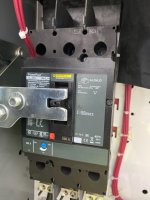
What would cause this breaker to not reset? Screwed up mechanism is my first guess. Haven't been there yet and we did not install. I actually thought we were off their vendor list.

New manager says it doesn't even attempt to snap. Load is a soft start for 100 hp motor, I think.
 
View attachment 2557752

That's big enough.

What would cause this breaker to not reset? Screwed up mechanism is my first guess. Haven't been there yet and we did not install. I actually thought we were off their vendor list.

New manager says it doesn't even attempt to snap. Load is a soft start for 100 hp motor, I think.

Sometimes the breaker/mech are not aligned and the range of motion is becomes slightly limited.
 
Your could remove the front cover and look at the mechanism, MX is shunt trip, MN is undervoltage, OF is auxiliary contacts, and SD is for an alarm switch.
 
Last edited:
Looks like the instantaneous trip setting anywhere from 1000-2000 amps.
I'll second that, and say it appears to be turned all the way up.

If this is supplying a soft starter I'd expect the soft starter to kick out on LRA before the breaker does.
 
What I thought but it doesn't. Shunt trip thought was the SS relay shutting the breaker off. IDK.
Is the problem the breaker cannot be reset or not turned on?
Reset issues are probably internal and mechanical.
If it can not be turned on, it maybe the shunt trip coil is energized causing the breaker to trip free.
 
What I thought but it doesn't. Shunt trip thought was the SS relay shutting the breaker off. IDK.
Not sure if this was resolved already, but if the issue persists (and you can reclose the breaker) there are a few things I would recommend checking (assuming this isn't related to UV release or shunt trip):

1. If the trip occurs from 0 to 11s, look for shorts in the main power circuit; i.e. starter, cable, motor. Turn-to-turn shorts may be challenging to find unless you can compare measurements with baseline data or a similar working unit. If no shorts detected, I would then test the breaker (via primary injection) to confirm the breaker is within spec.

2. If the trip occurs beyond 12 seconds, the issue may be related to acceleration of the motor. This might be due to mechanical problems such as the external load or something internal to the motor like bearings or the rotor bars. It could also be related to inadequate terminal voltage. Make sure all three phases are present, balanced and at an acceptable level.

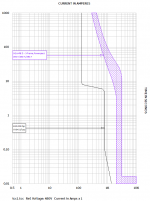
Note: Below is a standard 100HP motor with a JL breaker. The TCC shows no tripping should occur with across-the-line starting. Because this motor is being soft started, the motor starting/acceleration curve would really be lower to the left than what is shown here. This is why I am suggesting shorts or mechanical problems...

1631117007665.png
 
You're right. I mistakenly put in a 250A frame. Doesn't change much.
Ohh that wasn't regarding to the graph! Isn't that frame is rated for 250A? Why is that breaker has a trip setting of 1000-2000A then? Are these number indicate short-circuit amps, but I think SCA would be at least 14kA at 600V, wouldn't it?
 
Isn't that breaker rated for 200A only? Let me know if I am wrong with reason!
The 200 amp rating is the inverse-time rating, this CB also has an instantaneous trip rating that adjusts from 1000-2000 amps. If at any time the current reached that preset level ( like on motor start-up) the CB will trip.
 
Ohh that wasn't regarding to the graph! Isn't that frame is rated for 250A? Why is that breaker has a trip setting of 1000-2000A then? Are these number indicate short-circuit amps, but I think SCA would be at least 14kA at 600V, wouldn't it?
Unless you're dealing with a motor circuit protector, OCPD's don't just trip at the device rating. The device rating is just the asymptote where the breaker begins to trip, but only after a very long time. As infinity mentioned, we are dealing with an inverse-time breaker which will operate based on the purple curve above. That means the higher the current the faster the breaker will trip (up to a limit - the instantaneous characteristic). The instantaneous characteristic for this device is adjustable (1000 to 2000A range) so it allows you to adjust the lower part of the purple curve.
 
The Mechanism would not reset the breaker. My help had to push the handle of the breaker down to reset it.
The breaker tripped again when they attempted to restart the 100 hp hammer mill. It was plugged tight. (Operator Error.)

My tech helped with the clearing and once the mill was clean, the motor started fine.
I do not know the delay between start and trip. IDK why the instantaneous is set so high. We didn’t instal it.
 
My tech helped with the clearing and once the mill was clean, the motor started fine.
I do not know the delay between start and trip. IDK why the instantaneous is set so high. We didn’t instal it.
Most likely to allow the motor to start. Do you know it's normal accelerating time?
 
Status
Not open for further replies.
Top