IEEE 519 Harmonic Limits for three phase systems

Location
Texas
Occupation
Electrical Engineer
Hi,

My understanding of IEEE 519 seems that the individual harmonic limits as well as the total THD/TDD seem to apply to individual phases. However, this is not explicitly stated anywhere in the standard and I am having difficulty finding sources clarifying this point.

Does anyone know if the IEEE 519 limits also apply to the three phase harmonic content? If so, for individual harmonics would this be calculated as the square root of the sum of the squares of each phase /3 ? How would this be calculated for THD/TDD?
 
IEEE 519 definitely applies to three-phase systems. There are limits for total harmonic distortion as well as limits for individual harmonics. Do you have access to the standard?
 
IEEE 519 definitely applies to three-phase systems. There are limits for total harmonic distortion as well as limits for individual harmonics. Do you have access to the standard?
More specifically, IEEE 519 is about harmonics at the Point of Common Coupling or the utility service entrance.
 
In IEEE Std 519/2014 chapter Definitions it is noted:
maximum demand load current: This current value is established at the point of common coupling
total demand distortion (TDD) is expressed as a percent of the maximum demand current.
point of common coupling (PCC): Point on a public power supply system, electrically nearest to a
particular load, at which other loads are, or could be, connected. The PCC is a point located upstream of the considered installation.
In chapter 5. Recommended harmonic limits it is noted:
The recommended limits in this clause apply only at the point of common coupling and should not be applied to either individual pieces of equipment or at locations within a user’s facility.
In my opinion, the PCC has to be close to service entrance on facility -or at the neutral point of th
 
Yeah. This is what many "specifiers" miss.
I hated it when I saw specs for a new project that want IEEE519 to be met at the line terminals of a drive.
True, but the generalized philosophy on that, as has been explained to me by some of those who write those specs, is that if you require that every device meets it at their own terminals, it guarantees meeting it at the PCC as well, which eliminates their (specifier's) need to deal with it holistically. Basically they are pushing the responsibility and complexity down to the vendors, right or wrong.

The downside to that is that it EITHER increases the up front cost of the equipment SIGNIFICANTLY, or increases the likelihood that the low bidder will be the outfit that deliberately ignored it all and nobody will find out until it’s time to close out the project. Then the user eventually elects to forego it rather than delay the project and enter into fines etc., and allow a last minute mitigation at the PCC, which would have been the best approach in the first place. Been there, and despite my having warned them that the low bidder could not have taken the extreme harmonic mitigation costs into account, it was awarded to that low bidder, who pulled this exact stunt at the end.
 
Basically they are pushing the responsibility and complexity down to the vendors, right or wrong.
For sure.
Just it would have been nice to pick the PCC as the lugs of an MCC or switchboard instead of each individual VFD.
 
What does that look like?
Some kind of line reactor, or capacitor bank ?
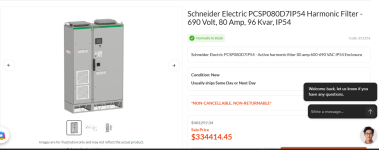
Active Harmonic Filters are my go-to choice now. You put them at the switchgear and they measure the THD, then create counter-harmonics that neutralize them. It’s the same concept as noise cancelling headphones.

The thing I like about that as a solution is that the AHF doesn’t care what creates the harmonics, so if you focus solely on the VFDs, you miss the harmonics caused by UPS, lighting ballasts and drivers, servo amplifiers, chargers etc.
 
Top