Improper way to crimp terminals

reyamkram

Senior Member
Location
Hanover park, il
This is what I was taught and told, when you crimp terminals you do not crimp on the seam because you can come loose and create arching issues or fire. You're supposed to crimp on the opposite side of the seam and I believe that is true I like to know your guys's opinion on this. In other words the indentation is supposed to be on the opposite side of the of the same and it indentation should be on the back.

I do think you all for any and all information
 
Never heard of such a thing. It would come down to what the manufacturers instructions says as part of the listing of the terminal.
 
" supposed to be on the opposite side of the of the seam and it indentation should be on the back"

That's the way I've always done it, even on non-current-carrying terminals, which admittedly were 95 % of the ones I've done over the years (audio and relay closures for broadcast).

The other 5 % WERE current-carrying, back when I did two-way service work, connections for radio power cables and light bars etc.

Besides, it looks better with the indention out of sight on the 'back side'.

Just my $ 0.02..........
 
Ring terminals 10 stranded wire only
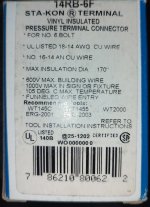
Those are usually required to be crimped using a crimper listed for the terminals so any direction as far as where to orient the seam would come from the manufacturer. The package may say something like this.

IMG_20251107_112035740.jpg
 
Those are usually required to be crimped using a crimper listed for the terminals so any direction as far as where to orient the seam would come from the manufacturer. The package may say something like this.
So where does the indent go when using a WT2000?
I can't find any instructions for that tool.
 
I have probably crimped thousands of these in auto, truck, 2-way and electrical service. Opposite the seam is the best way, but it is way too easy to under- or over-crimp. Insulated terminals are generally not really listed for an indent crimper.

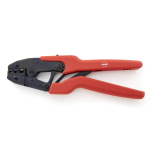
I use these, they are way better than anything else I have found.

1762639243535.png
 
Same here I have crimped thousands and I prefer nylon insulated with a brazed sleeve on the crimp end. Vinyl crimps are junk, the heat shrink type are better
The tool makes a difference. Controlled cycle crimpers are best, T&B, Panduit are $$$.
I like wirefly with interchangeable dies that are specific for each type crimp
 
Same here I have crimped thousands and I prefer nylon insulated with a brazed sleeve on the crimp end. Vinyl crimps are junk, the heat shrink type are better
The tool makes a difference. Controlled cycle crimpers are best, T&B, Panduit are $$$.
I like wirefly with interchangeable dies that are specific for each type crimp

If I have to order terminals I get nylon insulated with extra brass sleeve as well. But I always seem to end up with hundreds of ordinary vinyl, and the crimper shown above crimps them all just fine.

One thing I have noticed is the quality of ones from places like an auto parts store has gone way down in recent years. The brass ring has gotten like 50% as thick as it used to be and does not have the thickness to hold a crimp on the wires, beware, it's hidden under the crimped insulation.

I never use shrink unless it's someplace that will get really wet like the taillight harness under a truck.
 
If I have to order terminals I get nylon insulated with extra brass sleeve as well. But I always seem to end up with hundreds of ordinary vinyl, and the crimper shown above crimps them all just fine.

One thing I have noticed is the quality of ones from places like an auto parts store has gone way down in recent years. The brass ring has gotten like 50% as thick as it used to be and does not have the thickness to hold a crimp on the wires, beware, it's hidden under the crimped insulation.

I never use shrink unless it's someplace that will get really wet like the taillight harness under a truck.
Yes there is a big difference in quality. Years ago I used a name brand female disconnect to replace the one that was bad on my clothes washer. About a year later that one failed so I used a T & B female disconnect Sta kon. Used the same crimping tool on both. That one was still in great shape ten years later. I know its been over ten years since ABB purchased T & B but hope they maintain their best in class quality. Side note while working at large slaughter house the T & B rep asked me to get him a set of bull balls to have a taxidermy make a pen holder for s coworker. Purchase two sets of bull balls but he wanted the entire piece. They never would cut a piece off of the hides because it greatly reduced the price they sold hides after they sent them thru a defleshing machine and soaking in salt water pool.
 
Best to check the manufacturers instructions. Any sheet I've ever seen (Sta-kon, Panduit, Molex) for seamed crimps either illustrates or instructs you to position the indenter on the seam, i.e. crimp the seam. Brazed seams are a different subject.

Also, any crimps I've ever seen in an appliance, industrial machine, or consumer electronics have always been crimped on the seam. I'm not sure why people wouldn't assume this is common practice.

As a practical example, if you crimp a spade/fork terminal opposite of the seam, note how the fork cups. Once this is tightened down with a screw, the screw clamping force will actually be working against the crimp.
 
Side note while working at large slaughter house the T & B rep asked me to get him a set of bull balls to have a taxidermy make a pen holder for s coworker. Purchase two sets of bull balls but he wanted the entire piece. They never would cut a piece off of the hides because it greatly reduced the price they sold hides after they sent them thru a defleshing machine and soaking in salt water pool.
Have you done work in a rendering plant? It's much more yummy than a slaughter house
 
Best to check the manufacturers instructions. Any sheet I've ever seen (Sta-kon, Panduit, Molex) for seamed crimps either illustrates or instructs you to position the indenter on the seam, i.e. crimp the seam. Brazed seams are a different subject.

Also, any crimps I've ever seen in an appliance, industrial machine, or consumer electronics have always been crimped on the seam. I'm not sure why people wouldn't assume this is common practice.

As a practical example, if you crimp a spade/fork terminal opposite of the seam, note how the fork cups. Once this is tightened down with a screw, the screw clamping force will actually be working against the crimp.
Can you post a source for any of this? Goes completely counter to my own experience.
 
Have you done work in a rendering plant? It's much more yummy than a slaughter house
They had four big cookies that each ran eight hours then dumped contents. Cooked product was sent thru French presses to squeeze out tallow then thru several conveyors to a box car. They had a fifth cooker that used 120# of steam to reduce hundreds of gallons of blood into a moron color powder that was a great fertilizer. For years they dumped blood down the drains but it does something with the oxygen in fresh water that harms fish so had to stop that. Room was so hot condensation would form.on ceiling piles and when the hot drops hit bare skin it burned so ended up wearing long sleeve shirts. A few times I got called for a problem in the rendering middle of the night. The odor would enter your pores after a few minutes so had to take s shower & wash your smelly hair as soon as you arrived back home. Best thing about working there as worked six days a week and a lot of overtime. Joe Frazer worked there until winning in the 1968 Olympics and he could not return to work due to a broken hand. Company should have signed him to represent the company. Smoking Joe opened a boxing studio a mile away from the place.
 
They had four big cookies that each ran eight hours then dumped contents. Cooked product was sent thru French presses to squeeze out tallow then thru several conveyors to a box car. They had a fifth cooker that used 120# of steam to reduce hundreds of gallons of blood into a moron color powder that was a great fertilizer. For years they dumped blood down the drains but it does something with the oxygen in fresh water that harms fish so had to stop that. Room was so hot condensation would form.on ceiling piles and when the hot drops hit bare skin it burned so ended up wearing long sleeve shirts. A few times I got called for a problem in the rendering middle of the night. The odor would enter your pores after a few minutes so had to take s shower & wash your smelly hair as soon as you arrived back home. Best thing about working there as worked six days a week and a lot of overtime. Joe Frazer worked there until winning in the 1968 Olympics and he could not return to work due to a broken hand. Company should have signed him to represent the company. Smoking Joe opened a boxing studio a mile away from the place.
Are you from Philly? Remember Keystone Rendering? Darling Delaware had the little rotten meat transfer station behind SD Richman on Wheatsheaf? Way back in the day I had to stop to see David Richman and my girlfriend was in the truck. I had to go look at something that was on a trailer in the back. Darling Delaware started up that rotten meat auger and the conveyor to load a dump trailer. It made her vomit, I couldn't stop laughing
 
Top