Incorrect Graphic? Electron current flow vs Conventional current flow

fosland1

New User
Location
Tampa
Occupation
Electrical Designer
Electron vs Conventional Current Flow

I’m brand new to electrical and currently studying Mike Holt’s Understanding Electrical Theory course. I really enjoy the way Mike teaches and I’ve already learned a lot in the first few chapters, but I’m confused by the electron flow vs. conventional current flow diagrams in the workbook.


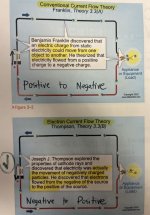
Specifically, I’m looking at the arrows shown throughout the circuits. I assume the arrows indicate the direction of current flow, but to me they seem backwards in some of the diagrams. Based on my understanding, electrons physically flow from the negative terminal to the positive terminal in a DC circuit (electron flow), while conventional current is defined in the opposite direction, from positive to negative.


In the top diagram, it appears the arrows show electrons flowing from the negative terminal, through the conductors and the load, and back to the positive terminal, which makes sense for electron flow. However, in the bottom diagram, the arrows appear to show current flowing from the positive terminal, through the circuit, and back to the negative terminal, which I understand to be conventional current flow.


Am I interpreting these diagrams correctly, or do I have something mixed up? I just want to make sure I’m reading the arrows the right way and not misunderstanding the difference between electron flow and conventional current.
 
I don't have access to the diagrams you described. All I can say is that somewhere in the distant past, someone decided that current shall be depicted as flowing in the direction of positive to negative. It was probably not the same person who decided that the word "negative" shall be associated with the electron. Either of those decisions could have just as easily gone the other way, but we are stuck with what we have been given. So no matter what electrons do with their spare time, if they are moving about, then the direction of their movement will be described as negative current.

My advice: ignore the movement of electrons. In AC circuits, it really isn't what you might think anyway. Think of current being the apparent motion of positive charge.
 
The last time I worried about the direction of electrons was back in basic theory classes in my first year of college.
Once I started studying Power Systems and Rotating Machines we only used Pos to Neg for current flow (Electron Current Flow). To this day I don't know or cared what my colleagues, that were involved with "electronics" and semiconductors, used.
 
The last time I worried about the direction of electrons was back in basic theory classes in my first year of college.
Once I started studying Power Systems and Rotating Machines we only used Pos to Neg for current flow (Electron Current Flow). To this day I don't know or cared what my colleagues, that were involved with "electronics" and semiconductors, used.
Yes, I would say with AC electricity, most people show and think about current flow from the positive to negative side, even though it's really alternating back and forth.

With AC, the current flow arrows and polarity signs (+ or -) aren't really about what direction the electrons flow, it's really all about keeping track of power flow.
 
Conventional current flow and electron current flow changed when there was a disagreement between existing engineering and science. So when we say the flow of current is from positive to negative it is considered the flow of holes in atoms and the opposite is the the flow of electrons.

A surplus of electrons provides a negative charge. A surplus of holes or lack of electrons provides a positive charge. Thus when you have a lack of electrons the electrons are filling the holes in.

So what is the positive flow of holes? It is conventional current flow.

If I am remembering correctly it was Benjamin franklin that screwed it up. It took a long time before electrons and protons where noticed and it was discovered to be backwards. He observed the charge of the holes being created as they lost electrons.

It only matters with solid state electrical engineering, to which I took one class, and regretted. lol Because your focus is on creating bands of excess holes or electrons to form semiconductors that require biasing to do the things we take for granted lol. Then you get to the part of trying to calculate doping concentrations of atoms and bonds to achieve certain design parameters. Like zener diodes and stuff.

If you really want to get into the thick of it, then start with chemistry and how charge is understood in chemistry. Terms like Anode and cathode. Stuff like that.

1770324881208.png
 
And just to add more fun to this thread...
The electrons barely move. Current is not electrons moving, it's charge. So conventional current flow is not 'wrong' because electrons go (almost infinitely more slowly) the other way. It's just literally a convention for how to notate the flow of charge.
 
Test question.

Q. At a generating plant, how many electrons leave the plant? . . . . . . A. 3,,,, but they come right back. lol
 
But as to the OP's question, the two diagrams shown in post #3 are backwards, yes?

In conventional current flow, the charge carriers are positive, and they flow from a battery's positive terminal to its negative terminal. While if negatively charged electrons are the charge carriers, they would flow from the negative terminal to its positive terminal. Yes?

The diagrams in post #3 are drawn with the arrows opposite the description in the previous paragraph.

Cheers, Wayne
 
But as to the OP's question, the two diagrams shown in post #3 are backwards, yes?

In conventional current flow, the charge carriers are positive, and they flow from a battery's positive terminal to its negative terminal. While if negatively charged electrons are the charge carriers, they would flow from the negative terminal to its positive terminal. Yes?

The diagrams in post #3 are drawn with the arrows opposite the description in the previous paragraph.

Cheers, Wayne
Correct.
 
The positive terminal of the supply is normally shown on top, and a black marking on a battery usually denotes the negative side.

So I would say they have the + and - shown reversed, and also the wire colors reversed.

But either way, the result is basically the same.
 
To stir the pot a little more, remember it is called "The theory of electricity." maybe electrons aren't actually electrons.
 
To stir the pot a little more, remember it is called "The theory of electricity." maybe electrons aren't actually electrons.
That is not the way the term Theory is used in science.
Technically, gravity is also a theory.
 
The positive terminal of the supply is normally shown on top, and a black marking on a battery usually denotes the negative side.

So I would say they have the + and - shown reversed, and also the wire colors reversed.

But either way, the result is basically the same.
Right; it doesn't make any difference. Just pick one and stick with it. :D
 
That is not the way the term Theory is used in science.
Technically, gravity is also a theory.

Yeah, whatever 'actually' is supposed to mean in that sentence.
Gravity isn't a theory, the theory of gravity is. That being what creates the force that holds us to the earth, actually means we really don't know if an electron is a particle, it could be a whole bunch of particles, for example.
 
Gravity isn't a theory, the theory of gravity is. That being what creates the force that holds us to the earth, actually means we really don't know if an electron is a particle, it could be a whole bunch of particles, for example.

There needn't be anything that creates the force; the theory is a model for how the perceived force behaves. And we have a very good model for that, thanks to Einstein. Of course our model for how an electron behaves is a bit difficult to square with our model for gravity. While it's conceivable we could discover a model that explains the behavior of both things better than the ones we already have, one could always ask if the elements of the model are 'actually' something else. That question only has meaning if there are gaps between the model and experience that a better model could close. Whether such gaps can be closed is an open empirical question. If it turns out we can't close them, then there'd be no difference between what an electron 'is' and how we model it.

In any case, models that fall far short of a theory of everything still have many practical engineering applications. The OP discussion is about such practical models.
 
Would it be adding too much fun to this thread to mention that the Navy teaches current flowing negative to positive (or at least it did when I was in the Navy)?
I always wondered, why they didn't just change the right hand rule to the left hand rule and teach all theory negative to positive, to avoid confusion. The Air Force, still taught flow and magnetic flux positive to negative and then switched when talking the rest of the theory. Very confusing.
 
There needn't be anything that creates the force; the theory is a model for how the perceived force behaves. And we have a very good model for that, thanks to Einstein. Of course our model for how an electron behaves is a bit difficult to square with our model for gravity. While it's conceivable we could discover a model that explains the behavior of both things better than the ones we already have, one could always ask if the elements of the model are 'actually' something else. That question only has meaning if there are gaps between the model and experience that a better model could close. Whether such gaps can be closed is an open empirical question. If it turns out we can't close them, then there'd be no difference between what an electron 'is' and how we model it.

In any case, models that fall far short of a theory of everything still have many practical engineering applications. The OP discussion is about such practical models.
Let me take another hit before answering :giggle:. Seriously, very deep subjects and we may one day discover answers that make current theory seem like flat earth.
 
Top