Tulsa Electrician
Senior Member
- Location
- Tulsa
- Occupation
- Electrician
Got it thank you.


Just like the nuts and washers carry 100% of the original load.If you add another and extend the original threaded rods but support from the actual kindoff itself you are now depending on nuts and washers to carry the load
The brand that triggered a code change in 310.15(B)(2) for the 2023 code....the 60°F adder currently applies to installations where the conduit is less than 7/8" above the roof...the thickness of "thin" strut from unistrut...but kindorf's thin strut is only 3/4".A brand of strut, like unistrut, etc.

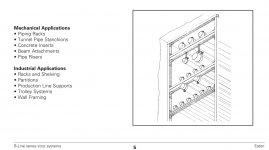
I think this is the root of the OP's concern.... but that doubled load on the upper washers and nuts was the biggest factor.
Then there is the Kansas City Hyatt skywalk collapse in 1981 where the design called for allthread extending through the upper walkway to a lower one with each independently supported by nuts and washers on the same rods.
As built, the upper walkway was supported by nuts and washers to a shorter length of allthread while the second walkway was suspended from the first by a second length of allthread.
Over 100 people were killed when the nut and washer attachment of the upper walkway failed.
Admittedly there were several other construction errors that differed from the design, but that doubled load on the upper washers and nuts was the biggest factor.
Well you cant support a conduit with another conduit . You cant support cables with conduits or support a box with another box. Why can you support a rack of conduit from a kindoff a saddle washer and nut which where never tested for this application
When I said "upper washers" I was awkwardly referring to the washers at the bottom of the upper rod.It did not double the load on the top of the upper rod - that part of the design wasn’t changed, it placed the weight of both levels on the newly-added nut on the bottom of the upper rod.
When I said "upper washers" I was awkwardly referring to the washers at the bottom of the upper rod.


Then there is the Kansas City Hyatt skywalk collapse in 1981 where the design called for allthread extending through the upper walkway to a lower one with each independently supported by nuts and washers on the same rods.
As built, the upper walkway was supported by nuts and washers to a shorter length of allthread while the second walkway was suspended from the first by a second length of allthread. ...
Which was really secondary, since the fourth floor walkway also feel as the nuts supporting it pulled through the box beam first.I'm just reading through this thread for the first time, and before I got to your post I was also thinking about the Kansas City trajedy. I believe that it was not only the strength of the rods, nuts and washers that was an issue. By suspending the second floor walkway from the fourth floor one, twice the force was applied at the suspension points under the fourth floor walkway. That ended up splitting the welds that joined two the channels which formed the box beams of the fourth floor walkway. Then the rods going down to the second floor walkway just fell through the gap.
I remember showing my dad (who had a doctorate in mechanical engineering from MIT) a picture of what they did in Kansas City, and he instantly shook his head in disbelief.
When additional racks are hanged from existing ones, I think one thing to avoid is applying excessive bending moments to the struts (which in the worst case could cause them to buckle). This could be done by hanging rods down from the upper struts at points that are close to where the upper struts are suspended.
Which was really secondary, since the fourth floor walkway also feel as the nuts supporting it pulled through the box beam first.
If cable in a conduit isn’t supported by the conduit, what is? And have you ever seen external grounds where required? How about when you have a 4x4 box for receptacles that is bolted or screwed to the outside of another box? Or “extensions” applied in various ways? And the rule about conduit and tray is it is supported every so many feet, not where the joints are. That is Code but mechanical design and support is something else entirely. Everything you are describing is NOT Code. It is all tribal knowledge stuff taught to first years mostly to eliminate bad installations like wrapping strapping around a conduit to suspend a second one from it.
Support cables WITH not In conduitIf cable in a conduit isn’t supported by the conduit, what is? And have you ever seen external grounds where required? How about when you have a 4x4 box for receptacles that is bolted or screwed to the outside of another box? Or “extensions” applied in various ways? And the rule about conduit and tray is it is supported every so many feet, not where the joints are. That is Code but mechanical design and support is something else entirely. Everything you are describing is NOT Code. It is all tribal knowledge stuff taught to first years mostly to eliminate bad installations like wrapping strapping around a conduit to suspend a second one from it.