Is the amp value on 310.16 based on RMS or peak values?

Genepires

Member
Location
Washington state
Occupation
Electrician
Rather embarrassed to not know the answer but I saw something on a reel that made we question something I thought I knew.
The value given on our clamp meter is RMS much like voltage is RMS. I think I assumed it was peak amps.
But is the values on table 310.16 RMS or peak amps? Couldn’t find language regarding that on the table but I hope it is based on rms amps.

 
Rather embarrassed to not know the answer but I saw something on a reel that made we question something I thought I knew.
The value given on our clamp meter is RMS much like voltage is RMS. I think I assumed it was peak amps.
But is the values on table 310.16 RMS or peak amps? Couldn’t find language regarding that on the table but I hope it is based on rms amps.


They are based on RMS amps.

The rational is that the current limits are set by resistive heating of the conductors, and RMS current is the number that gives the same resistive heating for different waveforms.

-Jonathan
 
Yes, all AC voltages and amperages are RMS in the NEC. However, for voltage effects such as shock, it is important to think about both peak and RMS voltage (one man's opinion).

Mark
 
And now we can invoke the ability of this forum to rip a poorly worded test question apart.

What do they mean by the 'maximum current on a circuit'? Do they mean the instantaneous peak current or the maximum allowed current or the trip rating of the OCPD?

When they ask 'the ammeter will read...' what sort of ammeter? A peak reading ammeter? An ammeter that measures _average_ current but then scales the reading to approximate RMS? A true RMS ammeter?

What is the form of current flow? A perfect sine wave or something distorted?

If you assume that the instantaneous peak of the current is 70A, and you use a true RMS ammeter, then the measurement should be 49.49747...A, which should round to 49.50A, not 49.49 :)

-Jonathan
 
1769005972815.png

It's been a while.
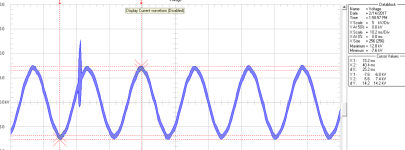
We were having problems with a VFD. This, transient was taken across the line side, assume L1-L2, of a starter for a sewing machine. 43B can only handle one voltage at a time. The other two are similar, but not as pronounced. IDR if we replaced this starter but we did put in a line reactor for the drive.

As I see it the peak to peak would have been 1420, with peak voltage of 710 and RMS at 502. Yes, voltage consistently ran high. Spike of 1280.
Please correct me.
 
This subject matter had me wondering whether or not I was ASSuming that the NEC is referring to RMS for current. In reality, the VOLTAGE is defined in Article 100 as being RMS, but not the amperage.

I did find this however, in 620.13 for elevator circuits:
Informational Note No. 1: The heating of conductors depends
on root-mean-square current values
, which, with generator field
control, are reflected by the nameplate current rating of the
motor-generator driving motor rather than by the rating of the
elevator motor, which represents actual but short-time and intermittent
full-load current values.
Now, why doesn't is state this in Article 100 or in 310? Good question.

I THINK it might be because the NEC does not presume you are using the conductors for AC or DC, and the REASON why RMS is used for AC current is because the RMS current has the same heating effect on conductors as the DC current would at the peak value. So by just using a current value, KNOWING that we refer to RMS when talking AC, they are correct for the conductor ampacities either way.

So the answer to the question:

Is the amp value on 310.16 based on RMS or peak values?


is Yes... ;)
 
Top