Isolation transformer for residential dock power

Status
Not open for further replies.

normel

Member
For a freshwater residential dock with convenience receptacles, lights, and boat lift: Is it possible to connect an isolation transformer (such as Charles Marine ISO-G2) to conform to NEC bonding requirements AND to have a true isolated grounding conductor? Issue is stray voltage on the existing grounding conductor that causes a mild “tingle” to swimmers when exiting the water.
Recommendation to use the isolation transformer comes from the utility.
 
There will be a connection to the primary grounding system via the primary EGC. That will be connected to the secondary grounded conductor and EGC in an installation that complies withe the NEC rules.
 
As mentioned you need to find the source of this stray voltage and correct the problem. Try turning off all the power at the source and see if there is still current flow on your ground conductors---as a start.
 
There will be a connection to the primary grounding system via the primary EGC. That will be connected to the secondary grounded conductor and EGC in an installation that complies withe the NEC rules.

Exactly, and this negates the establishment of a new isolated GEC and does not eliminate the issue.
 
As mentioned you need to find the source of this stray voltage and correct the problem. Try turning off all the power at the source and see if there is still current flow on your ground conductors---as a start.

That has been done. Utility admits the problem is on their end and recommends the isolation transformer as a solution.
 
That has been done. Utility admits the problem is on their end and recommends the isolation transformer as a solution.
Kick that issue up to the state authority that regulates the utility.

Assuming that the elevated voltage is from their primary neutral, you might be able to get them to install a neutral blocking device between the primary and secondary neutral at the transformer that serves the dock, and not have any grounding electrode at the transformer that connects to the primary neutral.
 
For a freshwater residential dock with convenience receptacles, lights, and boat lift: Is it possible to connect an isolation transformer (such as Charles Marine ISO-G2) to conform to NEC bonding requirements AND to have a true isolated grounding conductor? Issue is stray voltage on the existing grounding conductor that causes a mild “tingle” to swimmers when exiting the water.
Recommendation to use the isolation transformer comes from the utility.

Looking at this, I would be hesitant to install this per their instructions. They are showing connecting the neutral and ground together on the feed side of the isolation transformer. That is a no-no to the NEC.

It also says it is designed to be installed in the engine room, I was under the impression you were installing it on shore.
 
I had a similar situation once, and the source of the voltage to water was coming in on the PoCo neutral conductor (U/G service). Turning off the main breaker did not reduce the voltage (1.2-volts). The only way we got rid of it was to lift the incoming neutral.

PoCo said we had a grounding problem.

It went to the homeowner's board for discussion and I never heard about it again.

One thought was to drive ground rods down near the waterway and make it part of the grounding system. While that should mask the symptom, are we just transferring the problem out into the water? That makes me nervous.
 
It would appear this lake water maybe energized from another nearby electrical source and the utility neutral return current is using this ground system to "get back" to the utility primary neutral/ground side.

This is an extremely dangerous situation and can get much worse really fast.

A similar situation has already been fully documented on this website.
 
It would appear this lake water maybe energized from another nearby electrical source and the utility neutral return current is using this ground system to "get back" to the utility primary neutral/ground side.

This is an extremely dangerous situation and can get much worse really fast.

A similar situation has already been fully documented on this website.

Except there are no other possible sources nearby and this occurs at many residential docks many miles apart on two lakes with the common factor being they are served by the same utility.
 
As suggested,find the article on this website.It deals with an underground faulty primary neutral beside a lake " dumping neutral current into the entire lake " and caused electrocution deaths to the swimmers. A court case followed.
 
It would appear this lake water maybe energized from another nearby electrical source and the utility neutral return current is using this ground system to "get back" to the utility primary neutral/ground side.

This is an extremely dangerous situation and can get much worse really fast.

A similar situation has already been fully documented on this website.

I'm curious why you would go to a fault energizing the lake instead of the lake being a parallel bath to the utility grounding system and the voltage coming from voltage drop on the PoCo's wiring or a PoCo neutral developing a higher resistance than desired?

I'm not saying you are wrong but you seem to have ruled out other possibilities.
 
.. Issue is stray voltage on the existing grounding conductor that causes a mild “tingle” to swimmers when exiting the water. ...
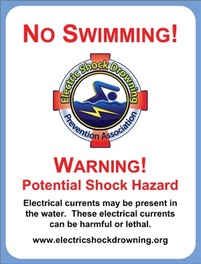
A "mild" tingle in the water is life-threatening.
https://www.webmd.com/fitness-exercise/news/20170615/electric-shock-drowning-silent-killer
https://www.electricshockdrowning.org/

People shouldn't be in the water anywhere near an electrified pier.
no-swimming-sign-from-wrap-city-graphics.jpg


... One thought was to drive ground rods down near the waterway and make it part of the grounding system. While that should mask the symptom, are we just transferring the problem out into the water? ...
That was my first thought, too: Surround the whole area with an equipotential grounding system, like a swimming pool or dairy barn.

... That makes me nervous.
Yeah, me too, after thinking about it for a few minutes.
If you don't really understand the root cause of the problem, you can't assure that you've adequately mitigated it.
And if you don't have access to the root cause, you never know when it will get worse, rendering all your mitigation efforts inadequate and the site unsafe.
 
Issue is stray voltage on the existing grounding conductor that causes a mild “tingle” to swimmers when exiting the water.

Can we get some clarity on how they are exiting the water? Are they climbing an aluminum ladder (bonded to the equipment ground?) on a dock, are they just walking out of a sloped bank (step voltage shock?)?
 
Can we get some clarity on how they are exiting the water? Are they climbing an aluminum ladder (bonded to the equipment ground?) on a dock, are they just walking out of a sloped bank (step voltage shock?)?

Climbing out of the water on an aluminum ladder bonded to the dock.
 
I have recently been advised to do the same by the utility. I was told I have 2 choices, Ronk Blocker or isolation transformer. The engineering Supervisor for the POCO advised me to drive a separate rod for the secondary of the iso and since it was now an SDS, the primary ground/neutral could remain isolated from dockside power. If anyone still sees this thread, lets discuss.
 
From what see on the Ronk Blocker datasheet, it is a reactor between the primary and the secondary neutral/grounds that has a high impedance as long as the 60 Hz RMS voltage across it is less than 12V. So there's still is a risk that any surges on the primary neutral which exceed this (or have the equivalent volt-seconds) will saturate the reactor and it will provide no isolation during the time interval(s) that it's saturated. While this approach may be effective most or nearly all of the time, I think an isolation transformer would be a better choice for safety reasons because it maintains isolation under a wide range of operating conditions. Also I think the Ronk Blocker will be more dependent on having a low GES resistance because the Ronk will be the series part of a voltage divider from the primary neutral voltage, and the GES will be the shunt part to earth for the secondary neutral.
 
I agree that the Iso is the better choice for the application, BUT, is this acceptable within the NEC to completely isolate H0 and X0 and bond X0 to its own ground rod? All I can find is 250.22(5) which is concerning submerged pool lighting.
 
I agree that the Iso is the better choice for the application, BUT, is this acceptable within the NEC to completely isolate H0 and X0 and bond X0 to its own ground rod? All I can find is 250.22(5) which is concerning submerged pool lighting.
There is no code compliant installation where the primary EGC will not be connected to the secondary EGC.
 
Status
Not open for further replies.
Top