KVA ratings of buck boost transformers

clemver

Member
Location
PA
Occupation
Electrician
Looking into the Federal Pacific K1XGF16-2 rated at 2kva. This is needed for a 1ph 208v primary to 1ph 240v secondary for a 50A appliance.


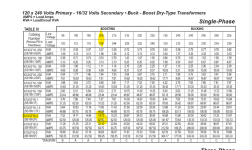
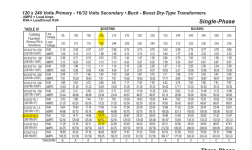
Looking at their voltage table (attached) that column (208v-236v @ 62.5A) shows a rating of 14.73Kva which makes sense. 236x62.5=14,750.

So where do these buck boosts get their label Kva rating from and why is it so much lower than what it can actually handle?

Edit: attached a screenshot to avoid downloading the chart pdf
Screenshot 2026-04-11 070344.png
 

Attachments

  • Buck-Boost_120X240-16X32.pdf
    526.8 KB · Views: 4
  • Screenshot 2026-04-11 070344.png
    Screenshot 2026-04-11 070344.png
    293.6 KB · Views: 4
So where do these buck boosts get their label Kva rating from and why is it so much lower than what it can actually handle?
The transformers are built as isolation transformers and get their label ratings from that application. When you use them as buck/boost, then you can power more kVAs.

For example, a 2 kVA 240V : 32V isolation transformer would have a rated secondary current of (2000/32) = 62.5A. That has a turns ratio of 240/32 = 7.5, so you can use it to multiply your voltage by either 8.5/7.5 (boost) or by 7.5/8.5 (buck). If you use it to boost 208V to (8.5/7.5 * 208) = 236V, then it can handle up to 62.5A on the lower voltage side, giving you 208V * 62.5A = 13 kVA of 236V load it can supply.

[If for some reason you wanted to boost 240V to (8.5/7.5*240) = 272V, then you could supply 272V * 62.5A = 17 kVA of 272V load.]

Cheers, Wayne
 
If you use it to boost 208V to (8.5/7.5 * 208) = 236V, then it can handle up to 62.5A on the lower voltage side, giving you 208V * 62.5A = 13 kVA of 236V load it can supply.
Mistake above, the secondary carries the full current on the higher voltage side; the higher current on the lower voltage side is split between the secondary and primary. So you could actually supply up to 236V * 62.5A = 14.75 kVA of 236V load.

Cheers, Wayne
 
Just to expand a little bit.

Imagine that instead of a transformer you have a small generator with 28V 62.5A output capacity. This generator has 1.75KVA output capacity.

Imagine that this generator has some magical synchronization capability so it is always in proper sync with your 208V supply. Place this generator in series with your 208V supply. You end up with a 236V supply with 62.5A capacity, or a _total_ of 14.75KVA capacity. In this setup the _generator_ still only has a capacity of 1.75KVA; the 208V supply is providing 13KVA for a _total_ of 14.75KVA.

The transformer in a boost configuration is essentially an electrically fueled generator, and its output is connected in series with the 208V supply. So you have 1.75KVA of capacity through the transformer _added_ to 13KVA of capacity drawn directly from the 208V supply, to net out 14.75 KVA. The transformer is still only handling 1.75KVA.

Finally, why 1.75KVA rather than 2KVA? Because the transformer is rated at 240V input 32V output. But in this particular situation it is only being used as 208V in to 28V out. When you use a transformer at lower than rated voltage, you end up only using a portion of its capacity.
 
Looking at their voltage table (attached) that column (208v-236v @ 62.5A) shows a rating of 14.73Kva which makes sense. 236x62.5=14,750.

So where do these buck boosts get their label Kva rating from and why is it so much lower than what it can actually handle?
The low voltage coil of this transformer is rated 2000 VA /32V = 62.5A. The high voltage coil of this transformer is mostly for excitation of the low voltage coil though it will draw additional current from input line at the primary to secondary ratio to match the net output VA.

When you place it in series with the 208 volts it is boosting it can't be supplying something that draws more than 62.5 amps or it will overload that 32 volt section of the series. Should you have a load drawing 75 amps then that 2000VA rated coil is actually loaded to 75 x 32 = 2400VA, a larger unit would be needed for a load with that current.
 
As an electrician, I will assume you don't want the science, just answers. ? Just remember the 'turns ratio'.....ALWAYS. I will walk some math here.

A 120/240p, 16/32s at 240 can do either 240/16=15:1 or 240/32 = 7.5:1. These are just the ratios BUT invert them for %. 1/15 = 6.6%. 1/7.5 = 13.33%

Input voltage at 208 is 208* the 13.33% which is 235.73V

What you will realize here is that % is the exact same value applied to the BB sizing. So normally at 1.0PF 235.73V*62.5A = 14,733va. Now, since you are running BB, which is a combo of parallel and series winding connections, you will use that 13.33% to size it. That is 14,733*13.33% = 16,692va, next size up is 2,000va or 2kva. Actually once you put a little PF in there, you want that next size anyway.

You will also notice the other 6.6% is in the table too. half the voltage delta, double the ampacity. The math works.
 
Top