Like for Like on a remodel

TealHeals

Member
Location
Oregon
Occupation
journeyman electrician & licensed signing supervisor
We are remodeling a 2001 modular office building. The NEC changed the rules in 2002 re: romex above drop grid ceilings in commercial spaces. For 2002 and after: romex shall NOT be used above drop grid ceilings.
This unit is so beat up that we decided to re-wire the whole thing. My initial training taught me that most remodels need to be brought up to the current code (yes, yes, we can all cite some exceptions).
My PM, who is not an electrician - more of a salesman, is insisting that we use romex in our re-wire because "we have to keep to the original, approved plan". Why wouldn't we wire it up to current code? He seems to be pulling from an ephemeral building codes rule without citation.
Can somebody help me make sense of this?
 
My friendly, competent AHJ has confirmed what I've known to be true in my 14 years of doing this stuff: when the sheetrock comes off, that portion gets re-done to today's current code. So instead of believing me the first time, I'm dropping the authoritative voice of the AHJ to my PM, and I will have my crew rip out what he tried to have them put in, in order to save a buck.
Does anybody know where the language of bringing remodels up to code resides? Is it building code? Regional adopted code? Electrical code?
^^ Thanks in advance for your help with this.
 
There nothing in the NEC that states you have to do that.
Just cause ahj says something does not mean anything—-

If it was compliant at install it’s still compliant—-

But if your rewiring the entire thing- than I would see what your state inspector says


I’ll correct my self anything new you put in has to meet today—- but if you can reuse portion of that wire—— that was compliant then you can.
 
There nothing in the NEC that states you have to do that.
Just cause ahj says something does not mean anything—-

If it was compliant at install it’s still compliant—-

But if your rewiring the entire thing- than I would see what your state inspector says


I’ll correct my self anything new you put in has to meet today—- but if you can reuse portion of that wire—— that was compliant then you can.
I hear where you're coming from. We ended up gutting this whole unit - wire included. So it didn't make sense to me to put in the 2001 wiring style. I told the painters good luck finding the original paint can. And next dwelling unit service call I do - I'll make sure to keep that knob and tube.
 
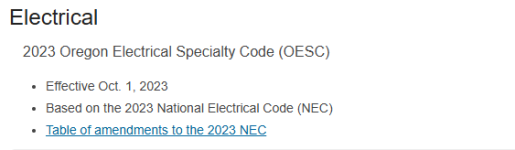
Here's what Oregon says about installations that were legal at the time. I'm still curious whose authority dictates bringing things up to code once a major remodel is underway. It's only been verbal knowledge taught to me up until this point.

OAR 918-305-0000
Existing Electrical Installations

Wiring installation in existing buildings in the State of Oregon that complied with the minimum electrical safety code standards, National Electrical Code or Oregon Electrical Specialty Code in effect at the time of installation shall not be considered in violation of the current minimum Electrical Specialty Code standards, unless the use or occupancy of the building is changed requiring different methods, alterations, or additions.
 
There nothing in the NEC that states you have to do that.
Just cause ahj says something does not mean anything—-
Ha! That's awsome, sometimes I wish that were true.

To the OP: The NEC is not the only code that regulates. Most states have some version of the existing building code, that's where you're going to find what you're looking for.
 
The relevant code comes from the International Existing Building Code, unless they amended it when they adopted. If you are just doing a repair, the following would apply:

(definition) [A] REPAIR. The reconstruction, replacement or renewal of any part of an existing building for the purpose of its maintenance or to correct damage.

406.1 Material.​

Existing electrical wiring and equipment undergoing repair shall be allowed to be repaired or replaced with like material.

If it is part of a remodel, the AHJ determines if it is a Level 1, Level 2, or Level 3 alteration. If it's Level 2 or more, any wiring being replaced would need to meet current code.

603.1 Scope.

Level 2 alterations include the addition or elimination of any door or window, the reconfiguration or extension of any system, or the installation of any additional equipment, and shall apply where the work area is equal to or less than 50 percent of the building area.

Exception: The movement or addition of nonfixed and movable fixtures, cases, racks, counters and partitions not over 5 feet 9 inches (1753 mm) in height shall not be considered a Level 2 alteration.

 
90.4(D) New Products, Constructions, or Materials. This Code may require new products, constructions, or materials that
may not yet be available at the time the Code is adopted. In such event, the authority having jurisdiction may permit
the use of the products, constructions, or materials that comply with the most recent previous edition of this Code
adopted by the jurisdiction.
Where the NEC requires electrical products to be “listed” or “labeled”, the words “listed” or “labeled” shall have the
same meaning as “certified electrical product” under ORS 479.530.
The occupancy classification and use designations shall be established in accordance with the Oregon Structural
Specialty Code (OSSC), as stated on the construction documents by the registered design professional and approved
by the building official.
The electrical datum plane as used throughout the OESC shall be the Design Flood Elevation as determined by the
flood plain administrator in accordance with the Oregon Structural Specialty Code (OSSC) or Oregon Residential
Specialty Code (ORSC) as applicable.
 

Attachments

  • 23oesc-table1-E-2025Jan.pdf
    383.2 KB · Views: 3
what are you getting at
That’s just specialty code not a administrative rules—-
If something was complaint upon install and you have not changed the fuction it’s grandfathered in—-
I took two cases to the chief inspector— and won—

One was a I changed a panel- then after removing some Sheetrock found they used a plumbing 90 I did not touch that just changed panel and it was originally inspected and approved that way so I won
 
90.4(D) New Products, Constructions, or Materials. This Code may require new products, constructions, or materials that
may not yet be available at the time the Code is adopted. In such event, the authority having jurisdiction may permit
the use of the products, constructions, or materials that comply with the most recent previous edition of this Code
adopted by the jurisdiction.
Where the NEC requires electrical products to be “listed” or “labeled”, the words “listed” or “labeled” shall have the
same meaning as “certified electrical product” under ORS 479.530.
The occupancy classification and use designations shall be established in accordance with the Oregon Structural
Specialty Code (OSSC), as stated on the construction documents by the registered design professional and approved
by the building official.
The electrical datum plane as used throughout the OESC shall be the Design Flood Elevation as determined by the
flood plain administrator in accordance with the Oregon Structural Specialty Code (OSSC) or Oregon Residential
Specialty Code (ORSC) as applicable.
That has nothing to do with prior install that is just what Oregon has amended— to current NEC—- there is still administrative rules and that is were you will find what I stated-
 
Ha! That's awsome, sometimes I wish that were true.

To the OP: The NEC is not the only code that regulates. Most states have some version of the existing building code, that's where you're going to find what you're looking for.
Thank you, I'm not fluent in building code yet.
 
Sorry I miss understood what you meant- sorry if I was rude
I didn't take anything you said on here as rude. For the remodel I was asking about - I would have felt fine in re-using the existing romex in the ceiling; but since we gutted the whole thing, I wanted to wire it to today's code. Funny how that line of change is there for me. I'm well versed in Table 1E for the oregon adopted electrical code - and nothing in there really answered my question. I think the IBC citations are what I was curious about. Thank you, everybody.
 
Top