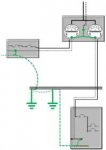
Line side taps and disconnect

Status
Not open for further replies.

electricalist

Senior Member
Location
dallas tx
If you line side tap the SEC either at the meter ( which is not allowed here)
Or on the line side of the first means of disconnect. Would the the disconnect that the taps feed be required to have a GES. Cold water and ground rod.?Single family dwelling.
The disconnect feeds the PV system.

I believe this is now a service disconnect
Thanks


Sent from my iPhone using Tapatalk
 
1- Would the the disconnect that the taps feed be required to have a GES.
2- I believe this is now a service disconnect

1- All I can really say about that is- the truth is out there. :huh:

The problem being that code doesn't really say, so your AHJ can interpret it any way they choose.

The way I understand it (around here) is you want a GEC *to the* existing GES from your PV disco, N and EGC are bonded in PV disco.
So- N bonded to G in main service panel, N bonded to G in PV disco, GECs from both to GES.

Around here, the POCO changed it back in January to require a dual meter (for PV feed-in-tariff output/site usage), the neutrals coming out of the meter sockets to the service panel and PV disco are both bonded to the meter can, so...
The POCO now kind of forces you to set it up as italicized above.
No more junction boxes, and I'm fine with that.

2- To me, of course it is.
There is a service to the house.
You connect the PV to the service conductors or service entrance conductors on the line side.
You have a PV disco switch.
It disconnects the PV from the service conductors.
Therefore, it's a service disconnect.
It disconnects the service from the PV connected to said service.

I can't understand why power being produced as opposed to consumed makes any difference.
If anyone has any theories as to why it would matter if power is coming into vs. going out from the premises, I'd love to hear them.

I'll say it again- the inverter does consume a tiny amount of watts at night, and I don't see a reason to wire it differently just because there is 3000w going out when the sun is up.

 
You understand my thinking.
To me it's the same as a tap can to a gutter that feeds 6 meters to 6 disconnects.
Each require a GES


Sent from my iPhone using Tapatalk
 
I need to read more or where those bonds can be made. ( which there is the ?)
If I'm taped off a neutral that is already bonded to cold water and a ground rod then maybe I do maybe I don't need my own bond.


Sent from my iPhone using Tapatalk
 
It depends on where you grounding electrode conductor connection originates.
If you grounding electrode conductor is connected ahead of any of the service disconnects such as in a wireway or the meter then you need no connection to the 2nd disconnect.
If your grounding electrode conductor originates in a service panel (or disconnect) and you add additional disconnects 250.64(D) requires every disconnect to have such a connection.
 
It depends on where you grounding electrode conductor connection originates.
If you grounding electrode conductor is connected ahead of any of the service disconnects such as in a wireway or the meter then you need no connection to the 2nd disconnect.
If your grounding electrode conductor originates in a service panel (or disconnect) and you add additional disconnects 250.64(D) requires every disconnect to have such a connection.

That's exactly what I thought.
Now I have to take a GEC to cold water and to a ground rod from my PV disconnect


Sent from my iPhone using Tapatalk
 
If I'm taped off a neutral that is already bonded to cold water and a ground rod

So that neutral- it's the grounded connector which is also bonded to the meter can and to ground in the main service panel, right?
And you're splicing the neutral from the PV disco switch into it?

I say the PV neutral between PV disco and splice point is a "supply side grounded conductor", and has to be bonded to ground wherever it ends, meaning in the MSP *and* the PV disco.

What do you think about this pic? Would it make a difference grounding wise if there was a supply side j-box instead of the dual meter?

SSbonding.jpg
 
I see your logic.
Although we can't line tap the load side in a meter ( in this jurisdiction ) so the tap would have to be in the first panel or disconnect.


Sent from my iPhone using Tapatalk
 
It depends on where you grounding electrode conductor connection originates.
If you grounding electrode conductor is connected ahead of any of the service disconnects such as in a wireway or the meter then you need no connection to the 2nd disconnect.

What's your take on a cold sequenced meter or meters?
If the switch between POCO xfmr and meter or meter bank is locked by POCO...
then it doesn't matter is it it fused or not, you simply don't bond N to ground there?
You just bond the "grounded service conductors" at every disco they run to, for instance with a SSBJ in switches or panels from each switch/panel neutral to ground bar, and GECs from every ground bar to the premises GES, right?

I see your logic.
Although we can't line tap the load side in a meter ( in this jurisdiction ) so the tap would have to be in the first panel or disconnect.

Right, but if there was a fault in for instance in the AC PV combiner, when the PV disco for that combiner is bonded to ground, that fault doesn't hit the main service panel?
Sound logical?
 
I see your logic.
Although we can't line tap the load side in a meter ( in this jurisdiction ) so the tap would have to be in the first panel or disconnect.
Whether or not you are required to run a GEC to the PV System disconnecting means of a supply-side interconnection depends on whether the AHJ considers the disconnecting means to be a service disconnecting means or not. You'll probably get varied recommendations here.
 
What's your take on a cold sequenced meter or meters?
If the switch between POCO xfmr and meter or meter bank is locked by POCO...
then it doesn't matter is it it fused or not, you simply don't bond N to ground there?
You just bond the "grounded service conductors" at every disco they run to, for instance with a SSBJ in switches or panels from each switch/panel neutral to ground bar, and GECs from every ground bar to the premises GES, right?


Right, but if there was a fault in for instance in the AC PV combiner, when the PV disco for that combiner is bonded to ground, that fault doesn't hit the main service panel?
Sound logical?

Maybe I should have said I understand what is being said but I was taught the bond goes in the service disconnect. Regardless of what might sound better.


Sent from my iPhone using Tapatalk
 
If you and your AHJ consider the new disco to be a new service disconnect, then see 250.64(D). Note that the PV system does not need a separate grounding electrode system, it just needs to be connected to the existing one. You can tap the GEC, install a separate GEC, or following what augie said if the connection is ahead of the discos you needn't do anything. You also put a main bonding jumper in the disconnect.

If your AHJ thinks the new disconnect is not a service disconnect because it's for a PV system, then run an EGC to somewhere where the neutral is bonded to ground. Depending on your code cycle an AHJ could also require a GEC for the PV system but that could be run from the inverter(s) and really has nothing to do with the disco and your particular question.
 
Although we can't line tap the load side in a meter ( in this jurisdiction ) so the tap would have to be in the first panel or disconnect.

Maybe I should have said I understand what is being said but I was taught the bond goes in the service disconnect. Regardless of what might sound better.

Wait, so you can't use a j-box between meter and main service panel? Hmm.
Ok- so you're tapping into the service entrance conductors ahead of the main service breaker, with L1, L2 and N.
Meaning the PV system neutral conductor is not connected to the panel's neutral bar?

I'll be the first to admit it's kinda confusing.

Seems to me you'd want PV system faults to go straight to the xfmr and the back to the PV OCPD, which is in the PV disco.
If you bond the PV system in the main service panel, it seems like one is introducing a detour somehow.

I have my own interpretation that says the PV disco is service *equipment*, so you bond/ground the PV system there even though it may not *technically* be a service disconnect.

I'm not really sure what the conductors between PV disco and any type of supply side connection point are supposed to be called.

Unless of course the PV is going to one meter of a dual meter bank (with other meter for loads).
Then PV meter to outdoor PV disco are 100% service conductors.
 
There is this:

When the new PV service disconnecting means is not in the same enclosure as the existing service disconnect means, the PV circuit neutral should be bonded to ground and a grounding electrode conductor originating from the PV service disconnect location must be routed to the grounding electrode (250.24).

Even where the PV inverter connection does not have a neutral connection, the utility neutral should be routed to at least the new PV service disconnect and any PV production meter. The meter may require the neutral for proper operation.
http://iaeimagazine.org/magazine/2013/11/16/supply-side-pv-connections-a-closer-look/
 
Ok- so you're tapping into the service entrance conductors ahead of the main service breaker, with L1, L2 and N.
Meaning the PV system neutral conductor is not connected to the panel's neutral bar?

I've done it both ways, i.e. tap the neutral with the same connector as the hots, or just land the neutral on the neutral bar. If it's all in the same enclosure then I can't see how it makes a difference in terms of safety or function. It really just depends if there's already a proper lug to use on the bar for the PV neutral, and if not then whether it's easier to add a lug or install a tap connector.

If you're tapping in a j-box then I'd say you should tap the neutral there, too, although about the only code I could cite to support that would be the 'neat and workmanlike manner' section. :cool:
 
If you line side tap the SEC either at the meter ( which is not allowed here)
Or on the line side of the first means of disconnect. Would the the disconnect that the taps feed be required to have a GES. Cold water and ground rod.?Single family dwelling.
The disconnect feeds the PV system.

I believe this is now a service disconnect
Thanks


Sent from my iPhone using Tapatalk

INCOMING!!! :D
 
1- All I can really say about that is- the truth is out there. :huh:
No, it's not, which is why this question always sparks a lively debate that goes on for pages and pages. We "regulars" are aware (some might say painfully so) of your thoughts on the matter, but your opinion is far from universal.
 
No, it's not, which is why this question always sparks a lively debate that goes on for pages and pages. We "regulars" are aware (some might say painfully so) of your thoughts on the matter, but your opinion is far from universal.

Again, lighten up?
That was an X-Files reference, so what I really meant was- it isn't.
You might say painfully so, but what exactly is the point of doing so?

There are engineers who disagree with you, the fact that I'm not one is irrelevant.
 
Again, lighten up?
That was an X-Files reference, so what I really meant was- it isn't.
You might say painfully so, but what exactly is the point of doing so?

There are engineers who disagree with you, the fact that I'm not one is irrelevant.
Again it appears that you are trying to place me in one camp or the other. I am agnostic on the issue; the AHJ makes the call and I comply, whichever way it goes, and it goes both ways. To the OP: if you can arrange for a preconstruction meeting with your AHJ to determine whether or not they consider the AC disco on a supply side interconnected PV system to be a service disconnect, that is what I recommend. In my world there are AHJ's on both sides of the question.
 
1 I've done it both ways, i.e. tap the neutral with the same connector as the hots, or just land the neutral on the neutra If it's all in the same enclosure then I can't see how it makes a difference in terms of safety or function

2 If you're tapping in a j-box then I'd say you should tap the neutral there, too, although about the only code I could cite to support that would be the 'neat and workmanlike manner' section. :cool:

1 Am I misunderstanding you? What about the PV EGC?
How is it a supply side connection if the PV EGC is connected to the same grounding bar as the loads?

2 We aren't allowed to use j-boxes here anymore. It's either split the service conductors at the weatherhead, or use a dual meter bank for PV output and house loads. When we did the j-box was bonded like the meter, so the neutrals coming out of it to loads and PV were both still "grounded service conductors", and were grounded because of the N-G bond to a GEC at the switches or breakers where they ended.
So 2 GECs connected in one GES.

I guess safety may be debatable, but having a supply side PV EGC connected to the MSP ground bar changes function as far as I can tell.
 
Status
Not open for further replies.
Top