
More voltage drop questions

Status
Not open for further replies.

hardworkingstiff

Senior Member
Location
Wilmington, NC
Lets assume load 1 is 120-volts, 14-amps and load 2 is 120-volts, 7-amps and both are fed from a #12 wire MWBC originating in your home panel and the length of wire is 100' for each load (leave the panel, go 100' of wire to a JB, then connect the 2 loads. (For ease of calculation, ignore conductor length from the JB to the load.)

Questions:

Assume a 120/240-volt service
What is the VD to load 1 if it is the only load turned on?
What is the VD to load 2 if it is the only load turned on?
What is the VD to loads 1 & 2 if both are turned on?

Assume the infamous 208/120-volt single-phase service.
What is the VD to load 1 if it is the only load turned on?
What is the VD to load 2 if it is the only load turned on?
What is the VD to loads 1 & 2 if both are turned on?
 
Using a simple DC formula VD=I*R, I came up with the following:​


Assume a 120/240-volt service
What is the VD to load 1 if it is the only load turned on? 5.4-volts.
What is the VD to load 2 if it is the only load turned on? 2.7-volts.
What is the VD to loads 1 & 2 if both are turned on? 1 = 4.05-volts and 2 = 1.35 volts.

Assume the infamous 208/120-volt single-phase service.
What is the VD to load 1 if it is the only load turned on? 5.4-volts.
What is the VD to load 2 if it is the only load turned on? 2.7-volts.
What is the VD to loads 1 & 2 if both are turned on?
I don't know how to solve for both loads on with the 208/120 "single-phase" service.

Am I close with any of the answers?
 
hardworkingstiff said:
Assume the infamous 208/120-volt single-phase service.
What is the VD to loads 1 & 2 if both are turned on?
I don't know how to solve for both loads on with the 208/120 "single-phase" service.
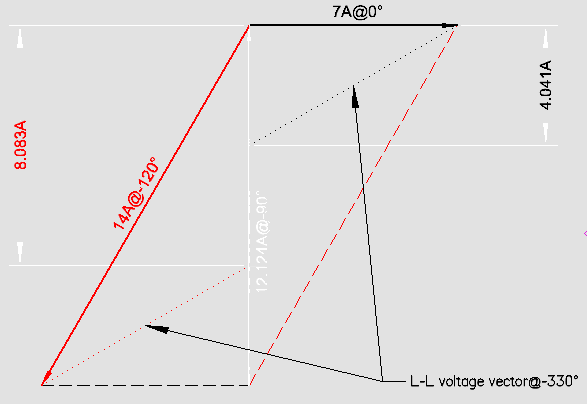
For 120/208 1? 3W, both loads on, you will have to calculate IN = √(I1? + I2? – I1?I2) to determine VDN. Then determine voltage drop per conductor—VD1, VDN, VD2.

Then determine voltage drop per load:
VD1 + VDN ? I1 ? (I1 + I2) = VDTOTAL Load 1
VD2 + VDN ? I2 ? (I1 + I2) = VDTOTAL Load 2​

vdunbalancedopenwye.gif


Note drawing. Calculation below is shortcut for determining Neutral current respective of load.
IN ? I1 ? (I1 + I2) = 4.041A
IN ? I2 ? (I1 + I2) = 8.083A
4.041A + 8.083A = 12.124A​
Since R is a constant in the formula VD = I ? R, VD and I are directly proportional. So...
VDN ? I1 ? (I1 + I2) = VDN Load 1
VDN ? I2 ? (I1 + I2) = VDN Load 2​

As best I can determine, this method yields the correct result, but it needs verified.
 
Last edited:
So,

The current in the neutral could be determined by SQRT((A*A+B*B+C*C)-(A*B+B*C+C*A)) = 12.12 (in this case).

14*14=196 + 7*7=49 + 0*0=0 all summed up = 245

14*7=98 + 7*0=0 + 0*14=0 all summed up = 98

245 - 98 = 147

SQRT(147) = 12.12

Total current in the ungrounded conductor are 14+7=21 amps.

14 is .6667 of 21
7 is .3333 of 21

12.12 neutral amps * .6667 = 8.084 CKT1 neutral amps
12.12 neutral amps * .3333 = 4.040 CKT2 neutral amps

If, VD=I*R, then:

CKT1 hot side: VD=14*(1.93*(100/1000))=2.702
CKT1 neutral side: VD=8.084*(1.93*(100/1000))=1.560
Total VD for CKT1 is 2.702+1.560= 4.262

CKT2 hot side: VD=7*(1.93*(100/1000))=1.351
CKT2 neutral side: VD=4.040*(1.93*(100/1000))=.7797
Total VD for CKT2 is 1.351+.7797= 2.131

% drop for CKT1 is 4.262/120= 3.55%
% drop for CKT2 is 2.131/120= 1.78%
 
hardworkingstiff said:
Lets assume load 1 is 120-volts, 14-amps and load 2 is 120-volts, 7-amps and both are fed from a #12 wire MWBC originating in your home panel and the length of wire is 100' for each load (leave the panel, go 100' of wire to a JB, then connect the 2 loads. (For ease of calculation, ignore conductor length from the JB to the load.)

Questions:

Assume a 120/240-volt service
What is the VD to load 1 if it is the only load turned on?
What is the VD to load 2 if it is the only load turned on?
What is the VD to loads 1 & 2 if both are turned on?

Assume the infamous 208/120-volt single-phase service.
What is the VD to load 1 if it is the only load turned on?
What is the VD to load 2 if it is the only load turned on?
What is the VD to loads 1 & 2 if both are turned on?


Vd1 = KIL2/CM = 12*14*100*2/6530 = 5.16v
Vd2 = KIL2/CM = 12*7 *100*2/6530 = 2.57v

Vd1(1&2) = (12*14*100/6530)+(12*7*100/6530) = 3.86v
Vd2(1&2) = 2.57v

Voltage drop should be the same for both problems.:confused:
 
roger3829 said:
Voltage drop should be the same for both problems.:confused:

I agree if only one of the circuits is turned on.

If both circuits are turned on, then the voltage drop will be different since the "hots" are out of phase by 180-degrees in the 1st scenario and out of phase by 120-degress (or 240 depending on how you look at it) in the 2nd scenario. They will act differently because of this (I believe).

I understand the the VD formula you are using is the better AC VD formula, but I've never really understood "K". I've seen that it is really dynamic depending on factors like, heat. The DC formula I was using was just my preference. I was just trying to see how differently MWBCs work between 120/240 circuits and 208/120 circuits.
 
roger3829 said:
Voltage drop should be the same for both problems.:confused:
Consider a balanced three-wire mwbc... say 14A on each hot, for both a 120/240 and a 120/208 system. Otherwise, same parameters as OP.

For the 120/240 system, the neutral conductor current would be 0A. Therefore only 100' of hot wire per branch will have an I?R loss. VD only occurs on wires having an I?R loss.

On a 120/208 system it is a bit different because there will 14A of current on the neutral conductor, hence an I?R loss and VD.
 
Status
Not open for further replies.
Top