
Saturn_Europa
Senior Member
- Location
- Fishing Industry
- Occupation
- Electrician Limited License NC, QMED Electrician
I work on a large fishing/factory boat. When I was hired the first thing I did was start asking questions about grounding. The Chief Engineer at that time told me that the boat is not "solidly grounded".
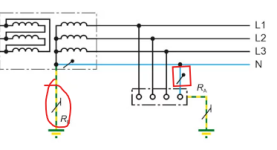
We have 3 generators and all of the generators do not show the center point grounded. Its a 480v 3 phase system. At any 480v panel on the boat I can go from leg to ships steel or the panel steel and get 277 volts.
We have a ground fault meter on the main switch board as well that reads leakage to ground.
About 3 years ago, I installed a 25 HP Allen Bradley VFD. It failed within a few days of production. We returned it to the distributor and an electrical engineer there said it failed because we did not pull the jumper for the Metal Oxide Varistors that are referenced to ground.
I went around the boat and around half of the jumpers were pulled and half not. We pulled all the jumpers on installed drives. Since then I have been pulling the jumpers on all the drives that I install.
This past October we had two drives fail on a three drive system. They are ABB drives that have been in service for around 10 years. They failed during switch over from shore power to generator than back to shore power. There was a lot of condensation built up in the room and we blamed it on that. The two drives that failed are ten years old and had the VAR jumper in place. The drive that didnt fail is around a year old and has the VAR jumper pulled.
I was talking to the other electrician on board during a rare overlap of our schedules and we started discussing why we pull the MOV or VAR jumpers. It boiled down to something someone had told me 3 years ago. And we've been rolling with it ever since. I've installed around $40,000 worth of drives this year and I want to make sure I am doing everything correctly. We havent noticed any increase of failures since we started pulling the VAR or MOV jumpers.
Allen Bradley has the benefits of the MOV as "Reduced electrical noise, most stable operation, EMC compliance, reduced voltage stress on components and motor bearings." My question is: Is there any harm in pulling the MOV or VAR jumpers other than whats listed in the manual?
How can I tell what type of grounding system I have on board? I am really only familiar with TN-S and TN-C. Ships ground is a difficult subject to research.

We have 3 generators and all of the generators do not show the center point grounded. Its a 480v 3 phase system. At any 480v panel on the boat I can go from leg to ships steel or the panel steel and get 277 volts.
We have a ground fault meter on the main switch board as well that reads leakage to ground.
About 3 years ago, I installed a 25 HP Allen Bradley VFD. It failed within a few days of production. We returned it to the distributor and an electrical engineer there said it failed because we did not pull the jumper for the Metal Oxide Varistors that are referenced to ground.
I went around the boat and around half of the jumpers were pulled and half not. We pulled all the jumpers on installed drives. Since then I have been pulling the jumpers on all the drives that I install.
This past October we had two drives fail on a three drive system. They are ABB drives that have been in service for around 10 years. They failed during switch over from shore power to generator than back to shore power. There was a lot of condensation built up in the room and we blamed it on that. The two drives that failed are ten years old and had the VAR jumper in place. The drive that didnt fail is around a year old and has the VAR jumper pulled.
I was talking to the other electrician on board during a rare overlap of our schedules and we started discussing why we pull the MOV or VAR jumpers. It boiled down to something someone had told me 3 years ago. And we've been rolling with it ever since. I've installed around $40,000 worth of drives this year and I want to make sure I am doing everything correctly. We havent noticed any increase of failures since we started pulling the VAR or MOV jumpers.
Allen Bradley has the benefits of the MOV as "Reduced electrical noise, most stable operation, EMC compliance, reduced voltage stress on components and motor bearings." My question is: Is there any harm in pulling the MOV or VAR jumpers other than whats listed in the manual?
How can I tell what type of grounding system I have on board? I am really only familiar with TN-S and TN-C. Ships ground is a difficult subject to research.