NEC rules for a permanently installed pool

Rjryan

Senior Member
Location
Trophy Club, Texas
Occupation
Master Electrician
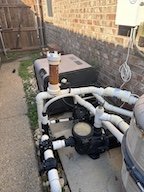
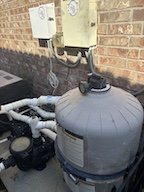
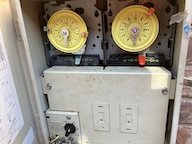
IMG_5316.jpegIMG_5317.jpegIMG_4179.jpegI gracefully bowed out of installing additional circuits for friends, because it got involved with a pool, reason being pool safety concerns. I understand now they are thinking about asking about these concerns.
Background: house built 2009, pool 2011 and house bought 2014
2 circuits involved 1. 2 pole breaker 20 amp 240 vac not GFCI
2. 1 single pole breaker 20 amp 120 vac not GFCI
Equipment: 2 pumps 240 vac, 2 timers 240 vac, Trumcell controller 240 vac, gas heater controls 240 vac
NEC 680.13 Maintenance disconnecting means, believe what's needed is a disconnecting means for the motor and timer controller for each motor
Disconnecting means for the Trumcell controller and a disconnect means for the heater controls.
NEC 680.5 (B) GFCI protection for the 2 pole 20 amp 240 vac breaker.
There are three other problems: added concrete on perimeter of pool extending it out from 1' to 3' for a small portion of the pool.
NEC 680.26(B)(2) Equipotential bonding extends 3' from pool perimeter, see no easy fix.
The patio next to the pool they have a 20 amp receptacle circuit tapped off the family room that is not GFCI less than 20' from pool.
NEC 680.22(A)(4) need to GFCI circuit.
Equipotential bonding wire smaller than #8.
NEC 680.26(B) #8 minimum bonding conductor, see no easy fix.
Don't know about single pool light, assume it is feed off the GFCI servicing receptacle and switched.

Any comments would be appreciate on the situation and are the NEC 2023 code articles correct.
 
I look forward to comments good and bad. I think the lack of comment, comes down to something Mike Holts says
in Mike Holt.com/pools. The gist, if I am getting it right, there is really no safe interface between electricity and water, we can only make it as safe as the NEC calls for with adhereance to rules. These are friends who paid $160 dollars for a pool inspection. They think their pool is safe.
As one of the Moderator said in effect go soft. If the safety issue comes up, I am going to tell them to contact a pool inspector that follows the extensive check list created by Mike Holt.
 
It appears there might be a load center there also which could satisfy 680.13. Everything else you list seems a legitimate concern plus 110.26 clearance problems
The equipotential bond problem is likely the most difficult to address.'
If you wish to remain "friends" I would politely bow out and tell them pools are specialized and they need someone who does pool electrical routinely
 
Everything but the equipotential bond is, or can be, addressed. Things like adding GFCI protection can be done. As was mentioned, the panel breakers can be the required disconnect. The EP grid presents a problem, it can be overcome, but would be quite an involved process.
 
It appears there might be a load center there also which could satisfy 680.13. Everything else you list seems a legitimate concern plus 110.26 clearance problems
The equipotential bond problem is likely the most difficult to address.'
If you wish to remain "friends" I would politely bow out and tell them pools are specialized and they need someone who does pool electrical routinely
The sad part about this situation, your right, is that someone needs to specialize in pools for an inspection, when I was looking for something on the order of Mike holt’s pool inspection, all that you find on YouTube for pool inspections are inspectors talking about perimeter fencing, filtering checks and other misc. things. The only electrical check they do is check the GFCI for the pool lights. The “ pool Inspector “ that did our friend’s inspection, came with scuba gear, checked the integrity of the pool structure for cracks, checked for restricted access, if the filtering system worked and of course if the pool light was GFCI. You just wonder way more people are not electrically hurt around pools.
 
augie47 correct about clearances. I noticed that too.

Just boggles my mind this has dual time clocks when EVERYONE is doing automation.
 
and are the NEC 2023 code articles correct.
If the pool was built in 2009 you probably at least need to consider if some the things you mentioned were compliant at the time of installation.

As mentioned GFCI protection is easy to add even if you want to update something that wasn't required at time of installation. The equipotential bonding requirements haven't had much for changes but as also mentioned are not going to be easy fixes when it comes to perimeter bonding type issues either.
 
Top