This may be the wrong place to ask as 2-phase is pretty specific but does anyone know if the neutral conductor of a 5-wire, 2-phase, system is a 'current carrying' (CC) conductor? Its pretty much two single phase systems that overlap so I say no.

You are using an out of date browser. It may not display this or other websites correctly.
You should upgrade or use an alternative browser.
You should upgrade or use an alternative browser.
Neutral conductor of a 5-wire, 2-phase, system is it CC?
- Thread starter WD40
- Start date
Have not worked with a two phase system but why would you consider the neutral to be any different than a neutral for a split phase or three phase system? It is designed to carry all unbalanced current or and single phase loads. I would consider it as a current carrying conductor.

LarryFine
Master Electrician Electric Contractor Richmond VA
- Location
- Henrico County, VA
- Occupation
- Electrical Contractor
Welcome to the forum.I would consider it as a current carrying conductor.
Any current on a genuine neutral is current not being carried by one or more lines.
It is considered to be a non-CCC.
jaggedben
Senior Member
- Location
- Northern California
- Occupation
- Solar and Energy Storage Installer
This may be the wrong place to ask ...
Nah it's probably the best place on the internet to ask, though it may take a bit to get the correct answer.
I would wager that because 2-phase 5-wire is not specifically called out in 310.15(E) it can be considered a non-CCC. But I don't have a more definitive answer ready regarding the balance of current. Hopefully someone will provide the math.

Have not worked with a two phase system but why would you consider the neutral to be any different than a neutral for a split phase or three phase system? It is designed to carry all unbalanced current or and single phase loads. I would consider it as a current carrying conductor.
I think both of your responses ignore that there are cases where an NEC defined neutral is current carrying, and cases where it is not, per the section I cited above. The OP has a reasonable question.Welcome to the forum.
Any current on a genuine neutral is current not being carried by one or more lines.
It is considered to be a non-CCC.
wwhitney
Senior Member
- Location
- Berkeley, CA
- Occupation
- Retired
If you have a set of n+1 conductors for which the currents sum to zero, then you have only n CCCs.
So 3-wire "split" single phase, 4-wire wye, 5-wire 2-phase, etc.
Cheers, Wayne
So 3-wire "split" single phase, 4-wire wye, 5-wire 2-phase, etc.
Cheers, Wayne
wwhitney
Senior Member
- Location
- Berkeley, CA
- Occupation
- Retired
OK, this is not phrased correctly, will reconsider.If you have a set of n+1 conductors for which the currents sum to zero, then you have only n CCCs.
Cheers, Wayne
zbang
Senior Member
- Location
- Roughly 5346 miles from Earls Court
Interesting question.
Thinking about the current sums, it looks like there is a case where the N current will exceed the current of each phase lead if same polarity leads of the two windings are used (1 and 2 in the image), I think this should come to (i1 + i2) * 1.73/2. This suggests that the N is a CCC, at least in some circumstances. (Note that it's late and I'm not completely sure of this.)
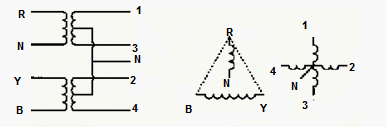
Thinking about the current sums, it looks like there is a case where the N current will exceed the current of each phase lead if same polarity leads of the two windings are used (1 and 2 in the image), I think this should come to (i1 + i2) * 1.73/2. This suggests that the N is a CCC, at least in some circumstances. (Note that it's late and I'm not completely sure of this.)

synchro
Senior Member
- Location
- Chicago, IL
- Occupation
- EE
In the drawing above, if there are equal L-N load cuurents on 1 and 2, the neutral current will be 1.414 times this current. The square root of 2 is used because of the 90 degree phase angle.
I think L1-L3 and L2-L4 are the only line-to-line loads that are used.
I think L1-L3 and L2-L4 are the only line-to-line loads that are used.
zbang
Senior Member
- Location
- Roughly 5346 miles from Earls Court
Thanks, I thought 1.73 looked wrong  but it's all I had at the time.
(All four lines could be used with a real two-phase motor, but I suspect they're rarer than hens' teeth. Having said that, someone will post a picture of one in the next few hours....)
but it's all I had at the time.(All four lines could be used with a real two-phase motor, but I suspect they're rarer than hens' teeth. Having said that, someone will post a picture of one in the next few hours....)
wwhitney
Senior Member
- Location
- Berkeley, CA
- Occupation
- Retired
Which is the reason for NEC 220.61(A) Exception. For unequal currents A and B on phases 1 and 2, the neutral current will be sqrt(A2+B2).In the drawing above, if there are equal L-N load cuurents on 1 and 2, the neutral current will be 1.414 times this current.
But this is not so different from the neutral being a CCC in a 2-wire 120V circuit. It's when the neutral is accompanied by a set of ungrounded conductors whose voltages relative to the neutral sum to zero, and the load power factors are all the same, that the neutral does not contribute as an additional CCC.
Cheers, Wayne
jaggedben
Senior Member
- Location
- Northern California
- Occupation
- Solar and Energy Storage Installer
So would the following be correct?
The neutral is not a CCC if it is run
a) only with lines 1 and 3
b) only with lines 2 and 4
or
c) with all lines 1-4
But if it is run with any other combination of line conductors, it's a CCC.
The neutral is not a CCC if it is run
a) only with lines 1 and 3
b) only with lines 2 and 4
or
c) with all lines 1-4
But if it is run with any other combination of line conductors, it's a CCC.


Joethemechanic
Senior Member
- Location
- Hazleton Pa
- Occupation
- Electro-Mechanical Technician. Industrial machinery
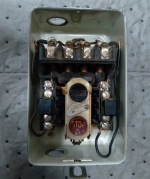
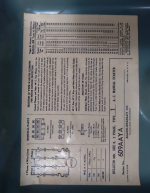
We had 4 wire 2 phase motor circuits coming from 5 wire 2 phase services all over in Philly. 4 pole fused discos, 4 pole magnetic motor starters, and 4 pole manual motor starters like this. On a 5 wire service, neutral to a phase was 110 volts. (power and light)Thanks, I thought 1.73 looked wrong
(All four lines could be used with a real two-phase motor, but I suspect they're rarer than hens' teeth. Having said that, someone will post a picture of one in the next few hours....)
On the 3 wire 2 phase services, the "neutral" (1.41 wire) to either phase was always 220 volts or higher.
If you had the 5 wire 220/110 service, you had to run a 4 wire circuit to your 220 volt 2 phase motors.
zbang
Senior Member
- Location
- Roughly 5346 miles from Earls Court
Had, how many of those 2-phase motors are still in service? That number drops every time an old building is renovated and the premises wiring converted to 3-phase.We had 4 wire 2 phase motor circuits
Side question- how much of Philly ever had 2-phase? Parts (some? most?) of Center City, but more than a couple of miles from City Hall? Along the same lines, IIRC the Wanamaker store building was one of the first stores build for electric lighting and had a power plant across 13th St, and would have originally been DC. When converted to AC power, did it get 2-phase or 3-phase? History of the building itself is hard to find.)
Joethemechanic
Senior Member
- Location
- Hazleton Pa
- Occupation
- Electro-Mechanical Technician. Industrial machinery
Not very many of them anymore. Bridesburg, Port Richmond, Nicetown, Fishtown, Kensington, and all those older industrial neighborhoods had lots of 2 phase up into the late 90's and beyond. As long as I can remember they were all Scott-T from a 3 phase primary, so it was kind of a patchwork of 2, 3 and single phase services building by building. I've never seen an active 2 phase primary in my life and I'll be 65 pretty soon.Had, how many of those 2-phase motors are still in service? That number drops every time an old building is renovated and the premises wiring converted to 3-phase.
Funny you bring up City Hall, in the basement where the electrical shop is, there are remnants of a DC system from the 1800's
As far as Wanamaker's goes, if they went to AC before 1912 it had to be 2 phase, and if they converted before about 1930, it was probably 2 phase
Thanks everyone for the feedback everyone, its all kinda over my pay grade
I was informed by a smarter than me person that each of the 4-wires (two phases) are 90° out of phase with each other and 'the neutral current' will balance like a 'normal' single phase system and does not need to be counted as 'current carrying'. But the the neutral needs to be sized at 140% of the phase wire, so a 200A service would be 250AL X4 and 4/0 AL X2. Since the neutral is a parallel conductor and the phase wires are not, it could be important to know if it counts as a CC so wanted to confirm but in my case it did not matter in the end.
Thanks again
I was informed by a smarter than me person that each of the 4-wires (two phases) are 90° out of phase with each other and 'the neutral current' will balance like a 'normal' single phase system and does not need to be counted as 'current carrying'. But the the neutral needs to be sized at 140% of the phase wire, so a 200A service would be 250AL X4 and 4/0 AL X2. Since the neutral is a parallel conductor and the phase wires are not, it could be important to know if it counts as a CC so wanted to confirm but in my case it did not matter in the end.
Thanks again
At my first job we had two phase five wire. We used the fifth wire that was center tapped to both phase to supply 120 volts for luminare & receptacles. Every time a two phase motor burnt out we would convert over to three phase. By the late 1970's our supply house in my stocked 30 amp two.phase four poke four fuse safety switches made by a low quality company. When a two phase started but the dust we would replace it with a three phase three poke starter and bolt on a lower pole. I got to wire in a rewound two speed two phase motor that had 8 leads. Worst thing about two.phase if you cross phased the connections instead but each motor winding receiving 240 vokts would only get maybe 170 volts.This may be the wrong place to ask as 2-phase is pretty specific but does anyone know if the neutral conductor of a 5-wire, 2-phase, system is a 'current carrying' (CC) conductor? Its pretty much two single phase systems that overlap so I say no.
Oops, should have also replied that on a two phase five wire system the nuetral is only current carrying if 120 volts loads are using power. The nuetral never gets connected to a two phase motor.Came to.my old mind that.flimsy Wasworth company were the only two phase safety switches supply house stockedAt my first job we had two phase five wire. We used the fifth wire that was center tapped to both phase to supply 120 volts for luminare & receptacles. Every time a two phase motor burnt out we would convert over to three phase. By the late 1970's our supply house in my stocked 30 amp two.phase four poke four fuse safety switches made by a low quality company. When a two phase started but the dust we would replace it with a three phase three poke starter and bolt on a lower pole. I got to wire in a rewound two speed two phase motor that had 8 leads. Worst thing about two.phase if you cross phased the connections instead but each motor winding receiving 240 vokts would only get maybe 170 volts.
winnie
Senior Member
- Location
- Springfield, MA, USA
- Occupation
- Electric motor research
The 140% thing comes from 2 phase 3 wire. You have 2 hots and a grounded conductor, with the H-N voltage of 'phase B' 90 degrees away from 'phase A'. In this configuration if you have 10A on each hot leg, you get 14A on the neutral. In 2 phase 3 wire you most certainly count the grounded (not neutral) conductor as a CCC.
But you (OP) were talking 2 phase 5 wire, with 4 hots and a grounded conductor that _is_ a neutral. You still need the oversized neutral because you _might_ only have two phases supplying load, but in the case of all 4 hots supplying equal load the neutral current drops to zero. The total number of CCCs for derating is 1 less than the total number of wires.
Let's assume a circuit rating of 100A, and consider all of the 'fully loaded' combinations (meaning some hots have full current, others have 0):
Circuit A carries 100A -> N carries 100A, 2 conductors worth of heating
Circuits A and B each carry 100A -> N carries 140A, between 3 and 4 conductors worth of heating (because of the oversized N)
Circuits A, B, and C each carry 100A -> N carries 100A, less than 4 conductors worth of heating (again because of the oversized N)
Circuits A, B, C, and D each carry 100A -> N carries 0A, 4 conductors worth of heating.
But you (OP) were talking 2 phase 5 wire, with 4 hots and a grounded conductor that _is_ a neutral. You still need the oversized neutral because you _might_ only have two phases supplying load, but in the case of all 4 hots supplying equal load the neutral current drops to zero. The total number of CCCs for derating is 1 less than the total number of wires.
Let's assume a circuit rating of 100A, and consider all of the 'fully loaded' combinations (meaning some hots have full current, others have 0):
Circuit A carries 100A -> N carries 100A, 2 conductors worth of heating
Circuits A and B each carry 100A -> N carries 140A, between 3 and 4 conductors worth of heating (because of the oversized N)
Circuits A, B, and C each carry 100A -> N carries 100A, less than 4 conductors worth of heating (again because of the oversized N)
Circuits A, B, C, and D each carry 100A -> N carries 0A, 4 conductors worth of heating.
Joethemechanic
Senior Member
- Location
- Hazleton Pa
- Occupation
- Electro-Mechanical Technician. Industrial machinery
I saw a lot of those. It got really hard to get 2 phase equipment later.Wasworth company
We even use to use the 4 wire delta high leg to get 2 phase out of sometimes. A-C (240v) was one phase and B-N (208v) was your second phase. They were 90 degrees apart but different voltages, so one phase did a bit more work. Most times it was some ancient machine tool, and the guy never worked it to capacity anyway.
I'm not sure if you remember North American Engines over on B Street, but they had a 2 phase building they used for storage and they ran it off of a 3 phase generator to power the elevator and hoists. If I remember right he just put 3 phase to the 2 phase equipment and ran it. But that was really low duty cycle. They were the local Waukesha Engine and generator dealer. Adam Talacki (RIP), AKA "The world's Smartest Pollack". And believe me, the guy was wicked smart, so he earned that name