New Fire Pump Electrical Service

Robbierobdude

Member
Location
NJ
Occupation
Electrical contractor
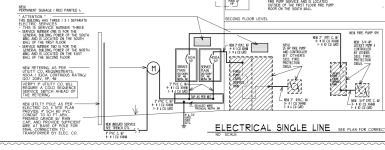
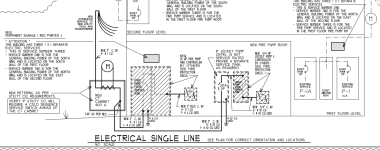
Hello all, I'm a electrical contractor that's doing my first fire pump job. I have never had the opportunity to do one before or even work on one in the past. Attached is the drawing provided to me. I'm concerned about a few things.
1- The service is done in (4-#1 cu wires) to a 400A CT cabinet. I'm assuming its a 125A service feeding the pump controller and jockey pump.?
2- The contractor does not want the floor cut. This means the wiring from the CT will be above ground. I'm thinking the wires will now need to be fused before entering the building. Could some one confirm what size each fused disconnect would be?

I also attached my drawing of how I think it should be done. I appreciate any advice on this as I'm also trying to watch as may videos and read up on this as much as I can. Sometimes you have to just jump right in and learn the hard way.
 

Attachments

  • Screen Shot 2026-02-03 at 2.14.58 PM.png
    Screen Shot 2026-02-03 at 2.14.58 PM.png
    226.9 KB · Views: 23
  • pump room .pdf
    54.6 KB · Views: 10
695.4(B)(2)

We don't know the voltage. Use table 430.251(B) for LRA or spec sheet.

Probably needs to be suitable as service equipment as well. You will have to decide on where you are bonding your neutral to ground. You will probably need to run the GEC outside to the switch.
 
Use table 430.251(B) for LRA
Read the note at the bottom of that table...the use of those numbers is very restricted.
For use only with 430.110, 440.12, 440.41, and 455.8(C).
For this application, you need the locked rotor code letter from the nameplate and you use that along with Table 430.7(B)...or an actual locked rotor current from the nameplate, but I have never seen that.
 
695.4(B)(2)

We don't know the voltage. Use table 430.251(B) for LRA or spec sheet.

Probably needs to be suitable as service equipment as well. You will have to decide on where you are bonding your neutral to ground. You will probably need to run the GEC outside to the switch.
Since the EOR said “alternate using a cold sequence metering, one would assume it’s 480/277, haven’t seen them use that on 208/120, but that doesn’t mean it hasn’t been done.
 
Read the note at the bottom of that table...the use of those numbers is very restricted.

For this application, you need the locked rotor code letter from the nameplate and you use that along with Table 430.7(B)...or an actual locked rotor current from the nameplate, but I have never seen that.

I just always thought it was similar enough. The fire pump contractor usually provides the cut sheet for pump and it has the LRA on it.

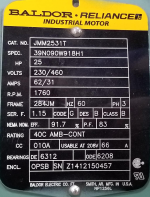
So in this case with the 25HP fire pump, if they were to use the table (assuming it is 480V) they would have 34A FLA and if we used the incorrect table have 183A LRA. If you multiplied the FLA by 6, then it is 204A. And if we choose 200A it might not be enough.

How do you do it? Multiply the FLA by 6 or something else?

Part of the reason I ask is MH's 2020 illustrated guide book, it has a fire pump overcurrent example that gives 183A as LRA. I just assumed it was pulled from the table since it matched. Same HP and 460V as well. Most of the submittals I have received have been really close to that table as well.
 
Recently read in the PECO/Exelon onl line blue book ( greater Philadelphia area ) they will not supply a dedicated service for a fire pump. Three places where I worked each had 13,200 dual service with automatic tie breaker. The fire pumps went thru ATS switches. I know it's a whole different ball game when you have emergency generators. When a switchgear room in a 50 year old building was being updated took several engineers a year to convince Philly L & I electrical unit there was no room to install a dedicated 13,200 to 480 volt transformer for two fire pumps ( one was a booster for roof helicopter landing ). You would think that having dual service and four 2,000 KW Diesel emergency generators would of more then enough for fire pumps.
 
How do you do it? Multiply the FLA by 6 or something else?
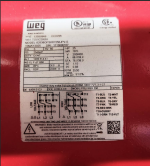
You need the locked rotor code letter from the motor nameplate. 430.7(A)(8) requires the nameplate to have either the locked rotor code letter or the actual locked rotor current. In the example below, the code letter is G. Code letter G in Table 430.7(B) says that the kVA is 5.6 to 6.29 per horsepower. Using the 6.29, that gives us 157.25 kVA for the locked rotor. Assuming the motor is connected at 480 volts the locked rotor current is 157.25/0.480 = 327.6 amps. This substantially different from Table 430.251. Even if you use the low end of the range for code letter G, you get a locked rotor of 291.7 amps.
1770226165785.png
 
Th
Is the fire pump room on an exterior wall? If so, the conduit could be surface mounted outside, and enter the fire pump room without ocp.
The pump controllers are located on an interior wall. It would have to run through the building about 8 feet unfortunately.
 
695.4(B)(2)

We don't know the voltage. Use table 430.251(B) for LRA or spec sheet.

Probably needs to be suitable as service equipment as well. You will have to decide on where you are bonding your neutral to ground. You will probably need to run the GEC outside to the switch.
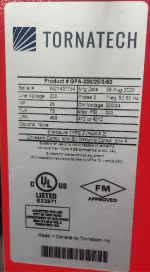
It is a 120/208V 3 phase. I guess the print would have me bond in the fire pump controller and the switch for the jockey pump. Its like it would have (2) mains as there is no main switch before the two pieces of equipment.
 
Th

The pump controllers are located on an interior wall. It would have to run through the building about 8 feet unfortunately.
695.6 is very restrictive for services and feeders.If you are running that service you need to comply with 230.6
 
It is a 120/208V 3 phase. I guess the print would have me bond in the fire pump controller and the switch for the jockey pump. Its like it would have (2) mains as there is no main switch before the two pieces of equipment.
Jockey pump does not have to, and usually does not come off the same feed as the fire pump. It does not even have to be on generator power if the fire pump is, but is good practice. It can come off one of the other services.
 
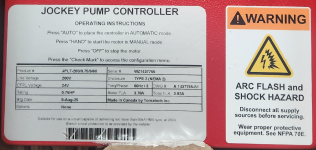
NFPA20 prohibits the jockey pump from being connected to the fire pump controller (or disconnects if any). It appears that the designer took that into account and called for an independent feed from the transformer.
On the few installs where I was involved the jockey pump power came from other building sources,
 
Hello all, I'm a electrical contractor that's doing my first fire pump job. I have never had the opportunity to do one before or even work on one in the past. Attached is the drawing provided to me. I'm concerned about a few things.
1- The service is done in (4-#1 cu wires) to a 400A CT cabinet. I'm assuming its a 125A service feeding the pump controller and jockey pump.?
2- The contractor does not want the floor cut. This means the wiring from the CT will be above ground. I'm thinking the wires will now need to be fused before entering the building. Could some one confirm what size each fused disconnect would be?

I also attached my drawing of how I think it should be done. I appreciate any advice on this, as I'm trying to watch as many videos and read up on this as much as I can, similar to how one might use online quran learning to study independently. Sometimes you just have to jump right in and learn the hard way.
The 4 #1 CU feeding the 400A CT cabinet is for metering purposes, so the actual service to the pump controller is likely smaller, probably around 125A, but you should verify this against the pump and jockey motor nameplate ratings. Since floor cutting isn’t allowed, the conductors will run above ground and will need overcurrent protection before entering the building. Each fused disconnect should be sized based on the pump motor’s full-load amps according to NEC 430.52/430.53, typically slightly above the motor FLA, for example, a 100A motor might use 125A fuses, though you must confirm with the motor and controller specs. Make sure the routing, disconnects, and fusing comply with NEC requirements and are readily accessible.
 
The 4 #1 CU feeding the 400A CT cabinet is for metering purposes, so the actual service to the pump controller is likely smaller, probably around 125A, but you should verify this against the pump and jockey motor nameplate ratings. Since floor cutting isn’t allowed, the conductors will run above ground and will need overcurrent protection before entering the building. Each fused disconnect should be sized based on the pump motor’s full-load amps according to NEC 430.52/430.53, typically slightly above the motor FLA, for example, a 100A motor might use 125A fuses, though you must confirm with the motor and controller specs. Make sure the routing, disconnects, and fusing comply with NEC requirements and are readily accessible.
Incorrect.
For fire pumps the individual source overcurrent protection is sized per 695.4 and is based on the locked rotor current not the FLA
 
Top