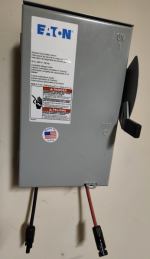
My only objection is the 30V rapid shutdown requirement, Article 690 should not impose any dwelling-unit voltage limits more stringent than those already established the rest of the code like 210.6(A).
IMO Emergency responders should be trained, equipped, and prepared to encounter 120-volt line-to-ground conditions in residential occupancies during fire fighting operations, and setting lower voltage thresholds like 30 volts may create a false sense of safety.
Consider all the hypothetical possibilities the code allows on a roof that could remain energized,
For a fictional illustration say there is a off-grid installation (no service) consisting of a remote cabin located next to a flood-prone river. Because periodic flooding is expected, all power-production and storage equipment is installed above grade on the roof. The owner prefers direct-current systems exclusively and has selected a nominal 120 V DC distribution system in the style of an Edison-era DC installation.
Ten 12-volt deep-cycle batteries are series-connected and housed in a rooftop battery enclosure, as the basis for the nominal 120 V DC battery system. A feeder is run from the rooftop battery enclosure to a listed 120 V DC distribution panel inside the structure using wiring methods permitted for the location. All interior lighting outlets and receptacle outlets are supplied from 120 V DC branch circuits, and the installation complies with 210.6(A).
Due to frequent high winds at the site, a wind generator is installed on the roof and connected through a rectifier and charge controller to maintain the 120 V DC battery bank in compliance with Article 694. To supply domestic water pressure, 120 V DC pump is installed in a detached pumphouse and supplied by a OH 120 V DC feeder routed in accordance with Article 225.
A120 V DC standby generator is also installed on the roof to recharge the 120 V DC battery system. When generator noise becomes objectionable, an Article 692 fuel cell system rated at 120 V DC is added.
We could probably think of more stuff to add..
All conductors are properly protected, and the complete installation is permitted, inspected, and approved and firefighters would encounter all of it energized on the roof.