
You are using an out of date browser. It may not display this or other websites correctly.
You should upgrade or use an alternative browser.
You should upgrade or use an alternative browser.
NM Cable for Solar Install?
- Thread starter MChav841
- Start date


MChav841
Member
- Location
- Blythewood, SC
- Occupation
- IS Security Engineer
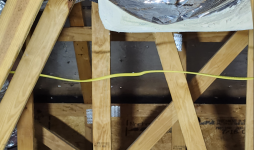
It's definitely 14-2 NM cable.
MChav841
Member
- Location
- Blythewood, SC
- Occupation
- IS Security Engineer
@MChav841 NM is the least of your problems if your feeding 157 volts into one input.
You're right, suemarkp, it is #12.Isnt yellow usually #12? Not that it matters though. And it doesnt appear to be secured every 4 feet either.
Tortuga, the Anker Solix F3800 Plus takes from 11v - 165v. The older F3800 is the unit that can only take up to 60v.
Needless to say, I'm disappointed again. They were supposed to come Saturday (yesterday) to put in the correct wire, but didn't show up.
If your not going to do rapid shutdown I'd still split it into two strings.You're right, suemarkp, it is #12.
Tortuga, the Anker Solix F3800 Plus takes from 11v - 165v. The older F3800 is the unit that can only take up to 60v.
Needless to say, I'm disappointed again. They were supposed to come Saturday (yesterday) to put in the correct wire, but didn't show up.
ggunn
PE (Electrical), NABCEP certified
- Location
- Austin, TX, USA
- Occupation
- Consulting Electrical Engineer - Photovoltaic Systems
What has the number of strings got to do with whether or not RSD is required?If your not going to do rapid shutdown I'd still split it into two strings.
solarken
NABCEP PVIP
- Location
- Hudson, OH, USA
- Occupation
- Solar Design and Installation Professional
Not really, the real issue is that NM cable is not allowed to be used for PV DC circuits inside buildings, as they have to be in metal raceway. My view is NM cable is permitted to be used for microinverter AC circuits that extend from interior spaces into rooftop surface mount J-boxes beneath arrays, like from EZ Solar or Soladeck, or similar. NM cable entering such a surface mount box under an array is not considered an outdoor wet space as far as I am concerned, no different than NM cable entering surface mount boxes for receptacles or lighting on the outside of a home, which exists in every single home that is out there. If it were not a surface mount Jbox, and there were conductors running to the Jbox outdoors in a raceway, that would be considered outdoor wet, in my opinion.From a code standpoint, your concern is 100% valid. 14-2 NM (Romex) is not allowed in outdoor, wet, or rooftop-exposed locations. It’s only permitted in dry indoor spaces, like inside walls or in a dry attic. So the real issue isn’t that it’s a solar system — it’s where the cable is being used.
On the roof and through the roof penetration: you should see PV wire, USE-2 cable, or THHN/THWN-2 in conduit. Once the wiring has entered a dry attic space, transitioning to NM cable can be acceptable. Also, your array is roughly 157V and 13.25A wired in series.
Even though 14 AWG is typically rated for 15A, solar circuits are treated as continuous loads, so code requires a 125% factor. That puts your effective current around 16.6A, which is really pushing (or exceeding) what 14 AWG should be carrying.
Using NM in a dry attic for a short run can be OK, but using NM on the roof or outdoors is not code-compliant. For an array like yours, 12 AWG THHN/THWN-2 or PV wire would be the safer and more correct choice
Would a system whose voltage never exceeds 80 volts not inherently comply with 690.12(B)(2)?What has the number of strings got to do with whether or not RSD is required?
It would. I have seen several inverters over the decades designed for low voltage high current arrays. They never catch on since the fat conductors required eat up all the savings in other areas. The electronics required for the high current switching also limit the inverter power.Would a system whose voltage never exceeds 80 volts not inherently comply with 690.12(B)(2)?
Last edited:
We have seen a few postings of people trying to install portable batteries like they were a permanently installed PV+BESS system. Since the goal here is to put in a super cheap system is it really any surprise that code compliance and quality of components goes out the window? I am at a loss as to why people are surprised with the results.
solarken
NABCEP PVIP
- Location
- Hudson, OH, USA
- Occupation
- Solar Design and Installation Professional
It would satisfy (B)(2) but not (B)(1), not more than 30V outside the array.Would a system whose voltage never exceeds 80 volts not inherently comply with 690.12(B)(2)?
Eddie702
Licensed Electrician
- Location
- Western Massachusetts
- Occupation
- Electrician
Most inspector won't go in an attic unless it has a stairway. Pull down stairs and an attic they usually will not go up.
Ok right not to derail the thread but as a thought experiment, say the OP split into two strings to get under 80 volts and set two fused disconnects at the array boundary.It would satisfy (B)(2) but not (B)(1), not more than 30V outside the array.
After the array disconnect is it just a DC feeder then?
A dwelling is not prohibited from having any number circuits or feeders with 120 VDC 'between conductors' [ 210.6(A) ] that remain energized when a the service (if any) is shut off.
No other system I think of in the NEC has such a restriction.
jaggedben
Senior Member
- Location
- Northern California
- Occupation
- Solar and Energy Storage Installer
Ok right not to derail the thread but as a thought experiment, say the OP split into two strings to get under 80 volts and set two fused disconnects at the array boundary.
After the array disconnect is it just a DC feeder then?
A dwelling is not prohibited from having any number circuits or feeders with 120 VDC 'between conductors' [ 210.6(A) ] that remain energized when a the service (if any) is shut off.
No other system I think of in the NEC has such a restriction.
It's typically going to be hard to put those disconnects at the array boundary and also readily accessible, but leaving that aside...
I think every power source that's additional to a service requires its own shutdown and placarding, (even if it's not always enforced for, say, residential generators).
Once rapid shutdown is initiated in your scenario then the DC feeder is shut down. So the procedure isn't so different here than for other systems.
I think every power source that's additional to a service requires its own shutdown and placarding
I don't think so, not on roofs, and do you think 30V limit is reasonable? I think its ridiculously low,
Say I have twenty old fashioned 6 volt AGM 200Ah telcom batteries on my roof there is no rapid shutdown for that, there just up there energized at 120 DC.
I skimmed over the NEC articles on 'wind generators', and 'fuel cells' (whatever they are) there may be other things and did see anything similar to rapid shutdown,
Even a plain old telephone line is over the rapid shutdown 30V limit at 48VDC, landline phone service is not limited on roofs it used to drape everywhere.
I think there is actually not even a restriction the distance electric service conductors can be run across a roof, say in conduit on unistruct as per 230.6.
I think one of the east coasters on here mentioned utilities actually running 120/240 distribution on insulators attached directly to the back of row homes.
In my hypothetical scenario (based on the op's system) there is no rapid shutdown 'system' the strings are arranged as to never go above 80 volts so they inherently comply.Once rapid shutdown is initiated in your scenario then the DC feeder is shut down. So the procedure isn't so different here than for other systems.
I am just making the case that rapid shutdown should only be required be at over 120V nominal.
Last edited:
jaggedben
Senior Member
- Location
- Northern California
- Occupation
- Solar and Energy Storage Installer
I don't think so, not on roofs, and do you think 30V limit is reasonable? I think its ridiculously low,
Say I have twenty old fashioned 6 volt AGM 200Ah telcom batteries on my roof there is no rapid shutdown for that, there just up there energized at 120 DC.
If you need a portable ladder to reach the roof then it seems like a low probability you can satisfy 480.7(A).
I skimmed over the NEC articles on 'wind generators', and 'fuel cells' (whatever they are) there may be other things and did see anything similar to rapid shutdown,
But they all have disconnecting means requirements to deenergize conductors some distance away, no?
I think what sets solar apart is the possibility of a huge percentage of the surface area on the premises containing high voltage equipment and conductors, and it's hard to argue that's wholly the same situation as these other types of sources.
Even a plain old telephone line is over the rapid shutdown 30V limit at 48VDC, landline phone service is not limited on roofs it used to drape everywhere.
Yeah thats a great point especially with single module open circuit voltages having been over 30V for a while now. I definitely won't defend that 30V limit when you've got 50V limits (or 60V as above) littering the rest of the code.
I think there is actually not even a restriction the distance electric service conductors can be run across a roof, say in conduit on unistruct as per 230.6.
I think one of the east coasters on here mentioned utilities actually running 120/240 distribution on insulators attached directly to the back of row homes.
On that last sentence, yikes, surely that's some legacy situation that's grandfathered. But on the more general point, I think it's difficult to stand behind the argument that a single conduit run is qualitatively the same kind of issue for firefighting operations as a potentially 22,500 sqft solar array, or a residential array covering a majority of a roof surface area.
In my hypothetical scenario (based on the op's system) there is no rapid shutdown 'system' the strings are arranged as to never go above 80 volts so they inherently comply.
I am just making the case that rapid shutdown should only be required be at over 120V nominal.
Yeah, to be clear, I basically agree with you that the requirements are too restrictive. Just playing devil's advocate on some of your points.
MChav841
Member
- Location
- Blythewood, SC
- Occupation
- IS Security Engineer
Here's the latest update. They came back and replaced the NM 12-2 cable with 10-gauge MC cable. The four 440-watt panels are supposed to be wired in series. I tested the voltage where the wires terminate in the garage, and I'm getting 144 volts. When I plug the cable into the Anker Solix F3800 Plus, I'm only getting 364 watts at a maximum. Four 440-watt panels should be producing more than this. Each input on the Anker Solix can handle 11-165v and up to 1,600 watts.
jaggedben
Senior Member
- Location
- Northern California
- Occupation
- Solar and Energy Storage Installer
Well, are the panels getting enough sun? No shade on any of them? Hard to say from here that there's a problem.
I think a forum like https://diysolarforum.com/ might be more appropriate at this point.
I think a forum like https://diysolarforum.com/ might be more appropriate at this point.