Odd multiwire circuit

Status
Not open for further replies.
Re: Odd multiwire circuit

Originally posted by charlie b:
You verify compliance by picking a point on the wall, and measuring the distance between that point and the nearest receptacle in either direction. If you find one within six feet, then that point along the wall is in compliance. Now pick another point along the wall.
Okay, so try this on:
:)
 
Re: Odd multiwire circuit

Originally posted by charlie b:
That is the difference.
Charlie I do appreciate your response and I have read it, thought about it, then I came back and read it again.

As it stands right now I still do not agree but I am going to keep thinking about this. :cool:

Thanks, Bob

[ November 20, 2005, 07:50 AM: Message edited by: iwire ]
 
Re: Odd multiwire circuit

George you sure are a wise guy.
Now for why you would fail my inspection.

I would require a receptacle on that wall. It is not a hall way (nice try) it is wall space and part of the bedroom. 2' or more receptacle required. The door makes no difference.

I am not an inspector so it does not matter but I would install one. This might be one of the most useful receptacles in the room. The other ones may all end up behind furniture. It is great to have one you can actually get at for vacuuming and such. We know how dangerous extension cords are.
 
Re: Odd multiwire circuit

Read 210.52(A)(1) again. My read on it is legal. No space measured along the floor line in that bedroom is more than 6' from a receptacle. :)
 
Re: Odd multiwire circuit

Originally posted by georgestolz:
Read 210.52(A)(1) again. My read on it is legal. No space measured along the floor line in that bedroom is more than 6' from a receptacle. :)
But isn't the rule along the wall, not away from the wall?
 
Re: Odd multiwire circuit

George any space that is broken by a door starts the measuremnet over. What are you getting at?
:confused:

You are required to have a receptacle in your example.
 
Re: Odd multiwire circuit

It's not worded that receptacles shall be placed on every wall. It's worded backwards, with an unexpected result.

(1) Spacing. Receptacles shall be installed so that no point measured horizontally along the floor line in any wall space is more than 1.8 m (6 ft) from a receptacle outlet.
There are two key components of this section:
1.
Think of it as X and Y coordinates, like a map or like a graph. Where X meets Y, there shall be an outlet within 6'.

So, where the floor area meets the wall area is where the official measurement is taken. Personally, I don't like to bend over, so I take my measurement at waist level, trying to keep the tape level while I measure. This is not scientific, and on occasion I goof.

2.
Technically, what this says that where these two planes intersect, there shall be no point that does not have a receptacle within six feet of it.

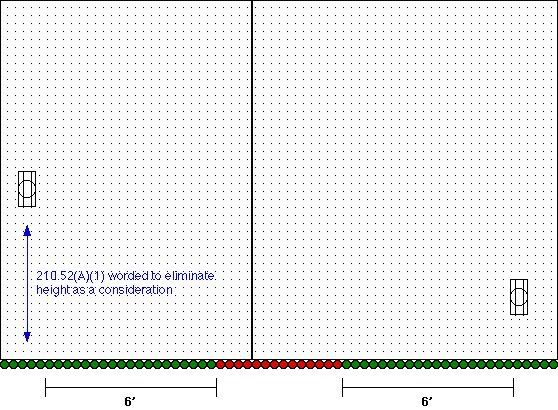
So look at this wall:

Wallspacedrawing.jpg

The green dots are points along this intersection that are in compliance with this rule. The red dots are points that are in violation of the rule.

(A)(1) establishes that you do not leave the floor line to take the measurement: "Measured horizontally" means we can't include the point or two (that are red, immediately next to the green ones) that would be added by lifting the measure off the ground to the receptacle.

Imagine placing a thumbtack with a 6' string on it at a red point, stretching it tight, and laying it on the floor. The string is outside of 6' from the point on the floor where the receptacle is. If you were to lift this string, you could touch the receptacle; it would be within six feet. But this section declares that we measure horizontally, not diagonally.

Essentially, all the receptacles, and all the points they are to serve, are considered at floor level for judging compliance with this section.
---------------------
A basic rule is that on any line, there are an infinute number of points. So to get on your knees and measure from every point to verify that ever point on a wall is in compliance, is a very backwards way of thinking. This is why this concept is kinda odd for us to try to grab onto and use in the field, because it truly is backwards. It seems that the points are in violation, not the receptacles. When we walk into a house, all the points are in violation until we are done laying out.

So we have developed a way to cope with this rule, by creating one of our own: There shall be a receptacle within 6' of every doorway, and there shall be no more than 12' between receptacles. This is an active, practicable rule for us to use when laying out a house, because the real rule is not productive. It's a checker, not a how-to'er.

Our rule of thumb helps us to lay out a house, the real rule is the one that we have to use to confirm that we are legal, and that all wall spaces are served.
---------------------
So, we're inclined to believe (thanks to experience and our little rule of thumb) to believe that a receptacle has to be on the same wall to serve it.

But the code doesn't say that.

Well then, it should have to be within 18" to serve a point on wall space.

Only if it's a floor outlet.

In conclusion, I can't say with conviction that this is the intent of the section, but I can say that this is my most thorough interpretation on what the text says.

 
Re: Odd multiwire circuit

Originally posted by electricmanscott:
George any space that is broken by a door starts the measuremnet over.
All that and I didn't directly address your post, Scott. ;)

Edit to add: 210.52(A)(2) is defining wall spaces, not declaring where the receptacles go. It's adding definitions so you can apply (A)(1).

[ November 20, 2005, 12:00 PM: Message edited by: georgestolz ]
 
Re: Odd multiwire circuit

I like calling this rule the "6-12-12-6" rule, as it describes the measuring.
 
Re: Odd multiwire circuit

George I honestly have no Idea what you are talking about or what your point is.
 
Re: Odd multiwire circuit

How's this: 210.52(A)(1)'s receptacle requirement is related to 210.52(A)(2)'s wall space definition

as

310.15(B)'s derating is to Table 9's conduit fill.

Wall spaces and required receptacles are related, but not the same thing. When you say "the measurement starts over when you get to a door" it is true. But that measurement is for one purpose: to determine if something is a "wall space."

You don't look at table 310.15(B)(2)(a) to see if you're overfilling a conduit.

You shouldn't look at 210.52(A)(1) in a similar fashion.
 
Re: Odd multiwire circuit

I don't know about Scott but that did not clear it up for me. :confused:

Now we have to derate walls?

[ November 20, 2005, 03:42 PM: Message edited by: iwire ]
 
Re: Odd multiwire circuit

BEDROOMRECPLACEMENT.jpg


Between LA and RA is the door leading into the bedroom.
The distance between LA and LB is 36 inches. The distance between RA and RB is 36 inches. The distance between the closet doors is 54 inches. The distance from the bedroom door and the corner of the closet is 90 inches.

By order of the Chief Electrical Inspector of the state of North Carolina there WILL be a receptacle on either side of this bedroom door.
This is also the wording found in 210.52(A)(2)
 
Re: Odd multiwire circuit

The following is a private discussion between Bob and myself, from this morning. More words might spur some insight from others:

Originally posted by iwire:
George careful here.
Does that receptacle serve the wall space on the opposing wall? Any point on that wall is within six feet of a receptacle.
(1) Spacing. Receptacles shall be installed so that no point measured horizontally along the floor line in any wall space is more than 1.8 m (6 ft) from a receptacle outlet.
I have always taken that as measured along the wall not away from the wall.
Funny that they chose the word "in". :eek:

Edit to add picture 2:32 MST

[ November 20, 2005, 04:34 PM: Message edited by: georgestolz ]
 
Re: Odd multiwire circuit

Originally posted by iwire:
Now we have to derate walls?
:D

No, I'm just saying that derating and conduit fill look and sound identical at first glance. So do the wall space definitions of (A)(2) and receptacle spacing requirements of (A)(1).

They are two different ideas that look similar.
 
Re: Odd multiwire circuit

Originally posted by georgestolz:
Originally posted by electricmanscott:
George any space that is broken by a door starts the measuremnet over.
All that and I didn't directly address your post, Scott. ;)

Edit to add: 210.52(A)(2) is defining wall spaces, not declaring where the receptacles go. It's adding definitions so you can apply (A)(1).
George, I think that you are right. As long as your measurement is measured horizontall along the floor line.
I'd never have thought of it but I believe that you are saying that there is no requirement for the wall space to have a receptacle. Just that it be served by one. In your case it's served by one nearby. I doubt if that was the intent, but I'd agree with your interpretation.
 
Re: Odd multiwire circuit

Originally posted by j_erickson:
As long as your measurement is measured horizontall along the floor line.
I'd never have thought of it but I believe that you are saying that there is no requirement for the wall space to have a receptacle. Just that it be served by one. In your case it's served by one nearby. I doubt if that was the intent, but I'd agree with your interpretation.
What he said. :)
 
Re: Odd multiwire circuit

I started typing my last post before George posted the pm, and I'm getting more confused, too the more I read.
 
Status
Not open for further replies.
Top