OKAY...LETS STIR THE POST SOME

Status
Not open for further replies.
Re: OKAY...LETS STIR THE POST SOME

Charlie,
"Because of these interferences, the nearest that I can mount an enclosure to that wall is 29 feet away, against this other wall, so I'll put the disconnect there."
If that is what the section means, then it should read "as near as practicable to the point of entrance of the service conductors". There have been many proposals to improve this wording over the years, but the CMP does not want to change the wording. I don't know why, because it is poor code and should be corrected so that the code users know what the panel really wants.
Don
 
Re: OKAY...LETS STIR THE POST SOME

peter d: i said i got off my soap box on this one. You know if Ca was put on end from NY to the west, it would almost get to Kansas, and just as there are numerous twists across the country to interpreting the code, the same is true in CA. It's just that even californians like to make fun of CA.

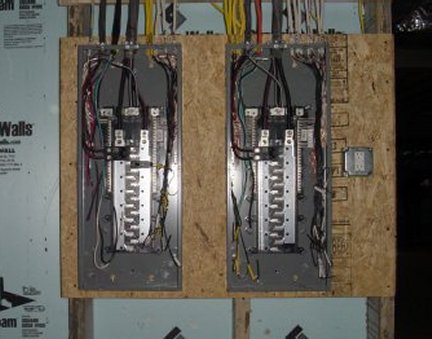
Is that a connector on top of the panel, or is it a chase nipple?

paul :)
 
Re: OKAY...LETS STIR THE POST SOME

You really don't need to know what the CMP wants for this particular requirement. All you need to know is what the AHJ wants. I don't think it is the intent of the CMP to define nearest or mandate a set distance. Similar to the exception to 300.10 and 250.86. What is short? Should the CMP mandate an actual length "short" constitutes? Or should this be left up to the AHJ to determine per specific installation? Isn't a section like 400.11 unecessary? Why 50'? What happens at 55'?

I feel certain sections of the NEC have to be purposely vague to allow for field conditions that cannot be predicted by the code.
 
Re: OKAY...LETS STIR THE POST SOME

Originally posted by apauling:

Is that a connector on top of the panel, or is it a chase nipple?

paul :)
It's a bunch of plastic snap-in NM connectors.

The Arlington NM-841 variety (if you know your part numbers.)

Despite the lousy workmanship of the wiring found throughout these tract homes, they refrained from using a large NM connector or chase nipple in the top of the panel.
 
Re: OKAY...LETS STIR THE POST SOME

Originally posted by pierre:
"Point of Entrance.
Within a building, the point at which the wire or cable emerges from an external wall, from a
concrete floor slab, or from a rigid metal conduit or an intermediate metal conduit grounded to an electrode in accordance
with 800.40(B)."
There it is: use conduit, ground it properly, and you can run the length you want.
 
Re: OKAY...LETS STIR THE POST SOME

Bryan
"I feel certain sections of the NEC have to be purposely vague to allow for field conditions that cannot be predicted by the code."

I think that is a very good statement for a lot of the "suspect" areas of the NEC.

My curiousity for this post is, why do some jurisdictions say it is safe at 5', 8', 15', as we have read here in other posts.
What is the reason we may want to restrict the installation of service conductors in a building???


If it is a safety item, why is 1' any more safe than 15'? Who is to say that that 1' piece is any safer than 15'?

and if the 15' is permitted, I do not see why any restriction should be placed on this installation. :D :D :D

[ October 16, 2005, 07:31 AM: Message edited by: pierre ]
 
Re: OKAY...LETS STIR THE POST SOME

A similarly vague code situation would be "short sections" of raceway not requiring bonding. What is a "short section"? 3'? 5'? 10'? :confused: :confused: :confused:
 
Re: OKAY...LETS STIR THE POST SOME

The NEC is vague intentionally to allow for local authority having jurisdiction the responsibility to interpret these rules. Normally, this interpretations would include or "favor " the accepted wiring practices of their jurisdiction. These interpretations still must assure that the intent of the code is fulfilled. The real problem is that too many AHJ's do not understand the theory behind the rule when making the interpretations. Also pressure from electricians who say we have been doing it that way for thirty years and never had a problem.

Service grounding theory, or ahead of the main grounding, is simple. There is no OCD to operate, thus the term unprotected conductors. In the case of a ground fault in the wiring method, only two things can happen. First, the arcing fault can burn itself into a short circuit and then cause enough current to flow and hopefully operate any OCD on the primary side of the supply transformer. Second, the arcing fault can burn itself clear. Both cases have a very bad word in them, burn. By reducing the distance inside a building a set of unprotected conductors can be run helps reduce the risk if and when a ground fault occurs.

I don't have a problem at my house, my water bede is directly above the service conductors and when they start burning and it gets to the bed, enough water is present to put the fire out! (tongue in cheek)
 
Re: OKAY...LETS STIR THE POST SOME

Despite the lousy workmanship of the wiring found throughout these tract homes, they refrained from using a large NM connector or chase nipple in the top of the panel

Large NM connectors are not rated for all that many pieces of NM.If I remeber correctly the max # is limited to a 1 in connector and 4 / 12 - 2`s. Being that we have to secure NM as it enters a panel the chase nipple is a thing of the past.
Oh it was so much easier when allowed a 2 1/2 in MA slip all hr`s in and make up the panel.
Peter why did you post that statment??? I agree nm is a cheezy wiring method but how can you classify the electricians that wire in NM as doing sub standard work :D
The day you think you know it all is the day you learned nothing :cool:
 
Re: OKAY...LETS STIR THE POST SOME

Ok, here's another one:

electrical1.jpg


Also from SoCal.
 
Re: OKAY...LETS STIR THE POST SOME

Allen, I really have no clue what you're getting at, so I'm not even going to attempt a response.

I'm a residential guy myself, so I don't know why this is such a big deal. We post lots of pictures of violations and lousy workmanship here and on other websites, why is this a problem? :confused:
 
Re: OKAY...LETS STIR THE POST SOME

Pierre, Probably because of the ambiguity of this section and of the extent of the problems caused by a fault occuring before the main OCPD, most AHJ's in this neck of the woods require the OCPD/ disconnect to be on the ouside of the building. Some also require conduit from there to the MLO panel. ;)


________________
Wes Gerrans
Instructor
Northwest Kansas Technical College
Goodland, KS
 
Re: OKAY...LETS STIR THE POST SOME

Originally posted by derf48:
I don't have a problem at my house, my water bede is directly above the service conductors and when they start burning and it gets to the bed, enough water is present to put the fire out! (tongue in cheek)
We've forgotten our high-school physics, haven't we? Any container with intimate content of its contained water will not burn until all ofr the water has evaporated. Remember boiling water in a paper cup?


(I know you know)
 
Re: OKAY...LETS STIR THE POST SOME

Originally posted by allenwayne:
By posting lousy workmanship that insulted 1000`s of guys that do a nice neat job in NM.

We have guys that wire residential and you would swear they iron each and every piece of NM they install.

Just because you came across some butchers or partook in a lousy job then there is no reason to bring it widespread across the board.

There are many qualified electricians out there that wire in NM.
Yeah, what he said!
;)

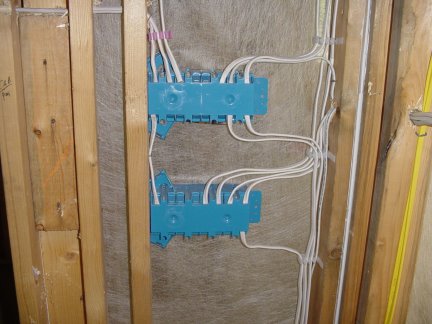
Seriously, I like to think my work is up to par:

panel.jpg


boxes.jpg
 
Status
Not open for further replies.
Top