Older Switch & Receptacle Questions

Merry Christmas
Status
Not open for further replies.

JFletcher

Senior Member
Location
Williamsburg, VA
I have several questions about switches and receptacles from I suppose the early 80s until the late 90s... bear with me here:

1) when / why did they get rid of receptacles that could accept number 12 wire as backstabbed?

2) when did the manufacturers get rid of the little pryouts for backstabbing and make them single-use only?

3) I seem to recall that houses in the late 80s and early 90s had plastic yoke switches made by Slater and others that had no EGC connection. Why were these discontinued? Did they lose their listing, or did NEC rules make them obsolete, requiring all switches to have ground connections?

4) was wrapping or putting two wires under one screw on a receptacle ever acceptable by code? Seen a ton of houses wired in the 50s that have what appear to be original wiring and two wires under one screw... How old is 110.3 B?

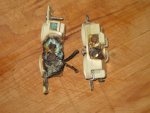
5) I have recently run across a slew of really odd receptacles, including ones that are backstab only with no side screws, ones with side screws only and no backstabs, and even one that had 12 and 14 gauge strippers built into the ears of the yolk... Who would ever use a receptacle yoke to strip wire? What kind of quirky manufacturing gimmicks have you guys run across with receptacles and switches?

6) I hate to ask this last question, however there seems to be much more disdain for backstab receptacles than with push in connectors (Wago, Ideal,etc.) I'm failing to see the difference between the two... is it the way they are manufactured that makes one good and one awful? Which leads to...

7) if backstabbing is such an awful practice, why do all residential switches and receptacles still have backstab slots, and why does the NEC allow it? Are newer designs better than the old ones?
 
With a back stab connection you are constantly moving or putting pressure on the back stabbed wire when plugging/unplugging.

With a Wago (Ideal push-in) the stabbed portion is not part of the receptacle and won't be effected by plugging/unplugging.

The Wago type (push-in) has a greater contact area and IMO, a stronger spring.
 
All you Wago lovers can assuage yourselves all you want claiming you are not as bad as the backstabbers, but I remove wires from both the exact same way, by grabbing the wire and twisting and pulling till the wire comes out. With my eyes closed I couldn't tell the difference between the two..
 
I have several questions about switches and receptacles from I suppose the early 80s until the late 90s... bear with me here:

1) when / why did they get rid of receptacles that could accept number 12 wire as backstabbed?

Not sure what the date was but I believe the manufacturers came to the realization that receptacle stabs (in general) are pure crap connections. They kept them in the design but only for # 14 wire. They're OK for s/p lighting loads but not a good idea for receptacles that are cascaded from one to another.
2) when did the manufacturers get rid of the little pryouts for backstabbing and make them single-use only?
From the ones I've seen they still have them.

3) I seem to recall that houses in the late 80s and early 90s had plastic yoke switches made by Slater and others that had no EGC connection. Why were these discontinued? Did they lose their listing, or did NEC rules make them obsolete, requiring all switches to have ground connections?
I remember Eagle Manufacturing made devices with plastic straps. Never liked them and I can remember at leasat (4) 4-way Eagle made switched failed on one house job.

4) was wrapping or putting two wires under one screw on a receptacle ever acceptable by code? Seen a ton of houses wired in the 50s that have what appear to be original wiring and two wires under one screw... How old is 110.3 B?
Not sure how far back 110.3 B goes but if you think about the logic of putting two wires under one screw it can't possibly be a solid connection that would hold up over time. I think that's something a HO would do and not an electrician worth his/her salt. IMHO

5) I have recently run across a slew of really odd receptacles, including ones that are backstab only with no side screws, ones with side screws only and no backstabs, and even one that had 12 and 14 gauge strippers built into the ears of the yolk... Who would ever use a receptacle yoke to strip wire? What kind of quirky manufacturing gimmicks have you guys run across with receptacles and switches?
I've seen both the backstab only and screw terminal only devices but never the stripper. Can you post a photo ?

6) I hate to ask this last question, however there seems to be much more disdain for backstab receptacles than with push in connectors (Wago, Ideal,etc.) I'm failing to see the difference between the two... is it the way they are manufactured that makes one good and one awful? Which leads to...

7) if backstabbing is such an awful practice, why do all residential switches and receptacles still have backstab slots, and why does the NEC allow it? Are newer designs better than the old ones?
Back-stabs are there for speed of installation. In most cases I run into them where a track builder put up say 100 houses and used the same electrician who gave him the same price for each house and getting all the work. Next time you find one of these devices that were back-stabbed take notice that the screws on the devices were never screwed in - takes more time on the job. IMHO, this poses a problem when devices are ganged together. This method increases the possibility of terminals accidentally touching together when working live (which we're not supposed to do).:thumbsup:
 
All you Wago lovers can assuage yourselves all you want claiming you are not as bad as the backstabbers, but I remove wires from both the exact same way, by grabbing the wire and twisting and pulling till the wire comes out. With my eyes closed I couldn't tell the difference between the two..

Don't think I have ever had a problem with "Gremlins" crawling in the wall and pulling on a Wago!
If I hear of it now I will know it was you!:p

I suppose you could also pull hard enough to pull the wires out of a wire nut. For the record, I've never used anything but the screws on the receptacle. I use Wagos mostly for switches as they take up less room than a wirenut, but will use them on receptacles on occasion.

The best use of a Wago (push-in) is for when there is only an inch or so of wire in a box and you need to extend it. Much easier to use one there than trying to get your hand in there to twist on a wirenut.
 
To the OP, no idea on your questions.

Could it be that a good many of us look down our nose in disdain at things we don’t approve of regardless of how well they work? I haven’t seen a disproportionate amount of failures with stab in, or insulation displacement connections, but I am prejudice against them. I tell myself it reeks of laziness and unprofessionally done work. In the end it is more likely I just find them a pain to do repair work on.

Thought the Square D I-line was the biggest joke I’d ever seen when they first came out. Now I feel quite different about them. Frankly seen less problems with #12 TW solid under a screw head than newer style pressure plate connections. Probably because the older stuff didn’t strip threads as easily. Ditto on twisted solid wire with wire nuts vs stranded with wire nuts.

Heck the old scotcklocks never failed but you have to hate them when you need to take them apart.
 
All you Wago lovers can assuage yourselves all you want claiming you are not as bad as the backstabbers, but I remove wires from both the exact same way, by grabbing the wire and twisting and pulling till the wire comes out. With my eyes closed I couldn't tell the difference between the two..

I am not totally decided yet. I think we need to wait for at least 15 years before we will be able to say whether we see as many Wago failures as we do on backstab receptacles. From what I have seen, there is a good chance there is a better spring to ensure better contact in the Wago's. Plus with Wago's you usually make the conections then tuck the conductors into the box, with a back stab receptacle - especially if you have marginal box fill you put more strain on the connection when you try to push the receptacle into the box. Seen several times where you go to pull a receptacle out of the box and you pull conductors right out of it in the process.

Thought the Square D I-line was the biggest joke I’d ever seen when they first came out.
Were you in the trade when they first came out? Haven't yet found any info on when they came out, but they have to be at least around 55-60 years old now. QO breaker was introduced in 1950's, I believe it wasn't much later before the I-line was developed. I have a plant I work at that has some I line panels that were installed sometime in mid 1960's - don't know exactly when, but talking to guys that worked there back then (some are now deceased)- they are original to the plant and plant is at least mid 1960's when it's original structure was built.
 
The ones with the built in stripper are Eagle/Cooper/Eaton. I tried the stripper once and it was totally worthless. I'm not sure why they still incorporate such a useless feature. Did anyone who makes them actually try them and field test them first? Unlikely. :?
 
I have not noticed problems with wagos so far

but remember backstabbing in the early days, and repairing for years after, when they failed

but always wondered how many of the failed backstabs were because wire not all the way in

I like that wagos are transparent, and always check visually, even when it means breaking out flashlite and reading glasses
 
I thought it was a code change in the '90s and not manufacturer decision?
Not sure if it was code or listing that changed but pretty sure it was one or the other -I'm leaning more toward listing. And yes late 80's or early 90's would have been about when it was.
 
I tried using that yoke stripper once. Didn't work. Have seen the plastic yoke devices in mobile homes and RV's, so I always assumed (without checking) they were unlisted and only used in that capacity. Just a guess, but the 12AWG backstab capacity seem to have disappeared in the 90's or late 80's, and I imagine it was due to the near impossibility of reliably providing both wire size capacity for #12 and sufficient spring pressure for #14.
 
Many years ago used the Slater "Hi-Tech" (plastic yoke) devices to trim a couple of houses, took a quick dislike to the receptacles because I thought they sucked & never used them again, Eagle used to have backwire only receptacles & the 1960's backwire receptacles had a much more robust brass strap to contact the conductors then what is used now. Maybe should open up some junkers I removed from 1964 & 1968 & then post pics....
 
I thought it was a code change in the '90s and not manufacturer decision?
OK, I'll buy that. In either case someone decided it was a crap way of making a connection with # 12 solid wire. Do you remember what the wording was on the Code change - just curious. I don't remember seeing anything regarding receptacle stabs.
 
OK, I'll buy that. In either case someone decided it was a crap way of making a connection with # 12 solid wire. Do you remember what the wording was on the Code change - just curious. I don't remember seeing anything regarding receptacle stabs.

Thinking further it seems unlikely that it was a code change, if so should still be in NEC

What I remember was that it seemed sudden, and I understood that we were not allowed to use 12 on the devices still being sold even though the hole was big enough for #12
 
Status
Not open for further replies.
Top