One Line Diagram - Multi Tenant High Rise

dvcraven0522

Member
Location
St. Louis, Missouri
Occupation
Engineer
I have attached a one line diagram for the above reference project. If anyone has a few moments to offer any comments or noted correction's needing attention it would be greatly appreciated. I understand it a lot to digest. We are now finally getting ready to build this. I was hoping to get another set of engineering eyes.

After looking at this one line for 100 hundred of hours I ten not to see the obvious.

Thank you
Dan Craven
 

Attachments

  • Pages from MANSION HOUSE_ELEC_V22_dcravenCXNTR 02.19.2026 1.pdf
    240 KB · Views: 21
  • Pages from MANSION HOUSE_ELEC_V22_dcravenCXNTR 02.19.2026.pdf
    261.3 KB · Views: 15
E-500
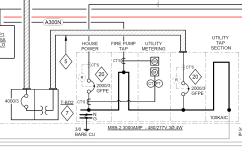
Double check your fire pump service grounding. You are going to need to MBJ in the fire pump service (where the OCPD is). Typical is treating the ground in that conduit like a SSBJ and a GEC piped in to the fire pump service OCPD/ controller. I don't know how that impacts the generator / fire pump controller ATS and the generator's MBJ. It looks like you are marking the generator as separately derived.

The Bus section in MSB-2 that goes to the 4000A bus duct should have the MBJ in my opinion. If your contractor can mount a grounding bus bar and pipe in there that would be better. I have see issues with switchgear manufacturers and section changes that impact the MBJ and GFPE / neutral disconnect links for testing.

On your transformer, I would suggest marking a GEC in the transformer or at the 4000A OCPD. TBD1, TBD-2.

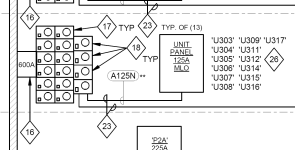
I would also mark your AFC at your 600A bus connections. All too often do I find that detail missing and then all the mains are 22kAiC and the AFC could be 50k or more. P.S. Bus has a SCCR rating for the conductor / equipment enclosure. I remember seeing it undersized on a pull section a while back. You might want to specify that on the plans.

Diamond #16 should say 120/280V 3ph 600A Main with an AFC or SCCR for the contractor to purchase. It is the wrong voltage (240V works but why say a different voltage than what is meant to be present).

Al GECs suck. it cant touch cement. Just mark it as 3/0 copper or per table 250.66 to a copper bus bar mounted in the electrical rooms where the gears and transformers are.

You have a 125A breaker with the conductor label "A225N". Verify conductor size. 2x

You have a 400A breaker with the conductor label "A225N". Verify conductor size.

You have a 225A breaker with a conductor label "A125N". Verify conductor size.

If plumbing is copper, I would suggest specifying a EGC sized to the apartment's feeder OCPD be bonded to the copper pipe at the point of the water's disconnect for that APT. It is a weird thing to specify but if they switch to PEX at the service or between where you bonded it and the apartment, rebond the copper water where it might become energized and that is at each apt individually. Or at a pump room if you have a motorized pump for pressure at certain floors. Also depends on the water heater for each apt. See 250.104(A)(2).

Other than the above, just verify wire sizes and EGC sizes and other OCPD typos.
 
Your utility allows their metering after a customer-owned transformer? Don't think that would fly here.
 
My comment is just for info. On wire schedule 300N (for example) you state to use MI or VItalink. It's also showing 3c500KCM. MI doesn't make that. The largest 3 conductor cable is a #3 AWG. The solution is to go to a single conductor MI, which they do make a 500 KCM, but it holds a free air rating so the ampacity/voltage drop will improve (you can use a smaller wire). Vitalink MC and Lifeline MC also make single conductor which also hold the free air rating as well. Also there are some systems available that use RHW-2 wires in EMT conduits with a 2 hour system rating but do not hold the free air rating. These are generally a better option if the circuit is less than 380 amps, otherwise a single conductor MC is the next best option. Also if the pump controller and pump, etc are all located within the same fire rated room (any fire rating) you can use normal wire (NEC Article 728.5 only requires them outside these rooms, otherwise you could never use MI cable since it must be spliced to normal wire inside them). As for the other emergency circuits (not the fire pump) if it's fully protected by the automatic sprinkler system or contained inside 2 hour rated rooms, or concrete encased, you can use normal wire as well (700.10D). Also when I'm doing designs, I just call out "install per FHIT" since that covers all fire resistive systems and not just a brand name (including fire alarm). It's a catch all.

 
Your utility allows their metering after a customer-owned transformer? Don't think that would fly here.
I agree. I have never seen a utility willing to absorb the losses of a customer's transformer. But there is nothing that prevents a customer from installing their own meters. Submetering has been around just about forever.

Many states allow owners to allocate energy bills among their clients as long as they are not 'profiting' by reselling energy.
 
The solution is to go to a single conductor MI, which they do make a 500 KCM, but it holds a free air rating so the ampacity/voltage drop will improve (you can use a smaller wire).
Depends on where the wire lands. See 110.14(C). You are limited to the 75°C rating of 310.16 for 99% of installs. The issue is how UL determines the termination ampacity. They use 310.16 and 75°C ratings for over 100A (#1 and larger).
 
I agree. I have never seen a utility willing to absorb the losses of a customer's transformer. But there is nothing that prevents a customer from installing their own meters. Submetering has been around just about forever.

Many states allow owners to allocate energy bills among their clients as long as they are not 'profiting' by reselling energy.
Aren't you guys reading this wrong. It looks like the utility goes to the 480 boards, and then to the customer owned transformers. Utility metering doesn't appear to be addressed on this riser.
 
I admit that fire pumps can be a little over my head. Others will educate me if I am wrong. But...
695.6(A)(1) requires both the service wires and the emergency to be either underground or 2 hour rated. I only see the generator wiring noted. Second 695.6(G) prohibits ground fault protection in front of the fire pump wiring.
 
Aren't you guys reading this wrong. It looks like the utility goes to the 480 boards, and then to the customer owned transformers. Utility metering doesn't appear to be addressed on this riser.
Maybe. I didn't bother to review the drawings, I only commented on the concept.
 
Aren't you guys reading this wrong. It looks like the utility goes to the 480 boards, and then to the customer owned transformers. Utility metering doesn't appear to be addressed on this riser.


To me it looks like utility metering is indicated for house and fire pump, but not the busway and transformer.
Then modular meter centers are indicated on upper floors for the individual units. I assumed these are for utility metering.

1774974705391.png

1774974805677.png
 
I greatly appreciate all of your comments. This gives some level of confidence. I will review all of these comments in detail. I have zoom meeting with local utility to discuss the one line and overall design intent.
 
Top