
You are using an out of date browser. It may not display this or other websites correctly.
You should upgrade or use an alternative browser.
You should upgrade or use an alternative browser.
Open delta transformer
- Thread starter jonathan
- Start date
- Status
- Not open for further replies.

Because the primaries of the two transformers are still connected to a 3-phase source.
The open delta transformer connection can be made with only two transformers instead of three. Usually the delta transformer are used in small business where the three phase transformer would be excessive. It should be noted that the output power of an open delta connection is only 87% of the rated power of the two transformers. For example, assume two transformers, each having a capacity of 25 kVA, are connected in an open delta connection. The total output of this connections is 43.5 kVA (50 kVA x 0.87 = 43.5 kVA) .
The voltage and current values of an open delta connection are computed in the same manner as a standard delta-delta connection when three transformers are used. The voltage and current rules for a delta connection must be used when determining line and phase values of voltage current.

I hope this helps.
The open delta transformer connection can be made with only two transformers instead of three. Usually the delta transformer are used in small business where the three phase transformer would be excessive. It should be noted that the output power of an open delta connection is only 87% of the rated power of the two transformers. For example, assume two transformers, each having a capacity of 25 kVA, are connected in an open delta connection. The total output of this connections is 43.5 kVA (50 kVA x 0.87 = 43.5 kVA) .
The voltage and current values of an open delta connection are computed in the same manner as a standard delta-delta connection when three transformers are used. The voltage and current rules for a delta connection must be used when determining line and phase values of voltage current.
I hope this helps.
The answer is "Phasors":
The answer is "Phasors":
It is really about Kirchoff's voltage law which states that the sum of the voltages around a closed loop is zero. That is, the vectorial sum of the two secondary voltages is equal to that of the third side..
The answer is "Phasors":
jonathan said:When two transformers are connected in an open delta configuration, how can three phases be derived from it? It seems that there would only be two phases! Thanks in advance, Jon B.
It is really about Kirchoff's voltage law which states that the sum of the voltages around a closed loop is zero. That is, the vectorial sum of the two secondary voltages is equal to that of the third side..

LarryFine
Master Electrician Electric Contractor Richmond VA
- Location
- Henrico County, VA
- Occupation
- Electrical Contractor
If you connect three Delta-Delta trasnformers in the usual fashion, but open one cormer of the secondary troangle, there should theoretically be zero volta across the gap. With a load applied, that will remain true to the limit of the ability of the transformers' impedances.
By the same token (whatever that means), if you remove a secondary from the triangle, the voltage across those two points of the triangle will remain at the voltage of that missing winding, again limited only by the ability of the remaining transformers' impedances under load.
If that didn't occur, excessive current would flow in the secondary triangle formed by three secondaries when normally connected, even with no load applied. The open Delta configuration can only work when the primaries are connected as two loads on a Y-connected primary.
In other words, the two transformers' primaries are connected to the distribution system's two supplied phases and the system neutral as you would apply two 120v loads to a 208/120v Y panel: each one connected line to neutral, or 'single-ended' to use power-company terms.
480's drawing doesn't show it, but the conductor connected to the point where the two primary windings meet is the system neutral, not the third phase wire. If it were, there would be no advantage to connect it as an open Delta, which is to derive 3-phase power with only two wires.
By the same token (whatever that means), if you remove a secondary from the triangle, the voltage across those two points of the triangle will remain at the voltage of that missing winding, again limited only by the ability of the remaining transformers' impedances under load.
If that didn't occur, excessive current would flow in the secondary triangle formed by three secondaries when normally connected, even with no load applied. The open Delta configuration can only work when the primaries are connected as two loads on a Y-connected primary.
In other words, the two transformers' primaries are connected to the distribution system's two supplied phases and the system neutral as you would apply two 120v loads to a 208/120v Y panel: each one connected line to neutral, or 'single-ended' to use power-company terms.
480's drawing doesn't show it, but the conductor connected to the point where the two primary windings meet is the system neutral, not the third phase wire. If it were, there would be no advantage to connect it as an open Delta, which is to derive 3-phase power with only two wires.
Last edited:

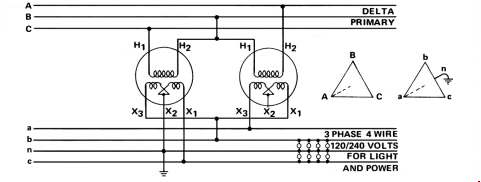
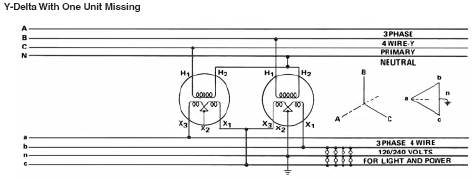
I believe you are confusing "Open Delta" with "Y-Delta with one unit missing".LarryFine said:In other words, the two transformers' primaries are connected to the distribution system's two supplied phases and the system neutral as you would apply two 120v loads to a 208/120v Y panel: each one connected line to neutral, or 'single-ended' to use power-company terms.
480's drawing doesn't show it, but the conductor connected to the point where the two primary windings meet is the system neutral, not the third phase wire. If it were, there would be no advantage to connect it as an open Delta, which is to derive 3-phase power with only two wires.
LarryFine
Master Electrician Electric Contractor Richmond VA
- Location
- Henrico County, VA
- Occupation
- Electrical Contractor
No, because a Delta-Delta missing a transformer would still require all three phases in the primary supply. In order to have more than a single phase with only two ungrounded phase wires, the neutral must be used as a reference in order to obtain the timing difference.rattus said:Larry, I believe the typical open delta is achieved by omitting one transformer from a delta-delta xfrmr bank.
Picture a 208/120v system. With only two hot wires and no neutral, you can only obtain 208v 1-ph. With two hots and the neutral, you can obtain two separate 120v sources with a timing difference of 120 deg. This is how the primary of an open Delta is supplied.
I may have done so in the first two paragraphs of my explanation. If so, I apologize for being less than clear. I started out using Delta-Delta with two transformers to make the point that the Delta secondary can supply three phases with only two transformers.Smart $ said:I believe you are confusing "Open Delta" with "Y-Delta with one unit missing".
Note that in your first drawing, Delta-Delta must use all three phases to supply three phases, while in your second one, Y-Delta, it does not. Every open-Delta system I've seen is supplied by a primary system of only two phases, and uses single-ended primaries.
Last edited:
Either way:
Either way:
Larry,
The open delta can be obtained with a wye-delta or delta-delta configuration. My book gives an example of delta-delta.
You must have two phases on the primaries and that requires 3 wires whether they are connected wye or delta. The neutral is not required to obtain the phase separation.
I must admit that I don't know which system is preferred. .
Either way:
Larry,
The open delta can be obtained with a wye-delta or delta-delta configuration. My book gives an example of delta-delta.
You must have two phases on the primaries and that requires 3 wires whether they are connected wye or delta. The neutral is not required to obtain the phase separation.
I must admit that I don't know which system is preferred. .
Last edited:
LarryFine
Master Electrician Electric Contractor Richmond VA
- Location
- Henrico County, VA
- Occupation
- Electrical Contractor
Absolutely, but Delta-Delta requires three ungrounded phase conductors and no neutral.rattus said:The open delta can be obtained with a wye-delta or delta-delta configuration. My book gives an example of delta-delta.
The neutral is required if you wish to omit the third phase conductor.You must have two phases on the primaries and that requires 3 wires whether they are connected wye or delta. The neutral is not required to obtain the phase separation.
In 480's drawing, reposted here, in order to demonstrate the open-Delta secondary:
If we call the left side the primary and the right side the secondary, and label the secondary conductors first, the wires from top to bottom would be 'b' phase, 'c' phase, and 'a' phase. If the lower secondary, 'a-c', was center-tapped and grounded, that would make 'b' the high leg.
Then, flopping over to the primary, the wires top to bottom would be labeled 'B', 'C', and 'N'. (If this were open-Delta-to-open-Delta, they would be 'B', 'C', and 'A', respectively). The idea is to obtain 3-phase power from two phases, so the system neutral must be the third primary conductor.
Last edited:
It's in The Book!
It's in The Book!
Larry,
You are arguing with "Alternating Current Machines", Puchstein, Lloyd, and Conrad, 1936, Wiley.
Now with a wye primary you must have a neutral, but not with a delta.
Edit: Looks like our posts crossed in the Ethernet! Still requires 3 wires, whatever you call them.
It's in The Book!
Larry,
You are arguing with "Alternating Current Machines", Puchstein, Lloyd, and Conrad, 1936, Wiley.
Now with a wye primary you must have a neutral, but not with a delta.
Edit: Looks like our posts crossed in the Ethernet! Still requires 3 wires, whatever you call them.
Last edited:
LarryFine
Master Electrician Electric Contractor Richmond VA
- Location
- Henrico County, VA
- Occupation
- Electrical Contractor
rattus said:You are arguing with "Alternating Current Machines", Puchstein, Lloyd, and Conrad, 1936, Wiley.
Bring them in on the discussion, then. :grin:
Now with a wye primary you must have a neutral, but not with a delta.
No arguement. I'm looking at it the other way around: in order to not need a third primary conductor (which is the goal), the two primaries must be connected line-to-neutral.
One, perhaps the only advantage is three phase service can be delivered where only two of three distribution primary lines exist. Saves on having to bring the third to that location.rattus said:There must some advantage to using the wye-delta. Anyone know?
LarryFine
Master Electrician Electric Contractor Richmond VA
- Location
- Henrico County, VA
- Occupation
- Electrical Contractor
rattus said:3 wires are required however you do it. There must some advantage to using the wye-delta. Anyone know?
Haven't I been saying that???Smart $ said:One, perhaps the only advantage is three phase service can be delivered where only two of three distribution primary lines exist. Saves on having to bring the third to that location.
I of course mean two ungrounded conductors.LarryFine said:If it were, there would be no advantage to connect it as an open Delta, which is to derive 3-phase power with only two wires.
LarryFine said:In order to have more than a single phase with only two ungrounded phase wires, the neutral must be used as a reference in order to obtain the timing difference.
Note that in your first drawing, Delta-Delta must use all three phases to supply three phases, while in your second one, Y-Delta, it does not. Every open-Delta system I've seen is supplied by a primary system of only two phases, and uses single-ended primaries.
LarryFine said:The neutral is required if you wish to omit the third phase conductor.
The idea is to obtain 3-phase power from two phases, so the system neutral must be the third primary conductor.
LarryFine said:in order to not need a third primary conductor (which is the goal), the two primaries must be connected line-to-neutral.
Last edited:
In distribution speak, it is not called an "Open Delta" configuration. Yes, it amounts to an open delta secondary.LarryFine said:No arguement. I'm looking at it the other way around: in order to not need a third primary conductor (which is the goal), the two primaries must be connected line-to-neutral.
Summary, I think:
Summary, I think:
OK,
It seems to me that a neutral is desired, perhaps required, in distribution systems, therefore the 4-wire wye is used with wye-delta xfrmrs. Then these xfrmrs would be used in most if not all applications, including remote locations where only three wires are brought in to feed an open delta xfrmr bank.
Comments?
Summary, I think:
OK,
It seems to me that a neutral is desired, perhaps required, in distribution systems, therefore the 4-wire wye is used with wye-delta xfrmrs. Then these xfrmrs would be used in most if not all applications, including remote locations where only three wires are brought in to feed an open delta xfrmr bank.
Comments?
LarryFine
Master Electrician Electric Contractor Richmond VA
- Location
- Henrico County, VA
- Occupation
- Electrical Contractor
Okie-dokie. I was at my best friend's house earlier tonight, and we read through this thread together. He is an EE who specializes in HV distribution, but is more into system design and protection, and not so much the hardware.rattus said:Comments?
During our talking, it became apparent that we need to differentiate between the evolution of electrical distribution, and the design of present-day systems. Also, I need to go over some of my posts and clarify a bit, but later on.
Many older systems were in place before the advent of poly-phase power, and most lighting loads preceded most motor loads. When someone wanted to add a 3-ph motor or two to an existing 1-ph system, it was usually done by adding a high-leg to a 240/120v 1-ph service.
In fact, a friend of mine from younger days (I'm 52, for reference) grew up in a house that had a separate 10ga wire run from the pole with the 3-wire service, through the meter and a separate disconnect, and was used solely for the A/C compressor.
This is the epitome of converting 1-ph to 3-ph by adding a second primary phase conductor and one more transformer to an existing system. Yes, the system neutral was already there, so there was no need for a third phase for Delta-Delta, even with only two transformers.
At this point, I want to make it known that this is the perspective from which all of my posts in this thread have been. I understand that there can also be Delta-Delta with two transformers, but this requires all three primary phases, whereas the Y-Delta does not, and only requires two phases and a neutral.
I live in Richmond, VA., (Va being one of the Original 13 Colonies), and an older industrial city, so there is a plethora of older electrical systems around. There are a lot of corner-grounded 240v and 480v systems, and high-leg 240/120v Delta systems still in use.
On the other hand, almost all new 3-phase services are 480/277-Y or 208/120-Y. It's rare to get a Delta service at all for new installations. In fact, let me quote from Dominion Power's Blue Book:
Anyway, my point is that most cases of open Delta are, or rather, were used because the desire was to deliver 3-phase power without having to run the third primary phase. I did not intend to imply that it could only be done that way, just that it usually was.120 CHARACTERISTICS OF ELECTRIC SERVICE
120.1 The Company normally provides the following secondary voltages:
• Single-phase: two-wire 120V
• Single-phase: three-wire 120/240 or 120/208 volts nominal.
• Three-phase: four-wire 120/208 and 277/480 grounded wye
• Three-phase: four-wire 120/240 open delta* volts nominal.
*The service size for this three-phase four-wire 120/240 volt open delta connection shall be limited to 200 amps. An open delta connection can create current and voltage unbalances that could potentially damage the Customer’s equipment. Certain types of equipment, such as motors and refrigeration compressors, are more susceptible to damage with this type of connection. Upgrades of existing delta connections beyond 200 amps are classified as a nonstandard voltage connection
120.2 Requests for secondary voltages not listed above are considered non-standard voltages. These must have prior approval from the Company’s Planning or Design Engineering departments, as well as approval by the Company’s Metering department.
On my last two large jobs, the one I'm doing now (commercial space with upstairs converted into two apartments) and a gutted-and-rebuilt restaurant, both had an open-Delta/high-leg service, both had A/C RTU's as the only 3-phase loads, and both re-used those A/C units.
The original engineered plans for the restaurant called for a new service of (what else?) 208/120v 3-phase Y system, which would have required new transformers as well as replacement of everything from the service mast to the service trough and the 200a 1-ph and 125a 3-ph fusible switches.
Instead, I managed to re-work the service layout so we could keep everything intact through the switches, and only had to run new conduits and conductors from the load terminals of the switches into the panels. We probably could not have even used the RTU's on 208v.
The second job, the commercial/residantial building which I engineered electrically, was gutted and rebuilt, with all-new services, and only the downstairs RTU was being re-used, but again, it will receive the same power it did before, from a small 3-ph ML panel.
I installed a 200a 1-ph MB panel for the rest of the commercial space, simply omitting the high-leg, and a pair of 200a 1-ph disco's to feed the two ML panels in the two apartments. The point is that I used both open-Delta services as intended: large 240/120v 1-ph loads and small 3-ph loads.
Wow, I didn't intend for this to get so long-winded. My apologies to all of you bleary-eyed forum members.

Last edited:

72.5kv
Senior Member
120/208 single phase is pulled off from a 120/208 3 phase service. two phase conductors and a neutral.
From interning at a power company, not all distribution system are Wye, but most are being converted to that. i recieved a publication from IEEE on the history of power distribution engineering, delta distribution was the norm back in the early days
From interning at a power company, not all distribution system are Wye, but most are being converted to that. i recieved a publication from IEEE on the history of power distribution engineering, delta distribution was the norm back in the early days
Last edited:
- Location
- Wisconsin
- Occupation
- PE (Retired) - Power Systems
Terminology means a lot. Most people misstate voltage systems, especially when one of them is 120V.
The standard (IEE/ANSI) is to list 3 phase service with the line-line voltage first followed by the line-neutral voltage, while single phase systems are just the opposite.
120/240 = 1 phase 3 wire, 120V to neutral and 240V line to line
120/208 = 1 phase 3 wire, 120V to neutral and 208V line to line
240/120 = 3 phase 4 wire (high leg), 240V line to line and 120V line to neutral
208Y/120 = 3 phase 4wire, 208 line to line and 120V line to neutral
I try to reduce confusion by including the phases and wires (i.e. 3P4W) although I am not always consistent.
The standard (IEE/ANSI) is to list 3 phase service with the line-line voltage first followed by the line-neutral voltage, while single phase systems are just the opposite.
120/240 = 1 phase 3 wire, 120V to neutral and 240V line to line
120/208 = 1 phase 3 wire, 120V to neutral and 208V line to line
240/120 = 3 phase 4 wire (high leg), 240V line to line and 120V line to neutral
208Y/120 = 3 phase 4wire, 208 line to line and 120V line to neutral
I try to reduce confusion by including the phases and wires (i.e. 3P4W) although I am not always consistent.
- Status
- Not open for further replies.