Oversized fuses with RHW Wire

Tainted

Senior Member
Location
New York
Occupation
Engineer (PE)
There is a building with a meter bank feeding apartments.

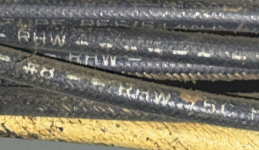
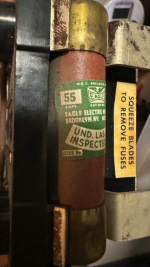
Each apartments is fed by 55 amp fuses with #8awg copper 75C RHW cloth wiring.

Building was built in 1963.

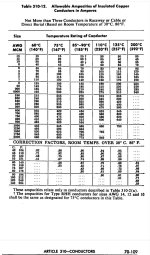
at 75C RHW is rated for 50 amps but why does the apartments have 55 amp fuses? Was there something in the old code that allowed this? The 55 amp fuses is not even a standard fuse size. Does anyone have wire ampacity chart from 1963?
 
Not sure why they would use a 55 amp OCPD. The 1965 NEC lists a 75° C copper conductor ampacity at 45 amps.
 
Not sure why they would use a 55 amp OCPD. The 1965 NEC lists a 75° C copper conductor ampacity at 45 amps.
What if they did adjustment factor to increase capacity due to to colder temps back in the day? Not sure what the temperature difference was in 1963 vs now.
 
#6 TW protected by 55 amp breakers in the meter stacks used to be common in my area. Maybe the original EC cheated and ordered #8 instead of #6 and no one caught it?
Anything can happen. Also #6 TW with 55 amp fuses/breakers is also common in very old NYC buildings.
 
My _guess_ is that rounding rules got changed (eg. round down to the nearest 5A was changed to simply round to the nearest 5A)

When I compare the 1965 table to the present day table, the numbers are either the same, or go up to the next 5A value
.
-Jonathan
 
Did they have something like 310.12 back then?

55 amps * 83% = 45 amps, which makes the 50A #8 wire large enough?
 
Did they have something like 310.12 back then?

55 amps * 83% = 45 amps, which makes the 50A #8 wire large enough?
Yes they had a note on the ampacity table, but like todays it never went below 100A.

I bet if there are fuses in the apartments you'll find some glass 30's where 15's and 20's should be.
My guess is the super got a deal on 55A fuses and when tenants blew the lower rated fuse he 'fixed' the issue by putting in a 55.
 
Top