I have a 800 amp panelboard I'm installing at my facility, and there is a discussion about how to feed it. right now the proposed plans are 4 runs of 3/0 Cu or 6 runs of 1/0 Cu. The question is, is it better to have less parallel runs and if so why. As of right now the 6 1/0 wire seems to be our most cost effective option with 2 sets in 3 raceways. I'm getting push back from some saying its too many wires, and i was just curious on others thoughts and opinions

You are using an out of date browser. It may not display this or other websites correctly.
You should upgrade or use an alternative browser.
You should upgrade or use an alternative browser.
Parallel conductors opinions
- Thread starter ASully
- Start date

- Location
- New Jersey
- Occupation
- Journeyman Electrician (retired)
I would never run 6 sets of #1/0 in parallel due to the extra cost of making more terminations. Are you wanting to only run two raceways?
- Location
- Wisconsin
- Occupation
- PE (Retired) - Power Systems
Is it normal for 800A devices to accept 6 conductors per phase. I think 4 is common.
NEC Inspector
Senior Member
- Location
- Kansas
- Occupation
- Inspector
Wouldn't 3 sets of 250 kcmil fit in the same number of raceways as 6 1/0s, and still work on an 800 amp breaker?
- Location
- New Jersey
- Occupation
- Journeyman Electrician (retired)
So 3 raceways. I would run 3 sets of 300 kcmil. 250's if your calculated load is 765 or less.as far as raceways go we are running 3 2 1/2" regardless, as far as terminations this panel can accept up to 8 conductors per phase.
NEC Inspector
Senior Member
- Location
- Kansas
- Occupation
- Inspector
It's usually the labor that makes the difference on these.

synchro
Senior Member
- Location
- Chicago, IL
- Occupation
- EE
Wouldn't 3 sets of 250 kcmil fit in the same number of raceways as 6 1/0s, and still work on an 800 amp breaker?
And there would be no derating necessary with one set in each raceway
right so labor isn't necessarily a factor its an inhouse facility and we get paid the same no matter how long the project drags out, as far a derating goes everything has been derated appropriately for what we've suggested so far, one of the arguments for the smaller wire is we have to run it overhead and its physically easier even thought we'd have to run more, also we are running this by hand we do not have a tugger at the moment and even if we did we can not fit one in the spaceIt's usually the labor that makes the difference on these.
NEC Inspector
Senior Member
- Location
- Kansas
- Occupation
- Inspector
In that case, 1/0s make a lot more sense. Easier to wrestle, for sure.right so labor isn't necessarily a factor its an inhouse facility and we get paid the same no matter how long the project drags out, as far a derating goes everything has been derated appropriately for what we've suggested so far, one of the arguments for the smaller wire is we have to run it overhead and its physically easier even thought we'd have to run more, also we are running this by hand we do not have a tugger at the moment and even if we did we can not fit one in the space
ggunn
PE (Electrical), NABCEP certified
- Location
- Austin, TX, USA
- Occupation
- Consulting Electrical Engineer - Photovoltaic Systems
Eight is not divisible by three. Doesn't each raceway have to contain the same number of conductors in order to comply with parallel sets rules?as far as raceways go we are running 3 2 1/2" regardless, as far as terminations this panel can accept up to 8 conductors per phase.
- Location
- New Jersey
- Occupation
- Journeyman Electrician (retired)
He's only using 6 sets, two per raceway.Eight is not divisible by three. Doesn't each raceway have to contain the same number of conductors in order to comply with parallel sets rules?
winnie
Senior Member
- Location
- Springfield, MA, USA
- Occupation
- Electric motor research
For the same total ampacity, you generally find larger copper cross section and lower voltage drop with fewer parallel conductors. Basically smaller conductors have better cooling and thus run with higher current density.
Multiple conductors in the same raceway and 'skin effect' for large conductors can mess with the general pattern.
Multiple conductors in the same raceway and 'skin effect' for large conductors can mess with the general pattern.

busman
Senior Member
- Location
- Northern Virginia
- Occupation
- Master Electrician / Electrical Engineer
All,
I didn't Google this; it took about two minutes to make my own chart of MCM versus ampacity. Note the first two are 2/0 and 4/0 converted to MCM. You can pick your point, but above 300 MCM it is pretty clear that the skin effect makes going parallel a much better alternative. So, I agree - 3 sets of 250 MCM.
Mark
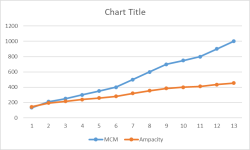
I didn't Google this; it took about two minutes to make my own chart of MCM versus ampacity. Note the first two are 2/0 and 4/0 converted to MCM. You can pick your point, but above 300 MCM it is pretty clear that the skin effect makes going parallel a much better alternative. So, I agree - 3 sets of 250 MCM.
Mark
- Location
- New Jersey
- Occupation
- Journeyman Electrician (retired)
Nice chart. Is there really significant skin effect at 60 hz?All,
I didn't Google this; it took about two minutes to make my own chart of MCM versus ampacity. Note the first two are 2/0 and 4/0 converted to MCM. You can pick your point, but above 300 MCM it is pretty clear that the skin effect makes going parallel a much better alternative. So, I agree - 3 sets of 250 MCM.
Mark
View attachment 2582689
winnie
Senior Member
- Location
- Springfield, MA, USA
- Occupation
- Electric motor research
Skin depth in copper at 60Hz is about 8.5mm, so you just start seeing effects in that 1000 kcmil range.
The chart that @busman is mostly dominated by heat dissipation; heat is generated over the entire cross section of the wire but heat escapes only through the surface of the wire. This means that larger diameter wire requires more copper per amp. But on the other side of the coin, more copper per amp means less voltage drop per amp.
-Jonathan
The chart that @busman is mostly dominated by heat dissipation; heat is generated over the entire cross section of the wire but heat escapes only through the surface of the wire. This means that larger diameter wire requires more copper per amp. But on the other side of the coin, more copper per amp means less voltage drop per amp.
-Jonathan
- Location
- Wisconsin
- Occupation
- PE (Retired) - Power Systems
Yes. It begins to kick in around 300kcmil. The NEC tables take this into account, which can be seen by the non linear ampacity increase.Nice chart. Is there really significant skin effect at 60 hz?
We shouldn't forget about proximity effect which also impacts current flow. This is particularly bad when two conductors of the same phase are lying next to each other.
Strathead
Senior Member
- Location
- Ocala, Florida, USA
- Occupation
- Electrician/Estimator/Project Manager/Superintendent
And sometimes, only three!Is it normal for 800A devices to accept 6 conductors per phase. I think 4 is common.
busman
Senior Member
- Location
- Northern Virginia
- Occupation
- Master Electrician / Electrical Engineer
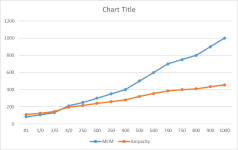
Here is a slightly expanded and better labeled version. Kind of clearly shows where parallel really becomes effective. Also, this is all the 60C column of 310.16.
Mark
Mark
wwhitney
Senior Member
- Location
- Berkeley, CA
- Occupation
- Retired
Seems to me the way to present the data would be to have MCM on the x-axis, rather than equally spacing the points. Then you could omit the blue line, as it would be straight, and we could see how much the orange line deviates from straight.Here is a slightly expanded and better labeled version.
Cheers, Wayne