path lighting not on GFCI circuit

Merry Christmas

jvf

Member
Location
Maui
Occupation
electrician
Hello,

Not sure what forum to post this. I'm installing low voltage landscaping lights for a client. All the low voltage transformers are plug in and say "must be installed on a GFCI circuit". There are some stairways and paths that I consider "critical paths" (no pun intended). I don't want them to go dark in an emergency just because a GFCI tripped and the transformer is dead. So, I say make sure the transformer is isolated per NEC: "These landscape lighting systems may also be used to supply submersible fixtures in fountains. In these cases, the transformer will have an isolated secondary to comply with Sec. 680-5(a), as required in Sec. 680-51(a) Ex. of the NEC. The lighting system will be marked "For Use With Submersible Fixtures Or Submersible Pumps."

I've had inspections where the Inspector waived a GFCI requirement as a "special use" circuit with only a simplex outlet so just the appliance could be plugged in. This won't be inspected but I think I'll get 680-5a listed transformers and plug them into single plugs where needed.

Am I missing anything?

Thanks,
jvf
 
Are you installing these light around a pool? If not 680 does not apply.

Are the receptacles located in areas that GFCI protection is required, such as outside? If so you can't ignore the GFCI requirements because you feel the lights going out is a safety issue. What if the circuit breaker trips? What if the utility power goes off?
 
Sounds like you need some of that new fancy glow in the dark stuff that's used for battery free emergency exit signs.
Your permanent lighting will charge them up, for the rare power outage.

But if the lighting is low voltage why do you even care?
The AC to DC is inside some dry clean utility room: that's not an outdoor outlet. That's not a wet location. Once it's DC
it's not regulated by the NEC nor needs to be.

An isolating transformer seems like creating additional confusion and failure points.
 
Sounds like you need some of that new fancy glow in the dark stuff that's used for battery free emergency exit signs.
Your permanent lighting will charge them up, for the rare power outage.

But if the lighting is low voltage why do you even care?
The AC to DC is inside some dry clean utility room: that's not an outdoor outlet. That's not a wet location. Once it's DC
it's not regulated by the NEC nor needs to be.

An isolating transformer seems like creating additional confusion and failure points.
Landscape lighting is typically AC not DC.

The primary and secondary windings are required to isolated from each other. Article 411 has some basic requirements and Article has requirements if part of or in the area of a swimming pool.

To say once its DC its not regulated by the NEC is a false statement.
 
Sounds like you need some of that new fancy glow in the dark stuff that's used for battery free emergency exit signs.
Your permanent lighting will charge them up, for the rare power outage.
I was using BradyGlo products 20+ years ago.
 
Thanks for everyone's responses. This will be a 12vac system using LED bulbs which, of course, will only be on half the time but it's fine-your brain can't tell the difference. So, since a transformer is needed it might as well be listed as isolating if the right one is available. All these low voltage transformers are isolating in that there are separate windings for the secondary. So, UL requirements to be listed as "isolating" are just a bit more stringent. Of this whole mess (as I told my brother-there ane no plans-just a lot of arm waving) there are two lights submerged in a small fountain at the main entry. By necessity, the transformers will be outside so under normal conditions a GFCI would be required but, as I mentioned, I'm going to consider this to be a special use circuit and I'm not going to plug the stair lights into a GFCI recepticle which a moist seabreeze can trip. I'd rate the chances of a nuisance GFCI trip far higher than a CB trip and there is a 60kW backup generator for (the frequent) power outages. As for the tree lights, who cares, I'll probably GFCI these circuits. We have varying requirements for on/off times so several circuits will be needed. Although I HATE the idea, I'm looking into a couple of "app based" systems to control the various strings.
 
If this is"critical path" is considered an emergency egress path and requires em lighting by another code like a facility with a large occupant load then article 700 might need to be considered, I am not sure what the building codes say on outdoor egress paths these days, probably depends on occupant load.
 
I do installs for temp lighting for example, outdoor tent lighting for weddings or other functions.
Inspectors requires Exit and emerg. lights not to be on a GFI protected circuit. Art. 700
 
Landscape lighting is not critical.

You don't get to choose eliminating GFCI protection is ok for an exterior receptacle because you feel its justified. That is like saying it ok to run speaker wire for a receptacle since you feel its ok.

Most transformer manufactures specify GFCI protection because the transformers are only list to be installed at exterior location, not inside. If the transformer does not have a listing requirement to be installed at an exterior location, install it is a location that does not require GFCI protection for receptacles. Some transformers are listed to have the cord removed and be hardwired so this could remove the GFCI protection listing requirements.
 
Most transformer manufactures specify GFCI protection because the transformers are only list to be installed at exterior location, not inside. If the transformer does not have a listing requirement to be installed at an exterior location, install it is a location that does not require GFCI protection for receptacles. Some transformers are listed to have the cord removed and be hardwired so this could remove the GFCI protection listing requirements.

This.

The OP has design reasons for not GFCI protecting the lighting transformer. And because the transformer itself is isolating, the GFCI protection doesn't extend to the lighting circuit itself anyway.

Thus the solution isn't to ignore GFCI requirements, but to change the transformer installation so GFCIs aren't required.

If you put a non GFCI outlet outside for 'special reasons' someone else will come along and use it for whatever it is they absolutely 'need' to use but it doesn't work on GFCI receptacles.
 
Here is an example of a commonly sold transformer at the irrigation supplies and used by landscapers in my area.
It comes with a cord but is also listed to remove the cord and hardwired.
 
This will be a 12vac system using LED bulbs which, of course, will only be on half the time but it's fine-your brain can't tell the difference.
Theoretically, if you alternate polarities, you should be able to halve the load current.
 
Thanks,
This is what I’m after: using a transformer that can be hardwired and eliminate a GFCI requirement. Even a ‘special use’ simplex can be unplugged and used for whatever which is problematic. I’m looking at the PX link. I remembered today that there is an Intermatic PX50 in the pump room for pool lights. Don’t know if the companies are related.

As for landscape lighting not being critical that is certainly true. But, an outside stone stairway from driveway to building or floor to floor that needs to be traversed in the dark (emergency or not) is a critical path in my view as well as a path from front door to driveway as you try to escape from the fire coming down the hill.
 
Running into a snag (or dimwit "tech support") with FXlighting. They say removing the PX cord voids the warranty. Don't see "listed for removal" in the specs but installation drawing shows a model with 1" conduit going to a Jbox that is protected by a GFCI circuit. So-no plug but everyone seems to want a GFCI.
 
but everyone seems to want a GFCI.
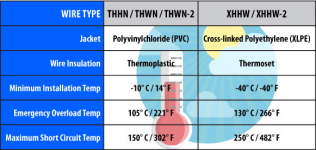
If your worried about insulation resistance holding up in waterlogged PVC use something besides skinny THWN-2, I would specify XHHW to your transformer, you could also use single conductor UF. The GFCI is not going to see past the transformer so I would not be worried about trips.
Over 10 years ago I did a design for a large public outdoor public art garden where you could have a occupant load of over 100 , the path lighting was all 120V and on GFCI breakers from a panelboard, the wire was #10 XHHW copper, the XHHW was chosen to because the insulation holds up better.
1765304886465.png
 
OK, the four horsemen of the apocalypse are cresting the hill so I’ve finalized the design and am ordering parts. XHHW would have been better and we’ve used it on high voltage parts of this project but the contractor supplied THHN so I’m stuck. It should be OK. For starters, reading through everyone’s comments has inspired me to take a creative approach that takes care of the silly fountain in the middle of things with its two submerged puck lights. We have a Jandy Aqualink RS8 control center in the pool room with extra relays because I over-specced the pool guy’s choice. I’m adding a GFCI breaker and feeding two of the relays whose outputs leave the pump room to the main wiring area. One relay jumps on the high voltage highway to the courtyard and on to the pump. The other feeds an Intermatic PX50S transformer listed for submersible fixtures and its output jumps on the low voltage highway to the puck lights. These relays are conveniently controlled by the pool keypad in the living room. The “critical path” lights are fed by an Intermatic PX300S controlled by photocell and hardwired to a 15amp breaker. To control the other six strings, we are using three “app based” Haven Lighting Stratus transformers having two zones each. Haven can combine the transformers and show all six zones on a page for the client. FX, Kichler and other app based transformers I looked at could combine the transformers but only showed them on screen so you have to choose a transformer to see the zones-too confusing for my client. These can be connected to a GFCI circuit. And, if the GFCI ever nuisance trips let’s just say the replacement won’t have that problem.

As you can see, my personal electrical code book written and revised for 50yrs running occasionally diverges from the NEC. However, I void warranties on a weekly basis. If it suits me to yank the power cords out of the Havens and hardwire them that’s how it will go down.

P.S. Back in the day (when the U.S. actually made stuff) I was on the Technical Committee for the UL Standard my company was under. That made the fun all the more interesting as I arm wrestled with the U.L. engineers during our product submittals.
 
Nice update, yeah when I order XHHW copper in small sizes it takes a week or so to get as I am in a smaller area.
post some photos when done sounds like a nice place.
 
Top