
You are using an out of date browser. It may not display this or other websites correctly.
You should upgrade or use an alternative browser.
You should upgrade or use an alternative browser.
Phase voltage of a 3 phase 208 system is 208\1.73 = 120v what about 240 3phase?
- Thread starter mta145
- Start date
- Status
- Not open for further replies.

jumper
Senior Member
- Location
- 3 Hr 2 Min from Winged Horses
240\1.73 = 138 ? how is there a 120\240 3 phase system with a phase voltage of 120?
center tapped delta, with a high leg,.phase B= 208V.

- Location
- New Jersey
- Occupation
- Journeyman Electrician (retired)
Typical 3 phase, 4 wire Delta voltages:
A-B= 240, B-C= 240, A-C= 240
A-N= 120, B-N= 208, C-N= 120
A-B= 240, B-C= 240, A-C= 240
A-N= 120, B-N= 208, C-N= 120
- Location
- Wisconsin
- Occupation
- PE (Retired) - Power Systems
240/120 3phase 4 wire is a delta voltage.
The formula Vln=Vll/1.732 is only used in Wye systems.
The formula Vln=Vll/1.732 is only used in Wye systems.
Last edited:
- Location
- New Jersey
- Occupation
- Journeyman Electrician (retired)
There are 240Y/139 volt systems although they are rather rare.

LarryFine
Master Electrician Electric Contractor Richmond VA
- Location
- Henrico County, VA
- Occupation
- Electrical Contractor
In a 208Y/120v system, three 120v transformer secondaries are connected so one end of all three are joined at one point, which we call the neutral, and we bond to ground.240\1.73 = 138 ? how is there a 120\240 3 phase system with a phase voltage of 120?
The other ends of the three secondaries are the three lines. There is 120 between any line and the neutral, and 208v between any two lines. The connection resembles the letter Y.
In a 3-ph Delta, three 240v transformer secondaries are connected end-to-end-to-end in a triangle, and the three corners are the three points where the lines receive their power.
One secondary can have a center tap (CT), which we call the neutral and bond to ground. The secondary with the two 120v-to-neutral lines and the neutral are exactly, and I mean eaxctly, the same as the 120/240v service in your house.
There is 120v between either of those two line and the neutral, and 240 between any two lines. There is also a higher, and useless, 208v between the neutral and the third line, which is where the term 'high leg' comes from.

glene77is
Senior Member
- Location
- Memphis, TN
Larry,
From your perspective,
what happens if:
(1) the split side of the Delta is loaded heavily,
(2) the high side of the Delta is lightly loaded?
How will these affect the 240/120 voltage?
Rationale:
We are working in a warehouse with 480 Delta, and 240/120 (reading 266/136),
so I am wondering if there is a possible unbalanced loading issue
somewhere in the system.
Thanks,
From your perspective,
what happens if:
(1) the split side of the Delta is loaded heavily,
(2) the high side of the Delta is lightly loaded?
How will these affect the 240/120 voltage?
Rationale:
We are working in a warehouse with 480 Delta, and 240/120 (reading 266/136),
so I am wondering if there is a possible unbalanced loading issue
somewhere in the system.
Thanks,
- Location
- Wisconsin
- Occupation
- PE (Retired) - Power Systems
Larry,
From your perspective,
what happens if:
(1) the split side of the Delta is loaded heavily,
(2) the high side of the Delta is lightly loaded?
How will these affect the 240/120 voltage?
Rationale:
We are working in a warehouse with 480 Delta, and 240/120 (reading 266/136),
so I am wondering if there is a possible unbalanced loading issue
somewhere in the system.
Thanks,
What are all of the 10 different voltages?
Va-b
Vb-c
Vc-a
Va-n
Vb-n
Vc-n
Va-g
Vb-g
Vc-g
Vn-g

Rick Christopherson
Senior Member
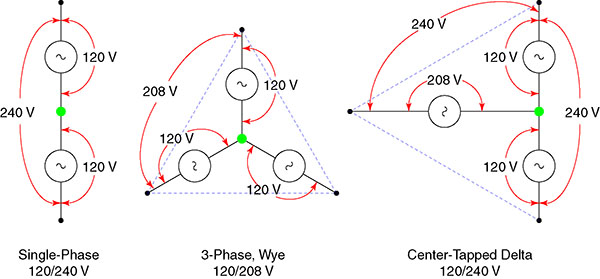
This might help you understand the system types.

richxtlc
Senior Member
- Location
- Tampa Florida
One secondary can have a center tap (CT), which we call the neutral and bond to ground. The secondary with the two 120v-to-neutral lines and the neutral are exactly, and I mean eaxctly, the same as the 120/240v service in your house.
This is not the same as the 120/240v house service. The house service is fed via a single phase to ground voltage not a phase-to-phase as with a center tapped delta. The voltages are 180 degrees apart with a center tap on the secondary.
This is not the same as the 120/240v house service. The house service is fed via a single phase to ground voltage not a phase-to-phase as with a center tapped delta. The voltages are 180 degrees apart with a center tap on the secondary.
- Location
- New Jersey
- Occupation
- Journeyman Electrician (retired)
One secondary can have a center tap (CT), which we call the neutral and bond to ground. The secondary with the two 120v-to-neutral lines and the neutral are exactly, and I mean eaxctly, the same as the 120/240v service in your house.
This is not the same as the 120/240v house service. The house service is fed via a single phase to ground voltage not a phase-to-phase as with a center tapped delta. The voltages are 180 degrees apart with a center tap on the secondary.
If you look at Rick C's third diagram on the right it sure looks like the center tapped portion is the same as a 120/240 volt house service.
glene77is
Senior Member
- Location
- Memphis, TN
What are all of the 10 different voltages?
Va-b Vb-c Vc-a Va-n Vb-n Vc-n Va-g Vb-g Vc-g Vn-g
Jim,
When we return to the warehouse, I'll gather more data.
I normally approach a problem from the conceptual side.
I am thinking that any load unbalance, amongst A and B and C,
can affect the Line to Neutral voltage (on the split side with a neutral).
I am thinking that the affect will be thus:
Given a Split Neutral, any unbalanced load on this side of the Delta
will cause the Neutral reference to shift towards the load, which would be measured as a decrease in the voltage Line to Neutral.
I see my discourse breaking down here.
I am making an analogy to a Single Phase system,
wherein the loss of a neutral causes the two hot legs to float on each other,
with no neutral reference.
I am sure you will suggest that I get out my EL theory books from the 80's and review, which is a point I would accept.
This discussion is getting interesting,
and in order to pursue it further I will have to do some reviewing.
Thanks.
Last edited:
LarryFine
Master Electrician Electric Contractor Richmond VA
- Location
- Henrico County, VA
- Occupation
- Electrical Contractor
Not at all (for the sake of this discussion.) Each secondary maintains its voltage independently.Larry,
From your perspective,
what happens if:
(1) the split side of the Delta is loaded heavily,
(2) the high side of the Delta is lightly loaded?
How will these affect the 240/120 voltage?
Added: By split side, do you mean the open side of an open Delta?
LarryFine
Master Electrician Electric Contractor Richmond VA
- Location
- Henrico County, VA
- Occupation
- Electrical Contractor
The only problem with these images is that they suggest (by use of the alternator symbol) that each source is 120v, and the high leg is a 208v source. They measure that way, but . . .This might help you understand the system types.
LarryFine
Master Electrician Electric Contractor Richmond VA
- Location
- Henrico County, VA
- Occupation
- Electrical Contractor
Sorry, Charlie, but I am correct. The house is not fed by a phase-to-ground source (unless you're in Europe), it is a phase-to-phase source with a center tap.One secondary can have a center tap (CT), which we call the neutral and bond to ground. The secondary with the two 120v-to-neutral lines and the neutral are exactly, and I mean eaxctly, the same as the 120/240v service in your house.
This is not the same as the 120/240v house service. The house service is fed via a single phase to ground voltage not a phase-to-phase as with a center tapped delta. The voltages are 180 degrees apart with a center tap on the secondary.
Where do you think you get both 120v and 240v from? Besides, your second sentence seems to contradict your first sentence, which is actually accurate.
LarryFine
Master Electrician Electric Contractor Richmond VA
- Location
- Henrico County, VA
- Occupation
- Electrical Contractor
Correct. It is, in fact, a mirror image of the left-most diagram.If you look at Rick C's third diagram on the right it sure looks like the center tapped portion is the same as a 120/240 volt house service.
The problem is the image suggests that the 208v is a real secondary.
Rick Christopherson
Senior Member
. . . . . .BUT. . . . . . . . . .Waiting for the other shoe to drop. . . . . . . .The only problem with these images is that they suggest (by use of the alternator symbol) that each source is 120v, and the high leg is a 208v source. They measure that way, but . . .

Come on. It's a diagram. It is intended to help understand systems. Besides, can you prove it is wrong?

broadgage
Senior Member
- Location
- London, England
There are 240Y/139 volt systems although they are rather rare.
Similar systems used to be common in Southern and Central Europe, at the slightly lower voltage of 127/220, most were modernised by changing to 220/380. This avoided having to replace 220 volt appliances when the changeover was made.
Europe has now officialy standardised on 230 volts for domestic use, therefore such systems would now be described as either 133/230 or 230/400, though I doubt that the actual voltage has changed.
Parts of the Middle East still use 127/220.

One secondary can have a center tap (CT), which we call the neutral and bond to ground. The secondary with the two 120v-to-neutral lines and the neutral are exactly, and I mean eaxctly, the same as the 120/240v service in your house.
This is not the same as the 120/240v house service. The house service is fed via a single phase to ground voltage not a phase-to-phase as with a center tapped delta. The voltages are 180 degrees apart with a center tap on the secondary.
If you look at Rick C's third diagram on the right it sure looks like the center tapped portion is the same as a 120/240 volt house service.
Sorry, Charlie, but I am correct. The house is not fed by a phase-to-ground source (unless you're in Europe), it is a phase-to-phase source with a center tap.
Where do you think you get both 120v and 240v from? Besides, your second sentence seems to contradict your first sentence, which is actually accurate.
I get the impression you guys are mixing issues...
A basic 120/240V 1? 3W "house" service IS (or may be) "fed phase-to-ground" (aka Neutral), on the primary side of POTS where distribution is wye type. Yet somewhere in the mix you guys are jumping directly to the secondary configuration and leaving the xfmr out of the picture
LarryFine
Master Electrician Electric Contractor Richmond VA
- Location
- Henrico County, VA
- Occupation
- Electrical Contractor
After Rich's post, I almost brought the primary conficuration into the discussion, but decided not to to minimize confusion. Line-to-line primaries are very rare around here. The only time I've seen them is on older Delta-Delta 3-ph industrial services.I get the impression you guys are mixing issues...
A basic 120/240V 1? 3W "house" service IS (or may be) "fed phase-to-ground" (aka Neutral), on the primary side of POTS where distribution is wye type. Yet somewhere in the mix you guys are jumping directly to the secondary configuration and leaving the xfmr out of the picture
Most services that began as 1-ph had line-to-neutral primaries, which is necessary to obtain an open-Delta service with only two primary lines. Line-to-line primaries would require all three phases even with an open Delta, minimizing the advantages.
- Status
- Not open for further replies.