Pole light grounding

Status
Not open for further replies.

memyselfandI

Senior Member
I know that this subject has been beaten to death but I am in a pinch. I was on a job today following behind a crew who just installed 30ft metal direct burial poles on a job. I looked in the hand hole and noticed no EGC connection. I asked them where the EGC was and they said that they did not need to pull one because the pole is metal and in acts as a ground. ??? WTF? I am curious as to find out what code these guys are referring to. I was under the assumption that all non current carrying metal parts of an electrical system must be joined together by a means acceptable to the NEC and that it must be returned to the source where the branch circuit originated from. Am I wrong to assume this? I have to ask them what article they are referring to so I can read it, but if anyone can help me out with this I would greatly appreciate it. I am pressed for time, my son has a Boy Scout meeting here in about 30 minutes and I need to get this potentially dangerous situation taken care of. I found this after the lights were not working and in one of the poles a wire with 277v on it had been cut in the pole hole below grade and it blew the wire apart.The breaker did NOT trip. IMO there is no short circuit protection and this worries me. Any thoughts people?
 
See section 250.4(A)(5) - especially the last sentence. An EGC must be run with the circuit conductors and be bonded to the non-current carrying metal parts of the pole.
 
You are entirely correct. The guys who installed the poles have blown it, bigtime.

touch.gif

touch2.gif

1100199786_2.jpg


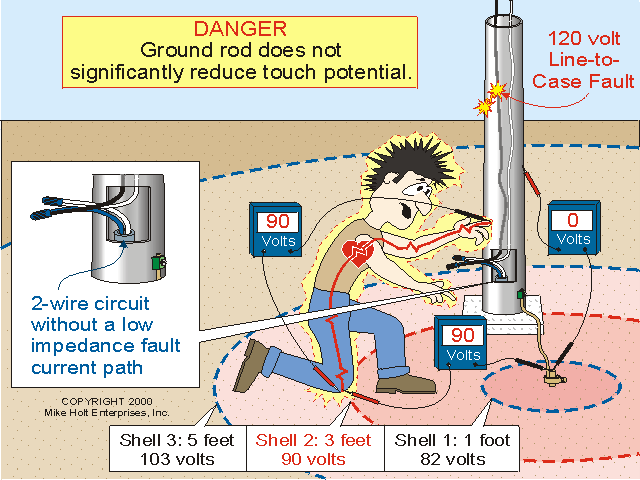
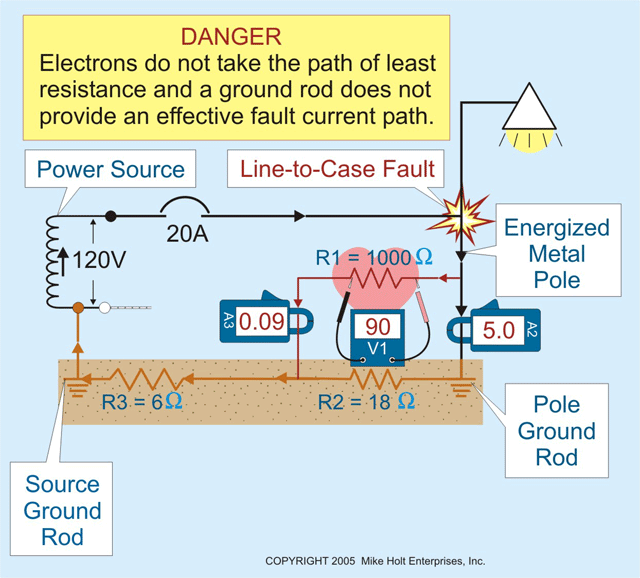
Here are some diagrams from Mike Holt to show them their mistake.

Please, lock out the poles until this is fixed. Someone could easily die from this, it happens all the time.
 
follow up to the post

follow up to the post

I confronted the individual who laid out the job and he said that the enginneer said it was acceptable. I requested the he get in contact with the engineer so that I could get the code article he was using to make his decision. I referred him to Article 250.4(A)(5), which by the way explains everything in great detail, and after reviewing the article he admitted his mistake and the repairs are being made as we speak. I read that code article before posting this and I was beginning to wonder if I was missing some other article that pertains to this situation. I know the code is very specific and if it doesn't say you can't do it, you can (within reason). But if it says you have to do it, then you have to do it.
 
Last edited:
memyselfandI said:
...after reviewing the article he admitted his mistake and the repairs are being made as we speak.
That is music to probably all of our ears.

There are enough energized poles and manhole covers from POCO mistakes, no need for workers under the NEC to be adding to the problem.

Thanks so much for getting the problem fixed and getting back to us.

Sound melodramatic? I'm genuinely overjoyed this worked out. :)
 
Yes, It's good to hear a good result to serious issue. I'm glad you stuck to your guns and reported back to us the positive results...
 
A new twist to this post

A new twist to this post

As I reported earlier that the repairs were being made, an engineer stepped in and said "hold everything". It seems that the engineer is saying that if we drive a ground rod between three poles and bond each of them together, that that would provide a sufficient ground. I fail to see where this would work, not to mention when I asked what if we drive one at each pole and he said that by doing that would be to much and it is not neccessary. I did that just to see what he would say. IMO, by doing what the engineer has suggested only bonds the three poles together, and does not provide a "low impedance" direct path back to the energy source. I contacted the AHJ and I explained my dilema and he said that not only is it in violation of 250.4(A)(5), but also 110.3(b), because there are grounding lugs at the hand hole provided by the manufacturer for the specific purpose of grounding that pole. The AHJ also went on to say that if the engineer was to have a written statement signed by him with his seal, accepting responsibility, then the state by law can accept that. However, the customer does not have to accept it if the customer feels that it is unsafe, and can have it corrected to meet the NEC requirments. Is there anyone out there that has a link to a study or documentation that has researched this situation, and if so, could someone please send me that link. I'm not trying to bust someone's @!#*, but I am trying to correct this problem and make it safe because I am the clown that has to service these poles and I want to see my kids grow up... to be engineers maybe?
 
Last edited:
memyselfandI said:
As I reported earlier that the repairs were being made, an engineer stepped in and said "hold everything". It seems that the engineer is saying that if we drive a ground rod between three poles and bond each of them together, that that would provide a sufficient ground.
Did you show him 250.4(A)(5), as Bryan suggested? I'll put it here for easy reference.

250.4(A)(5) Effective Ground-Fault Current Path. Electrical equipment and wiring and other electrically conductive material likely to become energized shall be installed in a manner that creates a permanent, low-impedance circuit facilitating the operation of the overcurrent device or ground detector for high-impedance grounded systems. It shall be capable of safely carrying the maximum groundfault current likely to be imposed on it from any point on the wiring system where a ground fault may occur to the electrical supply source. The earth shall not be considered as an effective ground-fault current path.

I contacted the AHJ and I explained my dilema and he said that not only is it in violation of 250.4(A)(5), but also 110.3(b), because there are grounding lugs at the hand hole provided by the manufacturer for the specific purpose of grounding that pole.
The lugs are required to be present by 410.15(B)(3), for connection of an equipment grounding conductor per 410.15(B)(5).

We can elect to install and connect grounding electrodes at our option, but the NEC does not require "grounding" (defined in 250.4(A)(1)) at metal poles.

The requirement that the poles be bonded (defined in 250.4(A)(3) is non-negotiable.

The AHJ also went on to say that if the engineer was to have a written statement signed by him with his seal, accepting responsibility, then the state by law can accept that. However, the customer does not have to accept it if the customer feels that it is unsafe, and can have it corrected to meet the NEC requirments.
Then hopefully, the following articles will persuade the AHJ to change their mind, or convince the customer that this installation will eventually result in a death on their property. I question the engineer's motives in this matter.

Ungrounded light pole likely cause in girl's death
An ungrounded light pole is being eyed as the possible cause of death of a 9-year-old girl at a self-serve carwash Monday evening, a city official said Wednesday.
The case was later settled for $1.3 million.

Hot Streets Manholes, Light Poles.
Jodie Lane, a 30-year old dog lover, was electrocuted while walking her dogs on a snowy day last winter.

Miami - Dietrichson v DOT Electrocution settled for $1,265,000
16 year old plaintiff while walking along the South Dade Expressway touched an adjacent light pole and was immediately electrocuted because the internal wiring had come loose and was touching the metal pole from inside.

Boy, 9, Killed when he touches light pole

Here is some information for the engineer from a Mike Holt Archive:
REMINDER: Dangerous voltage from line-to-ground faults cannot be removed by grounding the metal parts to the earth! This is because the earth is a poor conductor whose resistivity is around one billion times that of copper [IEEE Std. 142 Section 2.2.8] and it will not permit sufficient fault current to flow back to the power supply to open the circuit overcurrent protection device from a line-to-ground fault!
 
Last edited:
I did all the things that you had mentioned, referred him to the articles and strongly voiced my objection to his solution. I mentioned that regardless how far the poles are away from the source, he was still required to comply with 250.4(A)(5). If he has to increase the conductor size then so be it. Bottom line is he screwed up royally and his trying to cover his two big hams. The AHJ has said that they were required to pull a EGC. The AHJ IMO is reluctant to accept anything less than what is required by the NEC, but is obligated under state law to accept a statement signed, and stamped with a seal from the engineer stating that it is a safe installation. I think the problem is that the guy is old school, thinking that a ground rod solves every problem in life, and if there is a way to get around the code he will use it. I am going to keep the pressure on and keep dangling that article 250.4(A)(5) in his face. I would never forgive myself if someone was to be injured or killed because I wasn't doing my job as an electrician and pressuring a contractor to comply with a code that they are supposed to comply with in the first place. I will keep everyone posted as to the progress of this situation.
 
I started to type a response to this, but I'm having a hard time keeping my composure. Suffice it to say, I'm shaking my head. Is "engineer" sorta like "God"? Just wondering. I'd really like to see his calculation that shows how the overcurrent protection will ever open the circuit on a ground fault. Simply put, it will not.
 
mdshunk said:
I'd really like to see his calculation that shows how the overcurrent protection will ever open the circuit on a ground fault.

MemyselfandI....have I sent you a copy of "BLES Grounding Presentation.ppt" it's 738KB (small) and requires a MS Powerpoint Viewer? I posted about it in early October '06

The presentation gives very good information on how a CB will NOT open and save your life.

Offer is still open to all....
Send me a PM with your email address and I'll mail it out to you...if you need the PowerPoint Viewer, just ask and I'll send that also.
 
Sounds like the engineer is trying to use the light pole as a welder also (just joking) Even with equipment ground I've seen shorts that didn't trip the breaker, distance should be taken in consideration for current carriers as well as the ground wire. I think the safest application (have only seen this once or twice) would be to put an inline fuse in the hand hole and should be code.
 
willdogyou said:
I think the safest application (have only seen this once or twice) would be to put an inline fuse in the hand hole and should be code.

We do that quite frequently...BUT...that only protects one side of the conductors (load)....should the LINE side become "uninsulated"....
 
"we drive a ground rod between three poles and bond each of them together, that that would provide a sufficient ground. I fail to see where this would work"
The simple answer is if the ground rod resistance is 25 ohms, with an 120 volt enegized pole, the current via the earth will be 4.8 ohms. How will this clear the CPD?
This is one of the most misunderstood areas in street lighting. Thanks to Mike Holt for getting the word out.
George great job on the graphics.
If you engineer on this job has any questions, I'll be glad to call him if you PM me. I'm a member of the IESNA and on the IESNA roadway lighting commitee, we are responsible for RP-8, which is "the" roadway lighting standard.
 
As an engineer, I can tell you from personal experience that we are not gods. I've been quiet, reading with increasing horror how this thread is developing. The engineer defending this installation needs to be brought before his licensing board and have his credentials checked. He is obviously very short on electrical theory (and perhaps even practice.) Old style or new, you can't argue with Ohm's Law!
I applaud memyselfandI for sticking to his guns.
Heinz R.
 
Did anyone actually check that the engineer is indeed registered/licensed and current? Does he have a boss?
 
The engineers on this site better start sticking up for themselves with a round of witty comebacks soon, because that would be at least the third unanswered ribbing this week. :D

On a serious note, the engineers on this site never cease to amaze me with their knowledge.
icon14.gif
 
Could the _grounded_ circuit conductor be bonded to the pole to provide the ground fault current path, eg. as per 250.32(B)(2)?

The lighting pole is a structure, and it is detached from the building containing the supply.

Not advocating this as a good approach, just curious about how acceptable it would be, and what sort of safety implications would be expected.

-Jon
 
winnie said:
Could the _grounded_ circuit conductor be bonded to the pole to provide the ground fault current path, eg. as per 250.32(B)(2)?

IMO that would violate 410.21

410.21 Methods of Grounding.
Luminaires (fixtures) and equipment shall be considered grounded where mechanically connected to an equipment grounding conductor as specified in 250.118 and sized in accordance with 250.122.
 
Status
Not open for further replies.
Top