Pool bond question. Potential difference

The deck was tore up. There was no obvious bond, so they chipped into the old pool shell to get to rebar and installed 4 stingers. Installed a bond loop and tied it all together. Wet niche lights are a thing of the past and new lights are not bonded anymore. Water bonds are the rebar in concrete pools.
Were the 4 rebar points verified for continuity? Prior to running perimeter bond?
Wet niche lights are still used a lot. Thet have not disappeared.

I have not used a wet niche for new builds in over 20 years. Even on renos I remove original wet niche lights and use the nicheless lights, which is what you are referring to. Yes, no bonding or grounding on them.

A water bond is required for all pool types as Little Bill noted per 680
 
That's not correct. Anything bonding the water has to be in direct contact with the water.

(C) Pool Water. Where none of the bonded parts is in direct
connection with the pool water, the pool water shall be in
direct contact with an approved corrosion-resistant conductive
surface that exposes not less than 5800 mm2 (9 in.2) of surface
area to the pool water at all times. The conductive surface shall
be located where it is not exposed to physical damage or
dislodgement during usual pool activities, and it shall be
bonded in accordance with 680.26(B).
From the NFPA:
Where bonded items such as ladders, rails, or underwater luminaires are in direct contact with the pool water and provide the required surface area, it is not necessary to provide another conductive element. A conductive pool shell in contact with the water also satisfies this requirement. However, where the pool does not include any of those items, it is necessary to install a conductive element, such as the type illustrated below within a pool's water filter. These devices have been specifically listed as a means to provide this contact with the pool water.
 
From the NFPA:
Where bonded items such as ladders, rails, or underwater luminaires are in direct contact with the pool water and provide the required surface area, it is not necessary to provide another conductive element. A conductive pool shell in contact with the water also satisfies this requirement. However, where the pool does not include any of those items, it is necessary to install a conductive element, such as the type illustrated below within a pool's water filter. These devices have been specifically listed as a means to provide this contact with the pool water.
How does that apply to this installation? He only bonded the rebar in the deck.
 
How did you measure the voltage, and could it have been a DC measurement?

Is the voltage present with power off?

Are there different equipment terminals ( eg. pool and spa pumps) where you can take a resistance measurement?
Where would the DC voltage be coming from?
 
The OP reported less than 0.668V. That could come from a parasitic electrochemical cell formed by dissimilar metals in contact with pool water.

Not relevant since they got an AC measurement.
If it was a DC voltage from dissimilar metals, will cause a tingling shock feeling?
 
If it was a DC voltage from dissimilar metals, will cause a tingling shock feeling?

9V DC to the tongue certainly causes a shocky feeling. I don't know about 0.7V DC to wet skin. I'm not enough of a connoisseur to describe the difference between DC and AC low voltage shocks. :)
 
9V DC to the tongue certainly causes a shocky feeling. I don't know about 0.7V DC to wet skin. I'm not enough of a connoisseur to describe the difference between DC and AC low voltage shocks. :)
I still remember the joke that my dad played on me with the 9V battery. :D:D
 
Ac voltage. Yes power is off. I'm assuming this is NEV.
The fix for this is for the utility to swap out a one bushing Line - Neutral 7200V to a two bushing L-L transformer.
They do that for farms here.
Call the utility, if they blow you off, tell your customer to lawyer up, utilities need easements to use your customers property and using the earth as a conductor may not be of the legal uses of the easement (if there even is one) attorneys call this "inverse condemnation" or "electrical trespass", POCO's dont fair well in these cases.
When customers have sizable loss of income like the dairy farmers the damages the utilities have to pay are large, lawyers start crawling all over each other to take the case.
If a oil or sewer pipe leaked oil across your property everyone can plainly see the mess, just because electricity is invisible does not give them the right to leak across your property.
 
The fix for this is for the utility to swap out a one bushing Line - Neutral 7200V to a two bushing L-L transformer.
They do that for farms here.
Call the utility, if they blow you off, tell your customer to lawyer up, utilities need easements to use your customers property and using the earth as a conductor may not be of the legal uses of the easement (if there even is one) attorneys call this "inverse condemnation" or "electrical trespass", POCO's dont fair well in these cases.
When customers have sizable loss of income like the dairy farmers the damages the utilities have to pay are large, lawyers start crawling all over each other to take the case.
If a oil or sewer pipe leaked oil across your property everyone can plainly see the mess, just because electricity is invisible does not give them the right to leak across your property.
Stumbled on this watching you tube. Very interesting
 
The fix for this is for the utility to swap out a one bushing Line - Neutral 7200V to a two bushing L-L transformer.
They do that for farms here.
Call the utility, if they blow you off, tell your customer to lawyer up, utilities need easements to use your customers property and using the earth as a conductor may not be of the legal uses of the easement (if there even is one) attorneys call this "inverse condemnation" or "electrical trespass", POCO's dont fair well in these cases.
When customers have sizable loss of income like the dairy farmers the damages the utilities have to pay are large, lawyers start crawling all over each other to take the case.
If a oil or sewer pipe leaked oil across your property everyone can plainly see the mess, just because electricity is invisible does not give them the right to leak across your property.
As far as I've heard 2 bushing tx's are only common in California.
 
Update. I had a pool contractor pull up the decking a redo the bonding to the existing pool. As soon as the first bond touched rebar, the voltage went away.

Thanks for the update. Always nice to see how the story ends.

As far as I've heard 2 bushing tx's are only common in California.

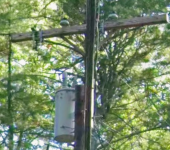
There is a lake that I visit a couple of times a year in central MA. I've noticed that the transformers there have two bushings, and are pretty old. I take this as a sign that someone there was thinking about stray voltage issues years ago.

1766714428683.png
 
The fix for this is for the utility to swap out a one bushing Line - Neutral 7200V to a two bushing L-L transformer.
They do that for farms here.
Call the utility, if they blow you off, tell your customer to lawyer up, utilities need easements to use your customers property and using the earth as a conductor may not be of the legal uses of the easement (if there even is one) attorneys call this "inverse condemnation" or "electrical trespass", POCO's dont fair well in these cases.
When customers have sizable loss of income like the dairy farmers the damages the utilities have to pay are large, lawyers start crawling all over each other to take the case.
If a oil or sewer pipe leaked oil across your property everyone can plainly see the mess, just because electricity is invisible does not give them the right to leak across your property.
Need to have two primary phase conductors present to even consider that. Also can not bond primary and secondary neutrals or you mostly right back where you started if NEV is coming from primary side.
 
Need to have two primary phase conductors present to even consider that.
I did not say it was easy, but it may be the most economical. Like I said lawyers love the cases as they take a generous cut of the settlement.
The one I herd of was a horse boarding facility near here that had inverse condemnation suit for 'electrical trespass' the stray current was in their experts opinion affecting the horses, it was quite some time ago but it was a large place and they had expensive horses there.
They push for jury trials.
The POCO was on the hook for 'loss of use' and 'loss of income', damages are awarded per day and it makes preemptively running that 2nd primary look to be a very affordable option.
There have been other cases with livestock places, dairy farms, as there are not many pools around here.
Inverse condemnation holds utilities responsible for property damage, loss of use, and loss of income if the loss is caused by, or can be attributed to their infrastructure on a easement, regardless of whether or not they cause it negligently.
Those same lawyers are now using that to sue several over wild fires we had that were sparked by overhead power lines, even if the sparks are part of 'normal' operations. The amounts these suits can get to is astronomical.
 
Last edited:
The fix for this is for the utility to swap out a one bushing Line - Neutral 7200V to a two bushing L-L transformer.
They do that for farms here.
Call the utility, if they blow you off, tell your customer to lawyer up, utilities need easements to use your customers property and using the earth as a conductor may not be of the legal uses of the easement (if there even is one) attorneys call this "inverse condemnation" or "electrical trespass", POCO's dont fair well in these cases.
When customers have sizable loss of income like the dairy farmers the damages the utilities have to pay are large, lawyers start crawling all over each other to take the case.
If a oil or sewer pipe leaked oil across your property everyone can plainly see the mess, just because electricity is invisible does not give them the right to leak across your property.
That cost to the utility is can excessive, and it is much more likely that they will install a neutral blocker than to change the transformer, especially where there is only one ungrounded primary conductor at the transformer location.
 
That cost to the utility is can excessive, and it is much more likely that they will install a neutral blocker than to change the transformer, especially where there is only one ungrounded primary conductor at the transformer location.
Yeah I noticed the the horse place here years ago when they ran a 2nd underground concentric cable it was next to a farm I was working on and asked the workers if they were upgrading the horse place to three phase and they explained the situation.
I know you've mentioned the blocker in the past but I have never seen one used here, not that I would know what I am looking at, but I do notice the two bushing transformers quite often at any place with cattle or live stock, so thought I'd mention it in this pool thread as its the same issue.
Probably just come up more with pools because Joe and Jane homeowner are not going to make as much of a stink as the cattle rancher / horse people / land owners, one was a retired judge.
Thats what I see, there are 3 or 4 in my area they all have two bushing transformers or two primary cutouts on the pole simple as that.
 
That cost to the utility is can excessive, and it is much more likely that they will install a neutral blocker than to change the transformer, especially where there is only one ungrounded primary conductor at the transformer location.
That is what they have done here in my past experiences. Around here they are pretty good about sending out people to investigate stray voltages, particularly when a livestock farmer is complaining about stray voltages. There is less dairy farms than there was 40 years ago. pretty much nothing for old school farms with only 4-10 stalls for milking unless it maybe is specialty milk, organic, etc. sold to smaller markets. There isn't the dairy processors in the region there used to be and what larger farms are still in the area do have their milk transported much farther away than they once did. They have to be a pretty large operation to be able to ship that far and to even get interest from the processing facility to accept their product, they ship out in semi tankers and it goes 150-200 miles to be processed where 40 years ago most the local farms had their product picked up by smaller straight trucks and maybe only went 20-40 miles to a processing plant.
 
Information copied from product tech sheet:

RONK’s BLOCKER® is installed between the primary and secondary neutrals of the distribution transformer. These units have a very low impedance (less than .5 ohms) for a voltage level above 12volts. This provides the fault current path in the event of a primary to secondary short in the distribution transformer (with a 7,200 volt primary, the voltage drop of 12 volts across the BLOCKER® is less than 0.2% and is, therefore, negligible).The device operates directly on the principle of magnetic saturation and does not depend on external controls or internal logic signals; therefore, it reacts instantaneously, providing immediate,continuous protection always. In the normal operation of a system, the primary to secondary neutral voltage seldom exceeds several volts (unless, of course, faults, poor grounds, or other problems exist). At these voltage levels, the BLOCKER® has very high impedance, effectively “blocking” the primary neutral voltage and current from entering the secondary neutral circuit and subsequently the system grounding conductors.
 
Top