

PV Swbd help

Location
Fl
Occupation
E
Hello, I am looking for some knowledge on how a PV section in a switchboard works. There is a 4 section switchboard 1 section for Utility CTs, another section for PV circuit breaker, another section for main circuit breaker, and final section for loads. Does the solar input go through the main breaker to the loads or does it go straight to the loads tself? The main breaker is 2500A and the solar breaker is 1200A. There is no battery backup, so what is the intent of the solar? to reduce the utility consumption as thus reduce bill? In this case, is is safe to assume the utility and solar run at the same time? How is this possible and how does it work to make the solar source as the "first" level consumption and then take the from the utility only what it needs?
 
Hello, I am looking for some knowledge on how a PV section in a switchboard works. There is a 4 section switchboard 1 section for Utility CTs, another section for PV circuit breaker, another section for main circuit breaker, and final section for loads. Does the solar input go through the main breaker to the loads or does it go straight to the loads tself? The main breaker is 2500A and the solar breaker is 1200A. There is no battery backup, so what is the intent of the solar? to reduce the utility consumption as thus reduce bill? In this case, is is safe to assume the utility and solar run at the same time? How is this possible and how does it work to make the solar source as the "first" level consumption and then take the from the utility only what it needs?
Your last question is a common one for newcomers to solar. There is no arbitration of where the power from a PV system goes; the grid and the PV system are parallel sources and the loads are all in parallel as well. The current goes to where the loads are, and current cannot go both directions at once in a conductor. The result is that as long as the loads are consuming more than the PV is producing, all of the PV output goes to the loads behind the meter and the grid makes up the difference. If the loads are consuming less than what the PV is producing, the loads consume what they do and the balance of the PV production flows backwards through the meter into the grid.
 
Your last question is a common one for newcomers to solar. There is no arbitration of where the power from a PV system goes; the grid and the PV system are parallel sources and the loads are all in parallel as well. The current goes to where the loads are, and current cannot go both directions at once in a conductor. The result is that as long as the loads are consuming more than the PV is producing, all of the PV output goes to the loads behind the meter and the grid makes up the difference. If the loads are consuming less than what the PV is producing, the loads consume what they do and the balance of the PV production flows backwards through the meter into the grid.
Understood. Is there a sequence or a controller that lets the PV source be used first? And does the PV source also go through the main breaker as well or straight to the loads bypassing the main?
 
Understood. Is there a sequence or a controller that lets the PV source be used first? And does the PV source also go through the main breaker as well or straight to the loads bypassing the main?
Actually you didn't understand. I'll post a drawing in a bit that I hope will clear it up.
 
Understood. Is there a sequence or a controller that lets the PV source be used first? And does the PV source also go through the main breaker as well or straight to the loads bypassing the main?
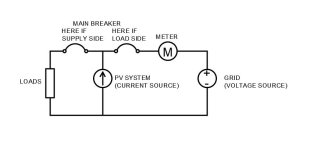
SCHEMATIC.JPG
The PV system is a current source, which means that the current it produces is dependent on the sunlight on the array, not the resistance of the circuit. The voltage is held constant by the grid and the current through the loads is dependent on the resistance of the loads. If the current through the loads is more than the output of the PV system, all the PV output goes to the loads and the remainder is made up from the grid. If the current through the loads is less than the PV output, all the current through the loads is from the PV and the excess from the PV goes to the grid through the meter. Whether the PV output passes through the main breaker or not depends on which side of the main breaker the PV is connected.
 
Hello, I am looking for some knowledge on how a PV section in a switchboard works. There is a 4 section switchboard 1 section for Utility CTs, another section for PV circuit breaker, another section for main circuit breaker, and final section for loads. Does the solar input go through the main breaker to the loads or does it go straight to the loads tself? The main breaker is 2500A and the solar breaker is 1200A.
Without a diagram it's impossible to be sure, but it sounds like this switchboard is being setup for a supply-side PV connection. In that case any solar output to the loads does go through the main breaker. For a new switchboard with PV this is a good setup. It's the simplest and possibly cheapest way to achieve code compliance given the relative size of the PV system to the load, although there are also other ways to do achieve compliance.

There is no battery backup, so what is the intent of the solar? to reduce the utility consumption as thus reduce bill?
Presumably, yes.

In this case, is is safe to assume the utility and solar run at the same time? How is this possible and how does it work to make the solar source as the "first" level consumption and then take the from the utility only what it needs?

To explain it a bit differently than ggunn (though everything he said is correct)...

First the solar inverter syncs its output to the utility voltage waveform. Then it increases the voltage of its output above the utility voltage in order to push out energy, because physics dictates that electrical energy flows from higher voltage to lower voltage with ordinary conductors. (If the voltage goes too high, it will stop for safety reasons.) By doing this it can push out as much energy as it wants, which usually by default is whatever is available from the solar panels based on the sunlight they're getting. That energy flows to the loads in the facility or to other loads on the grid based on how much the loads consume. There's no way to tell which energy is serving loads except by metering in multiple places to see how it adds up.

(Bit of an oversimplification but close enough.)
 
Without a diagram it's impossible to be sure, but it sounds like this switchboard is being setup for a supply-side PV connection. In that case any solar output to the loads does go through the main breaker. For a new switchboard with PV this is a good setup. It's the simplest and possibly cheapest way to achieve code compliance given the relative size of the PV system to the load, although there are also other ways to do achieve compliance.


Presumably, yes.


To explain it a bit differently than ggunn (though everything he said is correct)...

First the solar inverter syncs its output to the utility voltage waveform. Then it increases the voltage of its output above the utility voltage in order to push out energy, because physics dictates that electrical energy flows from higher voltage to lower voltage with ordinary conductors. (If the voltage goes too high, it will stop for safety reasons.) By doing this it can push out as much energy as it wants, which usually by default is whatever is available from the solar panels based on the sunlight they're getting. That energy flows to the loads in the facility or to other loads on the grid based on how much the loads consume. There's no way to tell which energy is serving loads except by metering in multiple places to see how it adds up.

(Bit of an oversimplification but close enough.)
Thanks!! very helpful
 
Top