Question EGC

Status
Not open for further replies.

hhsting

Senior Member
Location
Glen bunie, md, us
Occupation
Junior plan reviewer
Lets say I have 60A overcurrent protection then its Time Current Curve (TCC) starts at 60A. Now lets say I have overload of lets say 65A which according to TCC curve take 10,000 seconds for breaker to open.

Does the equipment grounding conductor carry overload current or it does not?
 
This is such a bizarre question I feel like I'm not understanding the question entirely. You seem to be wondering if excess current is intentionally shunted to ground in an overload situation? The normal circuit carries the excess current which is why it's protected. If the excess current is a result of a fault to ground, then of course the EGC carries the current back to the source. The size of the breaker is a nominal value and can carry some percentage above it's rating.
 
Its 60A break and when you have 65A current flowing or even 70A current how is that normal condition?
Please explain how the "extra" current suddenly ends up on the EGC when the breaker rating is exceeded.
 
This is such a bizarre question I feel like I'm not understanding the question entirely. You seem to be wondering if excess current is intentionally shunted to ground in an overload situation? The normal circuit carries the excess current which is why it's protected. If the excess current is a result of a fault to ground, then of course the EGC carries the current back to the source. The size of the breaker is a nominal value and can carry some percentage above it's rating.

For 60A breaker can you have phase to ground fault that is 65A or 70A?
 
For 60A breaker can you have phase to ground fault that is 65A or 70A?
You can, but that is not an overload of the intended load of the circuit that is a ground fault. It doesn't matter if it is low impedance or not it can still be a ground fault if it is current flowing to an unintended grounded pathway.
 
EGC's by design don't carry any current unless under a fault condition, at which point it carries fault current back to the transformer via the main or system bonding jumper to operate the circuit breaker in the instantaneous part of the trip curve. Overloads do not involve fault current and operate the circuit breaker in the long time overload region of the trip curve via the normal circuit conductors.
 
EGC's by design don't carry any current unless under a fault condition, at which point it carries fault current back to the transformer via the main or system bonding jumper to operate the circuit breaker in the instantaneous part of the trip curve. Overloads do not involve fault current and operate the circuit breaker in the long time overload region of the trip curve via the normal circuit conductors.
Fault current can be at low levels - that is why we have GFCI's for certain situations.

But it is desirable to have low impedance return path so that a direct contact with an ungrounded conductor would result in high level of current flowing to facilitate very quick OCPD response.
 
EGC's by design don't carry any current unless under a fault condition, at which point it carries fault current back to the transformer via the main or system bonding jumper to operate the circuit breaker in the instantaneous part of the trip curve. Overloads do not involve fault current and operate the circuit breaker in the long time overload region of the trip curve via the normal circuit conductors.

So since the 60A breaker TCC curve does not trip the breaker since 10,000 seconds at 65A your saying it is possible to have phase to ground fault at 65A?
 
So since the 60A breaker TCC curve does not trip the breaker since 10,000 seconds at 65A your saying it is possible to have phase to ground fault at 65A?
It would be a fault with 1.846 ohms of resistance in the current path if voltage is 120 volts, which demonstrates why it is important to keep the EGC path at as low of resistance as possible, and why we should increase EGC size in some situations.
 
So since the 60A breaker TCC curve does not trip the breaker since 10,000 seconds at 65A your saying it is possible to have phase to ground fault at 65A?
You simply don't understand how circuit conductors and EGC's work
 
So since the 60A breaker TCC curve does not trip the breaker since 10,000 seconds at 65A your saying it is possible to have phase to ground fault at 65A?
Here's an exercise for you. Take your 60 amp circuit and use all #6 conductors including the EGC. A phase to EGC fault happens 10' from the panel. This means you will have 20' of conductor in the circuit how much current is flowing?

Use Chapter 9 for the conductor resistance
 
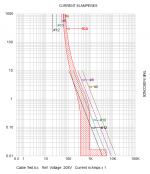
It is possible to get a fairly low level fault, but that is probably an arcing fault and would most likely propagate into a lower resistance fault or self-extinguish, especially at lower voltages. Also, the cables don't instantly fail at their NEC listed ampacity. Refer to the TCC below for a sample of several different THHW conductor size damage curves plotted against a 60A thermal magnetic circuit breaker.

1649858095238.png
 
Lets say I have 60A overcurrent protection then its Time Current Curve (TCC) starts at 60A. Now lets say I have overload of lets say 65A which according to TCC curve take 10,000 seconds for breaker to open.

Does the equipment grounding conductor carry overload current or it does not?
It does not. An EGC carries only ground-fault current. Circuit conductors carry overload currents.

Methinks your question is whether an EGC smaller than circuit conductors is subject to overload.

EGC size is based on duration and current. A fault should open the OCPD before damage occurs.

In theory, a controlled overload current could overload an EGC, but in a small window of current.
 
220413-0951 Edt

hhsting:

You have absolutely no understanding of electrical circuit components or circuits.

What is a simple fuse or simple single phase breaker? It is just a two terminal device with quite a low internal impedance that current passes thru.

This device is designed to conduct electrical current without interruption up to some break point. At that point the device opens, and can never be closed again ( a fuse ), or if it is a breaker it can be reused after tripping by some reset means.

A single phase fuse or breaker is simply a switch in series in a conductor that opens at some current level. It does not matter the path that the current follows after the fuse or breaker, when current exceeds some level, the device opens. That path can be on a neutral, an EGC, another hot wire, a conductor to the moon and back, or any other conductive path, or multiple paths.

.
 
Status
Not open for further replies.
Top