Questionable work performed by licensed electrician

Status
Not open for further replies.
Knowing Mike's forums are intended for professionals, I'm hoping you will provide some leeway since the work in question was performed by a licensed electrician... not the homeowner. Information gleaned from the NEC manual, for an upcoming project, has me on edge over work previously performed. For the professional, the NEC is often fuzzy. To the layman, the NEC is bordering on indecipherable.

Location: San Diego, CA

System as built: Residential electrical upgrade with 200 amp service panel and two 125 amp BR612L125FDP sub-panels (configured for 30 amp service); all manufactured by Cutler Hammer.

Questions:

1) An indoor rated Cutler-Hammer sub-panel was installed outdoor under a covered patio, protected from direct exposure to rain but not moisture. Is this acceptable?
2) The second indoor rated Cutler-Hammer sub-panel was installed in the attic, two feet (to the top circuit breaker) above attic decking, but easily accessible from the pull-down ladder accessing the attic opening. Is this acceptable? What min/max height requirement is typically required?
3) Tandem breakers were installed in the service panel and sub-panels without notched stabs. Is this acceptable?
4) The breakers installed in each panel, service and sub-panels, are not from the same manufacturer; they are a combination of CH and Siemens. Is this acceptable?

Save a life, adopt a pet.
 
Last edited:
I think this will be a good thread :)


From here the work does not sound top dollar. For one that exterior panel would be 3R- thats just what pros do around here, and a CH panel will have CH breakers. Not sure why you would put Siemens in there when you should have a thought out list when ordering at the supply house.
 
Knowing Mike's forums are intended for professionals, I'm hoping you will provide some leeway since the work in question was performed by a licensed electrician... not the homeowner. Information gleaned from the NEC manual, for an upcoming project, has me on edge over work previously performed. For the professional, the NEC is often fuzzy. To the layman, the NEC is bordering on indecipherable.

Location: San Diego, CA

System as built: Residential electrical upgrade with 200 amp service panel and two 125 amp sub-panels (configured for 30 amp service); all manufactured by Cutler Hammer.

Questions:

1) An indoor rated Cutler-Hammer sub-panel was installed outdoor under a covered patio, protected from direct exposure to rain but not moisture. Is this acceptable?
2) The second indoor rated Cutler-Hammer sub-panel was installed in the attic, two feet (to the top circuit breaker) above attic decking, but easily accessible from the pull-down ladder accessing the attic opening. Is this acceptable? What min/max height requirement is typically required?
3) Tandem breakers were installed in the service panel and sub-panels without notched stabs. Is this acceptable?
4) The breakers installed in each panel, service and sub-panels, are not from the same manufacturer; they are a combination of CH and Siemens. Is this acceptable?

Save a life, adopt a pet.

"To the layman, the NEC is bordering on indecipherable."

if you look carefully, we aren't having all that much luck with
it, either....

was the work permitted, and did it get signed off with a final?
a service change should have been permitted in san diego.
let's start there.

as to components. they need to be listed for that application.

as to the acceptability of the rated equipment, here is the
nema classifications, and their descriptions.


Definitions[from NEMA 250-2003]

In Non-Hazardous Locations, the specific enclosure Types, their applications,
and theenvironmental conditions they are designed to protect against, when
completely andproperly installed, are as follows:

Type 1 Enclosures constructed for indoor use to provide a degree of protection
topersonnel against access to hazardous parts and to provide a degree of
protection ofthe equipment inside the enclosure against ingress of solid foreign
objects (falling dirt).

Type 2 Enclosures constructed for indoor use to provide a degree of protection
topersonnel against access to hazardous parts; to provide a degree of protection
of theequipment inside the enclosure against ingress of solid foreign objects
(falling dirt); andto provide a degree of protection with respect to harmful effects
on the equipment dueto the ingress of water (dripping and light splashing).

Type 3 Enclosures constructed for either indoor or outdoor use to provide a degree
of protection to personnel against access to hazardous parts; to provide a degree
ofprotection of the equipment inside the enclosure against ingress of solid foreign
objects(falling dirt and windblown dust); to provide a degree of protection with
respect toharmful effects on the equipment due to the ingress of water
(rain, sleet, snow); and thatwill be undamaged by the external formation of ice
on the enclosure.

Type 3R Enclosures constructed for either indoor or outdoor use to provide a
degreeof protection to personnel against access to hazardous parts; to provide
a degree ofprotection of the equipment inside the enclosure against ingress of
solid foreign objects(falling dirt); to provide a degree of protection with respect
to harmful effects on theequipment due to the ingress of water (rain, sleet, snow);
and that will be undamagedby the external formation of ice on the enclosure.
 
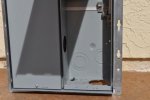
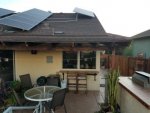
...An indoor rated Cutler-Hammer sub-panel was installed outdoor under a covered patio, protected from direct exposure to rain but not moisture...

Can you be more specific about the covered patio and the relation of the panel to possible moisture? How far under the cover is it?

...Is this acceptable?...

Depends on who is the accepting authority.
 
Normally we could not allow this thread to continue because it violates the forum rules. We moderators will debate that, but for now, I'll leave it alone. I will say this however;

It's all but impossible for us to judge the work and decisions made by another professional (making an assumption here) from afar. There are often numerous extenuating circumstances that may or may not be evident to non-professionals. That said, a couple of these issues do indeed look "troubling" to me; the indoor panel used outdoors and the tandem (apparently) non-CTL breakers in a C-H BR panel.. I too wonder if this was done as a permitted project or a "side job for cash".
 
Unfortunately, the awarding of a licence does not guarantee stellar quality work. Multiple choice test. Even a chimpanzee picking random answers has a chance of getting a passing grade. Working 12,000 hours for someone else is no guarantee either.

It's best to check references, reviews and complaints before hiring any tradesperson.
 
Several violations, redesign immediately

Several violations, redesign immediately

An attic is a confined space, nothing about it is "accessible". NEMA rating must be adhered to without exception. Don't complicate an already convoluted situation. This sounds expensive to fix, but the cost is worth it now so there are not nuisance problems for the next 20 years.
 
An attic is a confined space, nothing about it is "accessible"...

There are many types of spaces that people might call an "attic." You seem to be picturing a specific type that may not apply here. Indeed, he says this panel is at the "access" ladder to this attic. I've also never been in an attic that I would call a "confined space" which is a wholly different can of worms.

Granted, I can't think of a reason to put it there, especially without consultation, but I'm not on the job.
 
There are many types of spaces that people might call an "attic." You seem to be picturing a specific type that may not apply here. Indeed, he says this panel is at the "access" ladder to this attic. I've also never been in an attic that I would call a "confined space" which is a wholly different can of worms.

Granted, I can't think of a reason to put it there, especially without consultation, but I'm not on the job.

agree. An attic is generally not a confined space. The issue that the OP would nave with this is whether the required working clearances are adhered to.
 
Questions:

1) An indoor rated Cutler-Hammer sub-panel was installed outdoor under a covered patio, protected from direct exposure to rain but not moisture. Is this acceptable?
2) The second indoor rated Cutler-Hammer sub-panel was installed in the attic, two feet (to the top circuit breaker) above attic decking, but easily accessible from the pull-down ladder accessing the attic opening. Is this acceptable? What min/max height requirement is typically required?
3) Tandem breakers were installed in the service panel and sub-panels without notched stabs. Is this acceptable?
4) The breakers installed in each panel, service and sub-panels, are not from the same manufacturer; they are a combination of CH and Siemens. Is this acceptable?

Save a life, adopt a pet.
What did the inspector have to say?

Roger
 
the work in question was performed by a licensed electrician... not the homeowner.

Questions:

1) An indoor rated Cutler-Hammer sub-panel was installed outdoor under a covered patio, protected from direct exposure to rain but not moisture. Is this acceptable?
2) The second indoor rated Cutler-Hammer sub-panel was installed in the attic, two feet (to the top circuit breaker) above attic decking, but easily accessible from the pull-down ladder accessing the attic opening. Is this acceptable? What min/max height requirement is typically required?
3) Tandem breakers were installed in the service panel and sub-panels without notched stabs. Is this acceptable?
4) The breakers installed in each panel, service and sub-panels, are not from the same manufacturer; they are a combination of CH and Siemens. Is this acceptable?

Save a life, adopt a pet.

The work doesn't sound very good but probably not dangerous. Then again you may have spotted only the low hanging fruit and didn't notice other code violations.

Years ago a doctor gave me some good advice and said I should always get a second opinion.

That panel in the attic could be OK if there is proper working clearance (legal anyway).

An exterior panel wouldn't cost very much, not sure why they didn't use one.

If I were you I would call another licensed electrician and get a second opinion on work performed. They may spot things you wouldn't normally even notice or things may not be all that bad other than the obvious that you have noticed.
 
..Not sure why you would put Siemens in there when you should have a thought out list when ordering at the supply house.

Lets clarify some definitions, which of course never apply to licensed professionals.
-----------------------------------------------------------------------------------
1) Supply House = Whats can be pulled out of service vehicle, or pants pocket.

2) Inventory = Old breakers from previous panel replacements, spit polished of course.

3) Licensed Contractor = On-site Apprentice, underpaid, but double-billed, with thumb up butt.

4) Permits = Client permits the Dog & Pony show, because it appears functionally industrious.

5) Code Violation = Approved by Exception, Extenuating Circumstance, Training Allowance, or other Mulligan for paying licensees.

6) Inspector = Public-service Artisan. The most creative license of all, who can always make room for new rules.
 
Most of us have worked on HVAC disconnects in attics and in crawl spaces, some that are panels being used as disconnects. I have worked on many panels under houses, even installed transfers for whole house generators under a house. It all depends on the clearance. Most inspectors that I have dealt with consider the attic to be "readily-accessible," what's the difference between a panel in an attic and a panel behind a locked door? As far a different brand breakers in a new panel, sounds like poor planning to me. You know the ole "oops, I miscounted my breakers or didn't pay attention improperly sized breaker on the wrong wire."

Just to be clear, I think a panel in an attic is a TERRIBLE idea, but is it actually illegal is the question.
 
First, and foremost, I thank the moderators for not giving my thread the ax right away and during my unavoidable absence.

In spite of exercising due diligence in selecting a qualified electrician, I still fell victim to a chimpanzee with a monkey for an assistant. This electrical service upgrade was a prerequisite for the installation of a solar energy system. Both, the electrical upgrade and solar system, required permits and inspections; the former had to pass inspection prior to SDG&E re-energizing the service feed. The electrician (I use that term loosely) failed two inspections; a heat-bent pvc underground conduit from the curb to the house and the mutilation of the main service feed panel that required immediate replacement in order to have power restored on a Friday afternoon.

DSC_0003.jpg

T
he sub-panel located in the (typically large) attic is in preparation for HVAC equipment that is being relocated from the garage; furnace, air-handler and electronic filters. In addition to appliance outlets, it will also supply power for the 1,600 watt reptile heater that shall keep the lizard in good spirits. The location at the scuttle hole is convenient for resetting breakers without the need to enter the attic space. Perhaps the electrician installing the furnace will elect to relocate this panel if he sees any code violations. Thanks to the definitions provided by “ramsy”, I further researched equipment and found the Siemen’s P1224L1125CU panel more than suitable for both locations. They will also accept tandem breakers… of like manufacturer, of course.

The inspectors sympathized with my predicament and hastened the process by making repeated trips to ease my pain. As for singing off on the sub-panels, well, a nod is as good as a wink to a blind chimpanzee.

Can you be more specific about the covered patio and the relation of the panel to possible moisture? How far under the cover is it?


20171208_064945.jpg

It's been a pleasure and I thank one and all for the education.
 
Last edited:
The panel on the covered porch - if located in a spot that will never get rained on.... kind of sort of nothing wrong with a NEMA 1 enclosure. Where does "outside" end in such a situation? Put a N1 panel "indoors" but next to a window - it may still get wet if window is left open. 3R protects against falling liquid, but that is about all it does over N1. 3R is provided with "drain holes" as they do anticipate there will be condensation that develops within.

The attic with a permanent stairway (even a pull down stairway) is considered readily accessible. You must still have 110.26 clearances in front of the panel though. Standing on the stairway when accessing the panel probably means you don't have those clearances. 110.26 does have minimum height clearances also, you did not mention how high clearances are in said attic. There is no minimum height for a panelboard, but really low is generally not so pleasant to work on.
 
First, and foremost, I thank the moderators for not giving my thread the ax right away and during my unavoidable absence.

In spite of exercising due diligence in selecting a qualified electrician, I still fell victim to a chimpanzee with a monkey for an assistant.
If I were a chimpanzee I would feel insulted. :D
 
Status
Not open for further replies.
Top