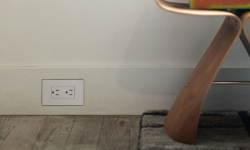
Recommended duplex receptacle depth for a receptacle that will be recessed in a wood baseboard

Cartoon1

Senior Member
Location
Florida
Occupation
Electrical Engineer
Hello!

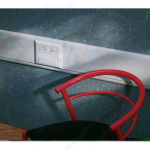
I have a situation where they want to add a few outlets to a wall. Unfortunately that wall is a cmu wall with plaster finish. The Architect is suggesting to add a 1-1/4" deep outlet boxes in a new wood baseboard, and mount the receptacle horizontally something similar to the attached picture. He wants outlets recessed. The conduits or MC cable will come from the bottom, because that is where they run all the electrical pathway for this building.

They need 4 single duplex receptacles that will share the same circuit, spaced about 2 feet apart.
I do not think 1-1/4" depth outlet box will be sufficient. In this case i believe my biggest box would require 18.0 cubic inches. Typically standard outlet boxes are about 2.5" depth. Is a 4"L by 4"W by 1.5"D CU IN is sufficient, but the depth to run wires seems a bit tough to work with.

Question 1: Is a 4"L by 4"W by 1.5"D box behind every single duplex receptacle work in a new wood basebooard? or the depth for wiring is tough?
Question 2: Doesn't the outlet need to be height 15" from the floor since this building will fall under B3 commercial type for reach range under some ADA commercial code? I understand the NEC has not height requirements. So how does installing outlets in a wood baseboard so low work?

Thank you, all suggestions appreciated.
 

Attachments

  • Flush.png
    Flush.png
    306.9 KB · Views: 9
You could use a 4x4 box with a mud ring. I would choose an adjustable type mud ring since it can be fine tuned to be flush with the finish. If ADA rules apply then the box may be too low. The architect should be able to tell you the answer to that.
 
Are ADA requirements being enforced on this particular job?

You are asking about using a 4” square box with a single gang mud ring???

Since the receptacles are only 2’ apart run a single cable to each box then to a j box and terminate them there.
 
Are ADA requirements being enforced on this particular job?

You are asking about using a 4” square box with a single gang mud ring???

Since the receptacles are only 2’ apart run a single cable to each box then to a j box and terminate them there.
My thought assumes there’s a crawl space or basement to junction in. My bad if there’s not.
 
The Architect is suggesting to add a 1-1/4" deep outlet boxes in a new wood baseboard,
If he's referring to a device box then it's not going to work due to box fill and the fact that T314.16(A) mentions 1½" deep as the smallest standard size for a device box. Not sure what type of 1¼" deep box he's actually referring to. I've seen boxes that are only 15/16" deep but not sure that they're code compliant with a device.
 
Ok, you want to install a receptacle in the limited space of the wood and the plaster, without penetrating the CMU. So you have a depth of 1-1/4" to work with? This is a solid CMU wall with plaster finish, not plasterboard furred out from the CMU?

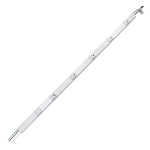
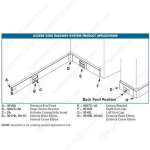
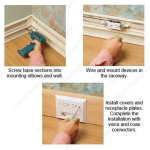
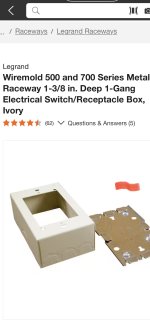
The smallest wiremold device box is 11.9 cubic inches, just barely enough to hold a single receptacle and 14ga wire. I know you said you wanted recessed, but since this is new molding you can install the wiremold recessed into the wood, with wiremold raceway buried in the molding and going down below.

It will be a squeeze any way you do things.
 
Ok, you want to install a receptacle in the limited space of the wood and the plaster, without penetrating the CMU. So you have a depth of 1-1/4" to work with? This is a solid CMU wall with plaster finish, not plasterboard furred out from the CMU?

The smallest wiremold device box is 11.9 cubic inches, just barely enough to hold a single receptacle and 14ga wire. I know you said you wanted recessed, but since this is new molding you can install the wiremold recessed into the wood, with wiremold raceway buried in the molding and going down below.

It will be a squeeze any way you do things.
I’ve done that before, wiremold boxes are slightly wider than a standard box, so you gain some cubic inches there. They will stick out slightly, but a midi or jumbo cover has enough lip to cover the gap.1 3/8” box is 18 cubic inches.
 
If he's referring to a device box then it's not going to work due to box fill and the fact that T314.16(A) mentions 1½" deep as the smallest standard size for a device box. Not sure what type of 1¼" deep box he's actually referring to. I've seen boxes that are only 15/16" deep but not sure that they're code compliant with a device.
Yes, per 314.16A. I don't see how 1 1/4" will be compliant. 1 1/2D" can work but it would need to be bigger width,etc. It needs to be NEC compliant, 15/16 will not work.
 
Ok, you want to install a receptacle in the limited space of the wood and the plaster, without penetrating the CMU. So you have a depth of 1-1/4" to work with? This is a solid CMU wall with plaster finish, not plasterboard furred out from the CMU?

The smallest wiremold device box is 11.9 cubic inches, just barely enough to hold a single receptacle and 14ga wire. I know you said you wanted recessed, but since this is new molding you can install the wiremold recessed into the wood, with wiremold raceway buried in the molding and going down below.

It will be a squeeze any way you do things.
Yes. This will be with at least #12 wire. So it would have to be bigger depth wiremold? if we go with that.
 
Yes. This will be with at least #12 wire. So it would have to be bigger depth wiremold? if we go with that.

You would be heavily constrained. If you have an 'end of run' installation, you have 2 circuit wires, 1 ground wire, and 2 units used by the receptacle. You would need 10 cubic inches for #14 wire, 12.5 cubic inches for #12 wire. The smallest wiremold boxes won't work for #12 wire, nor for daisy-chaining (2 wires in, 2 out to the next receptacle).

And that isn't counting a 'clamp', because the raceway/box arrangement doesn't appear to have a clamp that takes up space. If there is one, then there is no way to use those boxes at all.
 
This will work, you don’t have to go with the smallest. 18 cubic inches, the cover laps enough to make up for the 1/8 of an inch.
 

Attachments

  • IMG_3510.jpeg
    IMG_3510.jpeg
    196 KB · Views: 2
Top