
You are using an out of date browser. It may not display this or other websites correctly.
You should upgrade or use an alternative browser.
You should upgrade or use an alternative browser.
Reduce wire
- Thread starter OldeTimer
- Start date


- Location
- Illinois
- Occupation
- retired electrician
Did you use a 2 AWG equipment grounding conductor as required by 250.122(B)?

LarryFine
Master Electrician Electric Contractor Richmond VA
- Location
- Henrico County, VA
- Occupation
- Electrical Contractor
I wouldn't spend that much; I would just use a large wire-nut.Here most common solution is a polaris connector #2 to a short piece of #10
curt swartz
Senior Member
- Location
- San Jose, CA
- Occupation
- Electrical Contractor
I have never seen a W/N listed for larger than #6.I wouldn't spend that much; I would just use a large wire-nut.
I would use a Polaris or inline splice.
LarryFine
Master Electrician Electric Contractor Richmond VA
- Location
- Henrico County, VA
- Occupation
- Electrical Contractor
Okay, a split-bolt.I have never seen a W/N listed for larger than #6.
I would use a Polaris or inline splice.
winnie
Senior Member
- Location
- Springfield, MA, USA
- Occupation
- Electric motor research
I have never seen a W/N listed for larger than #6.
I would use a Polaris or inline splice.
This will do the job:
To the OP: the split bolt will be the cheapest way to make this splice, and learning to use split bolts is a good skill. But the 'polaris' style insulated set screw connectors mentioned cost more but are much faster to use.
brycenesbitt
Senior Member
- Location
- United States
I just ran into this lovely wire:
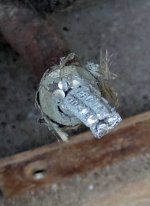
Which is the wrong way to trim wire. That wire was installed in 1958, on a 70 amp breaker, with
the conductors trimmed to fit. That said in 67 years of service there's apparently be no problem.
Which is the wrong way to trim wire. That wire was installed in 1958, on a 70 amp breaker, with
the conductors trimmed to fit. That said in 67 years of service there's apparently be no problem.

electrofelon
Senior Member
- Location
- Cherry Valley NY, Seattle, WA
- Occupation
- Electrician
brycenesbitt
Senior Member
- Location
- United States
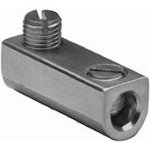
Part number ?Another option:
electrofelon
Senior Member
- Location
- Cherry Valley NY, Seattle, WA
- Occupation
- Electrician
Ilsco SPA-2, morris 90615, Burndy AMS2Part number ?

Joethemechanic
Senior Member
- Location
- Hazleton Pa
- Occupation
- Electro-Mechanical Technician. Industrial machinery
That's ugly, but I've seen just as bad last a long time.I just ran into this lovely wire:
View attachment 2580801
Which is the wrong way to trim wire. That wire was installed in 1958, on a 70 amp breaker, with
the conductors trimmed to fit. That said in 67 years of service there's apparently be no problem.

herding_cats
Senior Member
- Location
- Kansas
- Occupation
- Mechanical Engineer
yup split bolt or split nut. You can get at home depot. Get some 6 mil rubber splice tape too.Okay, a split-bolt.
brycenesbitt
Senior Member
- Location
- United States
When upsizing for voltage drop,
what section of the NEC specifically prohibits trimming stranded conductors?
Electrically it feel like there's more margin to using a trimmed stranded conductor with one connection point,
rather than the reducing tap that's three potential failure points.
what section of the NEC specifically prohibits trimming stranded conductors?
Electrically it feel like there's more margin to using a trimmed stranded conductor with one connection point,
rather than the reducing tap that's three potential failure points.
electrofelon
Senior Member
- Location
- Cherry Valley NY, Seattle, WA
- Occupation
- Electrician
Part of me is like its so hack to do that, and the other part is like what is the big deal? ITs probably better overall to trim in fact because you avoid a splice. With aluminum conductors, if you carefully cut around the perimeter with a sawzall blade, about halfway through a "ring" of strands, you can then bend and break them off and it ends up being super neat.When upsizing for voltage drop,
what section of the NEC specifically prohibits trimming stranded conductors?
Electrically it feel like there's more margin to using a trimmed stranded conductor with one connection point,
rather than the reducing tap that's three potential failure points.
Birken Vogt
Senior Member
- Location
- Grass Valley, Ca
There is no way to assure that the trimmed strands have a tight connection to the untrimmed strands.
electrofelon
Senior Member
- Location
- Cherry Valley NY, Seattle, WA
- Occupation
- Electrician
I dont understand, can you elaborate?There is no way to assure that the trimmed strands have a tight connection to the untrimmed strands.
ggunn
PE (Electrical), NABCEP certified
- Location
- Austin, TX, USA
- Occupation
- Consulting Electrical Engineer - Photovoltaic Systems
I think he means that when you trim only some strands they can separate from the untrimmed strands back from the trim pointI dont understand, can you elaborate?
winnie
Senior Member
- Location
- Springfield, MA, USA
- Occupation
- Electric motor research
IMHO it is very very unlikely that there isn't pretty good conductivity between the various individual strands of a stranded conductor.
What you don't have is reliable assurance of such conductivity. At the terminations the strands are squeezed together in the lugs. But in the middle of the wire the strands are just laying together. I could imagine (unlikely, but possible) that water could wick into an aluminum wire and insulate the strands from each other.
What you also don't have is a tested mechanical connection. Another plausible failure mode is that the stress of the entire wire applied to the termination through only a few strands could lead to mechanical failure of the strands being used.
So my gut feeling is that trimming strands to fit terminations, for the case of conductors oversized for voltage drop, could plausibly work just fine, but that the installation is sketchy with untested failure modes, and not 'workman like'.
What you don't have is reliable assurance of such conductivity. At the terminations the strands are squeezed together in the lugs. But in the middle of the wire the strands are just laying together. I could imagine (unlikely, but possible) that water could wick into an aluminum wire and insulate the strands from each other.
What you also don't have is a tested mechanical connection. Another plausible failure mode is that the stress of the entire wire applied to the termination through only a few strands could lead to mechanical failure of the strands being used.
So my gut feeling is that trimming strands to fit terminations, for the case of conductors oversized for voltage drop, could plausibly work just fine, but that the installation is sketchy with untested failure modes, and not 'workman like'.