Resonance occurs when?

Merry Christmas
Status
Not open for further replies.

JJWalecka

Senior Member
Location
New England
I have a question about "Resonance". I read the question in a exam preparation text book.

The question states:
Resonance occurs when, which of the following conditions are true?
(a) Efficiency= 100 percent
(b) Power Factor = 100 percent
(c)Xl=Xc in a series circuit
(d) Resistance= Impedance (R=Z)

The answer is (c) Xl=Xc in a series circuit.
Can anyone give me an example or direct me to a reference material that would explain it in detail?

Thank you for your time and effort.

Justin W.
 
Re: Resonance occurs when?

Ok, hear it goes. The frequency which the impedance of the series cicrcuit or the admittance of the parallel circuit is purely real, is called resonant frequency, and the circuits themselves, at this frequency, are "in resonance". This concept your asking about is important for engineers for things like attitude control systems, for the Saturn vehicles had to ensure that the control systems frequency did not excite the body bending (resonant) frequencies of the vehicle. Otherwise if it went unchecked, we know the outcome. There would be a buildup of stress until the vehicle would finally break apart.

In "resonance" the voltage and current are in phase and, therefore, the phase angle is zero and the power factor is unity. In the series case, at resonance the impedance is a minimum and, therefore, the current is maximum for a given voltage. At low frequencies the impedence of the series cicuit is dominated by the capacitive term and the admittance of the parallel circuit is dominated by the inductive term. At high frequencies the impedance of the series circuit is dominated by the inductive term, and the admittance of the parallel circuit is dominated by the capacitive term. Let me know if you need further clarification.

P.S. In a series circuit, current is common to every elecment and in a parellel circuit voltage is common to every element.
 
Re: Resonance occurs when?

Chris posted:

(c)Xl=Xc in a series circuit
I believe it is when capacitance = inductance
I think you probably meant it is when capacitive reactance equals inductave reactance.

Steve
 
Re: Resonance occurs when?

Cool, I knew that one. Hard to imagine an electrician having to know that. Never met one that did.

I'll probalby hear a bunch of common field application type stuff for this now. "I had to design and build the tramsmitter without ever leaving the job site. And I had to use only the natural recourses that were available there.

I always thought resonant circuits are very interesting. Especially parallel. Flywheel circuits.
 
Re: Resonance occurs when?

Originally posted by steve66:
Chris posted:

(c)Xl=Xc in a series circuit
I believe it is when capacitance = inductance
I think you probably meant it is when capacitive reactance equals inductave reactance.

Steve
Yes, sorry. Hence your dealing only with the real portions.
 
Re: Resonance occurs when?

Chris, reactance is frequency dependant, inductance and capacitance isn't.

Bob, I looked at the link you posted and although I didn't really read much, it looks like a good piece on it. Good schematics and equations. :cool:
 
Re: Resonance occurs when?

Bob, Aeletricalman, Steve66, and Physis thank you very much. I tried looking it up in a few texts to no avail. I appreciate your effort and feedback.

Justin W.
 
Re: Resonance occurs when?

This kind of "engineering stuff" is one of my favorite subjects. I'd encourage anybody who's interested in it to learn about it. To some people it seems wierd but a lot of folks actually enjoy this stuff.

I still think that this being put on an electrician's test is only an effort to make sure no one gets 100%. It has no place there.
 
Re: Resonance occurs when?

Hi Scott.

You've been registered for a long time. I haven't seen you post before.

I'll try to help you stir it up some if you want. :cool:
 
Re: Resonance occurs when?

Suprisingly,
that was an extremely short post by Scott.

I'm a fan of his work. Please expand on your thoughts, Scott.

I've been registered at ECN for a long time and maybe have a few posts there. I can't even remember my password. I will occasionally lurk around though.
 
Re: Resonance occurs when?

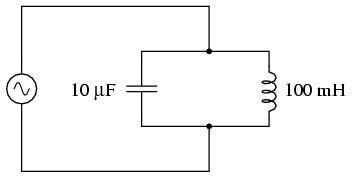
Simple parallel (tank circuit) resonance
A condition of resonance will be experienced in a tank circuit when the reactances of the capacitor and inductor are equal to each other. Because inductive reactance increases with increasing frequency and capacitive reactance decreases with increasing frequency, there will only be one frequency where these two reactances will be equal.

02096.png


In the above circuit, we have a 10 ?F capacitor and a 100 mH inductor. Since we know the equations for determining the reactance of each at a given frequency, and we're looking for that point where the two reactances are equal to each other, we can set the two reactance formulae equal to each other and solve for frequency algebraically:

12088.png


So there we have it: a formula to tell us the resonant frequency of a tank circuit, given the values of inductance (L) in Henrys and capacitance (C) in Farads. Plugging in the values of L and C in our example circuit, we arrive at a resonant frequency of 159.155 Hz.

What happens at resonance is quite interesting. With capacitive and inductive reactances equal to each other, the total impedance increases to infinity, meaning that the tank circuit draws no current from the AC power source! We can calculate the individual impedances of the 10 ?F capacitor and the 100 mH inductor and work through the parallel impedance formula to demonstrate this mathematically:

12089.png


As you might have guessed, I chose these component values to give resonance impedances that were easy to work with (100 Ω even). Now, we use the parallel impedance formula to see what happens to total Z

12090.png


We can't divide any number by zero and arrive at a meaningful result, but we can say that the result approaches a value of infinity as the two parallel impedances get closer to each other. What this means in practical terms is that, the total impedance of a tank circuit is infinite (behaving as an open circuit) at resonance. We can plot the consequences of this over a wide power supply frequency range with a short SPICE simulation:

02097.png


tank circuit frequency sweep
v1 1 0 ac 1 sin
c1 1 0 10u
* rbogus is necessary to eliminate a direct loop
* between v1 and l1, which SPICE can't handle
rbogus 1 2 1e-12
l1 2 0 100m
.ac lin 20 100 200
.plot ac i(v1)
.end


freq i(v1) 3.162E-04 1.000E-03 3.162E-03 1.0E-02
- - - - - - - - - - - - - - - - - - - - - - - - - - - - - - - - -
1.000E+02 9.632E-03 . . . . *
1.053E+02 8.506E-03 . . . . * .
1.105E+02 7.455E-03 . . . . * .
1.158E+02 6.470E-03 . . . . * .
1.211E+02 5.542E-03 . . . . * .
1.263E+02 4.663E-03 . . . . * .
1.316E+02 3.828E-03 . . . .* .
1.368E+02 3.033E-03 . . . *. .
1.421E+02 2.271E-03 . . . * . .
1.474E+02 1.540E-03 . . . * . .
1.526E+02 8.373E-04 . . * . . .
1.579E+02 1.590E-04 . * . . . .
1.632E+02 4.969E-04 . . * . . .
1.684E+02 1.132E-03 . . . * . .
1.737E+02 1.749E-03 . . . * . .
1.789E+02 2.350E-03 . . . * . .
1.842E+02 2.934E-03 . . . *. .
1.895E+02 3.505E-03 . . . .* .
1.947E+02 4.063E-03 . . . . * .
2.000E+02 4.609E-03 . . . . * .
- - - - - - - - - - - - - - - - - - - - - - - - - - - - - - - - -

The 1 pico-ohm (1 pΩ) resistor is placed in this SPICE analysis to overcome a limitation of SPICE: namely, that it cannot analyze a circuit containing a direct inductor-voltage source loop. A very low resistance value was chosen so as to have minimal effect on circuit behavior.

This SPICE simulation plots circuit current over a frequency range of 100 to 200 Hz in twenty even steps (100 and 200 Hz inclusive). Current magnitude on the graph increases from left to right, while frequency increases from top to bottom. The current in this circuit takes a sharp dip around the analysis point of 157.9 Hz, which is the closest analysis point to our predicted resonance frequency of 159.155 Hz. It is at this point that total current from the power source falls to zero.

Incidentally, the graph output produced by this SPICE computer analysis is more generally known as a Bode plot. Such graphs plot amplitude or phase shift on one axis and frequency on the other. The steepness of a Bode plot curve characterizes a circuit's "frequency response," or how sensitive it is to changes in frequency.

REVIEW:
Resonance occurs when capacitive and inductive reactances are equal to each other.
For a tank circuit with no resistance (R), resonant frequency can be calculated with the following formula:

12091.png


The total impedance of a parallel LC circuit approaches infinity as the power supply frequency approaches resonance.
A Bode plot is a graph plotting waveform amplitude or phase on one axis and frequency on the other.

[ April 20, 2005, 06:55 AM: Message edited by: physis ]


 
Re: Resonance occurs when?

What's posted on the last page comes from here

There's something interesting that I put in bold for Charlie B.

Notice how the math isn't capable of describing it but none the less the impedance at resonance is infinite.

This is without using an infinite complex plane.

If not for the operation being disallowed, X/0=infinity. That's what happens in the real world, just can't use math to describe it.

Edit: oh, and, :p

[ April 20, 2005, 06:26 AM: Message edited by: physis ]
 
Re: Resonance occurs when?

Posted by Physis:

Notice how the math isn't capable of describing it but none the less the impedance at resonance is infinite.
Sam, I have to disagree about where the math doesn't hold. If we talk about admittance (the inverse of reactances), it becomes zero. Zero current flows. It is basically an open circuit. The math is no problem. Open circuits are quite common.

The interesting part would be just the opposite - a series resonant circuit with Z=0. Then the admittance becomes infinite. And the current would also become infinite (for a fixed voltage).

In a nutshell, infinite impedence isn't unusual, but infinite current is.

Steve

[ April 20, 2005, 09:14 AM: Message edited by: steve66 ]
 
Re: Resonance occurs when?

It's not the infinite impedance I'm pointing out Steve. It's what happens with the math at resonance. As you approach resonance the calculation for impedance approaches 1/0 and the impedance aproaches infinity. The math can't actually be allowed to say it but the impedance at resonance is 1/0=infinity.

Edit: And I'm not sure but are you saying the inverse of 0 is infinity?

[ April 20, 2005, 10:14 AM: Message edited by: physis ]
 
Re: Resonance occurs when?

And I'm not sure but are you saying the inverse of infinity is 0?
No. But I think you are saying the inverse of 0 is infinity :D

If we do the same example with Admittance, admittances in parallel just add. So use:

A as the parallel admittance (instead of the parallel impedence)

Al as the inductive admittance (instead of Zl)

Ac as the capactive admittance (instead of Zc).

Instead of Z= 1 /( 1/Zl + 1/Zc ) we get:

A = Al + Ac =

.01 at 90 + .01 at -90.

which equals zero.

It is the same problem, but I have eliminated all the 1/Z's.

If we now apply a voltage to this circuit V (using bold as phasors), we can find the current:

I = V * A (this is ohms law using admitance instead of impedence).

But since A = 0, any applied voltage gives a current = 0. Just what we would expect.

Steve

[ April 20, 2005, 01:39 PM: Message edited by: steve66 ]
 
Re: Resonance occurs when?

What I'm saying is that you can use the circuit to describe the math.


The circuit can go from 0 at DC to infinity at resonance. We divide 1 by smaller and smaller numbers to represent the circuit approaching resonance. The math, 1/(1/Zl + 1/Zc), describes the circuit perfectly all the way up to just before resonance. But this math can't tell us what happens at resonance, because of divide by 0.

But we know what the circuit does. So we can use it as a model to describe the math and find out what happens when 1 gets divided by zero. The circuit says 1/0=infinity.

If you can represent a circuit with math, why can't you represent math with a circuit?
 
Status
Not open for further replies.
Top