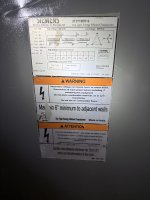
Reversed Transformer

kec

Senior Member
Location
CT
Occupation
Electrical Contractor
On a recent call for no power after the lost of power from the utility co. which must have created a surge, the client reported
smoke coming from a transformer. Main breaker feeding distribution was tripped.
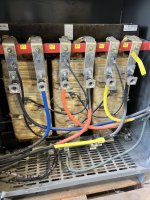
Found a burnt bonding wire coming from the panel feeding it. It was lugged to the cabinet back box. Not sure why that was the only cooked wire.

What struck me was this trans was reversed. If I recall, large transformers should not be used this way. 3 Phase 203 step up to 480 volts.
Other ongoing post made me question this. This this a common application?IMG_5680.jpegIMG_6170-preview 2.jpeg
 
Transformers like this are often reverse fed. They have few problems except when the X0 terminal is connected to the source neutral.

One of the problems with connecting the X0 terminal is that the neutral wire may get overloaded duets circulating currents in the delta side. Also, if the X0 is bonded to the fame in the transformer, you are creating a situation of the 208V neutral being bonded in two locations.
 
Why the timing, I can only speculate.
One problem with connecting the X0 of a reverse fed wye is when unbalanced currents flow, such as when the utility has a phase loss. By forcing the wye point to stay as a neutral point, rather than float around, the transformer draws increased current on the X0 to source neutral conductor.
 
  • Like
Reactions: kec
It's a straight 3 phase to 3 phase set-up No neutral just the egc wire connected.
 
It's a straight 3 phase to 3 phase set-up No neutral just the egc wire connected.
But the EGC is also bonded to the neutral at the source. During a severe unbalance the EGC, to the transformer, turned into a neutral conductor for which it was undersized.
 
It's a straight 3 phase to 3 phase set-up No neutral just the egc wire connected.
What is the conductor with all of the insulation burnt off of it that connected to the X0? That's a neutral or the EGC?
 
It's a straight 3 phase to 3 phase set-up No neutral just the egc wire connected.
Isn't the horizontal bar at the bottom with the EGCs connected to it the X0?

There should be a common connection of one end of all three LV windings.

That common connection should be floating, with no external connections.
 
This is an excellent post. The neutral would just pass through here and got to the panel, not bond to XO? Floating neutral correct?

But XO is always EGC?
 
The neutral would just pass through here and got to the panel, not bond to XO? Floating neutral correct?
A neutral need not be run with the supply at all.

The neutral point of the wye: yes, left floating.

But XO is always EGC?
No, only the secondary neutral (corner, etc.) needs to be bonded, etc.
 
But you have to assume that it's feeding a panel? That panel will have a neutral bar for 277V branch circuits. That's what I mean by passing through is "floating the neutral". Correct?
 
But you have to assume that it's feeding a panel? That panel will have a neutral bar for 277V branch circuits. That's what I mean by passing through is "floating the neutral". Correct?
The secondary grounded conductor (which would be a corner (because the HV is delta (eliminating L-N 277v loads))) requires a grounding-electrode connection (which could be the supply EGC if it qualifies), but it would never be a supply neutral conductor.
 
What is the conductor with all of the insulation burnt off of it that connected to the X0? That's a neutral or the EGC?
It's the EGC that the original installer connected from XO to the cabinet feeding the trans.
The other green wire on the right goes to the bonding bar via ser cable to a 3 phase only panel.
Does not seem right to me.
 
It's the EGC that the original installer connected from XO to the cabinet feeding the trans.
The other green wire on the right goes to the bonding bar via ser cable to a 3 phase only panel.
Does not seem right to me.
It's not right which is why that one conductor is burnt to a crisp. The X0 should have nothing connected to it.
 
Top