Scissor Lift Static Shock

Merry Christmas
Status
Not open for further replies.

2Broke2Sleep

Senior Member
Location
Florida
Does anyone know why some scissor lifts our company rents give everyone a good static shock after we drive them any distance? Is there something not hooked up somewhere that is supposed to be? If anyone knows can you PLEASE tell me. We rent these for months at a time and I'd rather not get shocked for that long!
 
Does anyone know why some scissor lifts our company rents give everyone a good static shock after we drive them any distance? Is there something not hooked up somewhere that is supposed to be? If anyone knows can you PLEASE tell me. We rent these for months at a time and I'd rather not get shocked for that long!

same reason you get static shock anywhere. movement thru dry air creates static on the surface of the metal. there is no real good answer to this.
 
same reason you get static shock anywhere. movement thru dry air creates static on the surface of the metal. there is no real good answer to this.

Rubber tires on carpeted surface will build up a static charge. A piece of bare #12 copper wire attached to the lift's frame and trailing on the floor may be enough to dissipate the charge, maybe not.


SceneryDriver
 
If I clamp a peice of wire to the metal frame can I discharge the static with that wire instead of my body?

That would probably work. How much of a charge are we talking about here? Is it anything more than annoying?


SceneryDriver
 
Automobile tires are conductive, to drain away the static charge on the chassis before refueling. (otherwise, the static charge would be discharged between the fuel nozzle and the fuel tank neck -- not a great place for a spark) Apparently, the lift tires aren't.

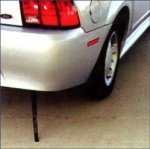
A piece of copper wire probably won't make very good contact or last very long. Rubber anti-static strips -- common in the 1950s and 1960s -- still exist.
https://www.bellautomotive.com/Anti-Static-Strips-p/22-1-00108-3.htm
(while perusing random images on the Internet, I began wondering how many of these are attached to non-metallic vehicle fascias)

vehicle-ground-strap.jpg

If you anticipate it, you can drain the static charge through a wedding ring, metal watchband or piece of metal held firmly in your hand. If the spark doesn't jump to your skin, the pain will be greatly reduced.
 
Where do you feel the shock? In your hands when you climb off the lift, or in your hands when you touch building structure after you move? Or do you feel it in your feet?

What sort of surface are you driving the lift around on?

-Jon
 
Bolt or clamp a metal curb feeler from the frame of the lift to the ground. Static won't build up as much that way if the charge can be dissipated back to ground. If you can't do this for whatever reason, touch the lift with the back of your hand instead of your fingertips, it is a lot less startling that way... Less nerve endings on the back of your hand than on your fingertips.

as to why it happens with some lifts and not others, who knows... Probably a difference in Tire Construction. Or some lifts may already have devices on them to dissipate any static buildup.
 
I don't remember ever getting a static shock from a scissor lift. Kind of wonder what type of surface they are driving the lifts on.
 
As to why it happens with some lifts and not others, who knows... Probably a difference in Tire Construction. Or some lifts may already have devices on them to dissipate any static buildup.

Maybe some of them are like ours, with plentiful screws embedded in the tires to drain off any charge as it is driven.
 
Several of my customers hang a foot or so of ordinary chain from the rear of fork lifts to dissipate static charges.
 
To answer a couple of questions: the surface is concrete with those small pebbles that are sealed on the top. I get shocked wherever I touch structural metal not the lift itself. Whatever part of my body touches gets shocked.
 
To answer a couple of questions: the surface is concrete with those small pebbles that are sealed on the top. I get shocked wherever I touch structural metal not the lift itself. Whatever part of my body touches gets shocked.
I assume that means when you are on the lift and touch structural metal. You are at the same potential as the lift - structural metal is at ground potential. You likely get similar shock if you were on something well grounded and touched the lift.
 
To answer a couple of questions: the surface is concrete with those small pebbles that are sealed on the top. I get shocked wherever I touch structural metal not the lift itself. Whatever part of my body touches gets shocked.

Then you and the lift are at a higher potential then the structural metal that you are eventually touching. The lift as it rolls across the ground, for whatever reason, is building up a static charge, which you are equalizing when you touch an uncharged piece of metal. These charges can easily exceed 10000 volts, although extremely low amperage. Nevertheless, getting popped by what has essentially become a stun gun is unpleasant.

Myself, I would engineer something on the fly to fix this problem, probably a piece of quarter inch all thread with numerous wraps of electrical tape around the middle to grab, then touch it to the lift and the structural steel. $0.10 worth electrical tape and a trash piece of all thread left in the lift bucket or platform will fix this problem. Then you're not spending money fixing rental lifts
 
It is also quite likely that the static discharge current is not enough to be a problem in this case. If it were, you would feel it in more than the hand touching the structure. Instead the problem is the small arc.

Post #7 mentions this; guide the discharge through some bit of metal that you are in solid contact with. The current flows through your body but the arc hits the metal. Just grab a metal tool, hold it firmly, and touch the metal to the structure.

If the charge is really big, you might feel it in your feet, however.

-Jon
 
Most scissor lifts come with a rubber grounding strap, normally attached at the rear center. Whenever I get a static shock in a lift, I always find that the strap is missing. I bet the lifts that don't zap you have the straps intact.

The solution is simple, replace the missing strap, or use a wire or chain as everyone is suggesting.

Sent from mTalk
 
Most scissor lifts come with a rubber grounding strap, normally attached at the rear center. Whenever I get a static shock in a lift, I always find that the strap is missing. I bet the lifts that don't zap you have the straps intact.

The solution is simple, replace the missing strap, or use a wire or chain as everyone is suggesting.

Sent from mTalk

I would agree. I'm surprised this is an issue in Florida though, as moist as the air is there. In my neck of the woods, Sam's Club used to have static drain wires on all the shopping carts. My store got so bad at one time that I would not use any cart that the wire was missing. I haven't noticed them lately-maybe they just corrected the humidity level in the store.
 
I would agree. I'm surprised this is an issue in Florida though, as moist as the air is there. In my neck of the woods, Sam's Club used to have static drain wires on all the shopping carts. My store got so bad at one time that I would not use any cart that the wire was missing. I haven't noticed them lately-maybe they just corrected the humidity level in the store.
or have carts with higher conductive wheels.
 
Status
Not open for further replies.
Top