Service Size Determinant for Meter Collars

BarklieEstes

Member
Location
Richmond, VA
Occupation
Master Electrician
Greetings,

I frequently encounter services that consists of (2) 200a indoor load center fed from a CL 200 utility meter. Assuming the utility approves a design for a meter collar interconnection, is it code compliant to install a Tesla Backup Switch in these instances? The Installation Manual says nothing about amperage requirements. The Specification Sheet only says that the rating is 200a continuous.

I gather that the utility is allowed to feed 400a worth of equipment from a 200a meter because they're the utility and they do what they want. I'm wondering if that logic extends, at least partially, to meter collars, and if not what the Code violation would be. It seems like it would be a reach to call out a 110.3(B) violation since the listing instructions don't include any requirements regarding OCPD.

Regards,
Barklie Estes
 
Greetings,

I frequently encounter services that consists of (2) 200a indoor load center fed from a CL 200 utility meter. Assuming the utility approves a design for a meter collar interconnection, is it code compliant to install a Tesla Backup Switch in these instances? The Installation Manual says nothing about amperage requirements. The Specification Sheet only says that the rating is 200a continuous.

I gather that the utility is allowed to feed 400a worth of equipment from a 200a meter because they're the utility and they do what they want. I'm wondering if that logic extends, at least partially, to meter collars, and if not what the Code violation would be. It seems like it would be a reach to call out a 110.3(B) violation since the listing instructions don't include any requirements regarding OCPD.

Regards,
Barklie Estes
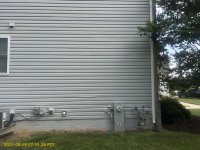
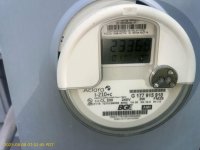
Normally it is a 320 amp meter base, and is a bolt in meter, not a standard plug in meter. If it is a bolt in meter, the Tesla collar will not physically work. Someone may have used a 200 amp service to feed two 200 amp panels. Does the meter base look unusually large for the meter? Then it’s probably a 320 amp meter.
 
Photos are attached. Looks like a 200a to me.
 

Attachments

  • Utility_Meter_Closeup-38.jpg
    Utility_Meter_Closeup-38.jpg
    175 KB · Views: 22
  • Utility_Meter-37.jpg
    Utility_Meter-37.jpg
    135.1 KB · Views: 22
I would say that pedestal is only rated for 200 amps, don’t have much for electrical inspections there? If they passed that, you are not going to have any problems with the Tesla collar! LOL!
 
You should check with the utility. They could have used a CL200 meter in a 320 cabinet. It is the same socket.

To ultimately answer your question though, the utility will decide on if you can use that tesla back up switch. If it is rated 200A then you have limited the service to 200A and will need to to verify that with load calcs.

Given the utility put in a CL200 meter, you are more than likely okay. They would have noticed the customer hitting the max demand amount (if they meter demand). You can also ask them for the billing / month reads for sizing purposes to answer that question.
 
Thanks. The NM application already solicits the method of interconnection and makes us select the make/model of the meter collar being used. The utility already approved all that. My fear is that I install it and the electrical inspector fails it. I know that the NEC does have a few things to say about meter collars but unclear as to whether those things only apply when installing in a private meter base. It sounds like that's the case.
 
Thanks. The NM application already solicits the method of interconnection and makes us select the make/model of the meter collar being used. The utility already approved all that. My fear is that I install it and the electrical inspector fails it. I know that the NEC does have a few things to say about meter collars but unclear as to whether those things only apply when installing in a private meter base. It sounds like that's the case.

This has been my little issue with meter collar interconnections. The install instructions vs utility vs NEC. It is hard to tell if you need to install a 200A main on the service. Maybe their install instructions are more clear as to the requirements on OCPD. I was looking at one the other day that required 200A OCPD. I don't think you are meeting something like that.
 
Must be a regional thing.
I'm sure it is. The PoCo probably looks at the actual load and decides. Most of the homes around here that have two panels and a 320 are that way just to get more than 42 spaces (built before the restriction was lifted) and would be just fine on a 200A. Most appliances here are NG.

Thanks,

Mark
 
I'm sure it is. The PoCo probably looks at the actual load and decides. Most of the homes around here that have two panels and a 320 are that way just to get more than 42 spaces (built before the restriction was lifted) and would be just fine on a 200A. Most appliances here are NG.

Thanks,

Mark
Yeah, most seldom get over 100 amps, unless emergency resistance heat kicks in. Most sit around the 30 amp range on average, and with the advent of led lighting, lighting load is virtually nothing.
 
Yeah, most seldom get over 100 amps, unless emergency resistance heat kicks in. Most sit around the 30 amp range on average, and with the advent of led lighting, lighting load is virtually nothing.
I don't think most non-electricians get how much power 240V at 200A is. If nothing else, at .10/kWH, it is $4.80/hr.

Mark
 
I dont think may electricians and non-electricians understand what people effictivly pay per kWH for running on a Power Wall or or any other Energy Storage System (ESS) (or small generator for that matter), myself included.
Say a customer needs at max 500 kWh/yr of backup power, has no solar,
The specs on the Tesla say 13.5 kWH.
That could probably could get thru a 1-week blackout, but say on average its 500 kWh/yr over 10 year warranty?
What do these ESS's cost installed ? $15,500 for a 13.5 kWh battery in 2026?

The specs also say ~89% efficiency so delivering 1 kWh requires about 1 / 0.89 = 1.12 kWh of charging energy.
Example for me, no solar, grid rate $0.14/kWh, installed cost $15500, 5000 kWH over 10 year life,
(15500/5000) + (0.14 * 1.12) = $3.25 per kWH.
or almost about 24X what it cost me to be powered off the grid normally.
 
I dont think may electricians and non-electricians understand what people effictivly pay per kWH for running on a Power Wall or or any other Energy Storage System (ESS) (or small generator for that matter), myself included.
Say a customer needs at max 500 kWh/yr of backup power, has no solar,
The specs on the Tesla say 13.5 kWH.
That could probably could get thru a 1-week blackout, but say on average its 500 kWh/yr over 10 year warranty?
What do these ESS's cost installed ? $15,500 for a 13.5 kWh battery in 2026?

The specs also say ~89% efficiency so delivering 1 kWh requires about 1 / 0.89 = 1.12 kWh of charging energy.
Example for me, no solar, grid rate $0.14/kWh, installed cost $15500, 5000 kWH over 10 year life,
(15500/5000) + (0.14 * 1.12) = $3.25 per kWH.
or almost about 24X what it cost me to be powered off the grid normally.
That’s why even solar doesn’t pay off in my area, our rate is .10 a kWh. There are places where solar can pay for itself, but ours is not. We have a lot of hydro.
 
Thanks. The NM application already solicits the method of interconnection and makes us select the make/model of the meter collar being used. The utility already approved all that. My fear is that I install it and the electrical inspector fails it. I know that the NEC does have a few things to say about meter collars but unclear as to whether those things only apply when installing in a private meter base. It sounds like that's the case.

The governing code section is 230.90 Exception 3, which states that when you have multiple circuit breakers or sets of fuses as the service OCPD then the sum of them can exceed the ampacity of the service conductors provided the *calculated load* does not.

So the proper way to verify this installation is to do a load calculation.

I'd entertain at least three possibilities pending further investigation.

1) The load calc might come in under 200A and then it would be code compliant to install your meter collar.

2) The load calc is over 200A and the utility mistakenly put a 200A meter instead of a 320A meter.

3) the load calc is over 200A but both the meter socket and meter are only 200A and therefore not code compliant. Possibly other parts of the service conductors are also not code compliant.

In either of the latter scenarios installing the meter collar would not be code compliant.
 
Top