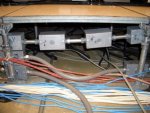
Short sections of conduit support

Status
Not open for further replies.

Michealh7

New member
I have All ways thought that there was a code that stated you had to support short sections of conduit if more than 18 inches. But now I can't find any code that says anything more than within 36 inches.
 
There was one code cycle where you could use up to 18" without support if the raceway had no couplings. For example in the 2008 NEC this was a code change for EMT.

358.30(C) Unsupported Raceways. Where oversized, concentricor eccentric knockouts are not encountered, Type EMT
shall be permitted to be unsupported where the raceway is
not more than 450 mm (18 in.) and remains in unbroken
lengths (without coupling). Such raceways shall terminate
in an outlet box, device box, cabinet, or other termination at
each end of the raceway.
 
I have wondered why a fitting at a box is not considered adequate to both support and secure at that point, given that a plastic wire tie is often considered acceptable.

technically if you butted a couple boxes up to each other and ran a nipple between them wouldn't they need some kind of support?
 
I have wondered why a fitting at a box is not considered adequate to both support and secure at that point, given that a plastic wire tie is often considered acceptable.

technically if you butted a couple boxes up to each other and ran a nipple between them wouldn't they need some kind of support?

I have seen this issue before. I don't have an easy way to cut and paste code, so I won't paste the 2011 woring for 358.30, but...

I read it to be that, if the conduit is less than 3 feet between boxes it is in compliance with 358.30(a) and doesn't require any additional support. I feel that exception #1 reinforces this because it even allows this length to be 5 feet in certain instances. I realize that this is an interpretation of exclusion, but merely the fact that they removed the requirement from 2008 also supports this assumption I believe. Lastly, common sense says there is no need to support the EMT that is only 24 or so inches long.
 
I have wondered why a fitting at a box is not considered adequate to both support and secure at that point, given that a plastic wire tie is often considered acceptable.

technically if you butted a couple boxes up to each other and ran a nipple between them wouldn't they need some kind of support?

You could end up with this. :ashamed:
 

Attachments

  • Boxsupportweb.jpg
    Boxsupportweb.jpg
    30.8 KB · Views: 59
I have seen this issue before. I don't have an easy way to cut and paste code, so I won't paste the 2011 woring for 358.30, but...

I read it to be that, if the conduit is less than 3 feet between boxes it is in compliance with 358.30(a) and doesn't require any additional support. I feel that exception #1 reinforces this because it even allows this length to be 5 feet in certain instances. I realize that this is an interpretation of exclusion, but merely the fact that they removed the requirement from 2008 also supports this assumption I believe. Lastly, common sense says there is no need to support the EMT that is only 24 or so inches long.

I don't disagree with your logic but the code is about rules and not logic. I copied the text from the 2011 version.

358.30(A) Securely Fastened. EMT shall be securely fastened in
place at least every 3 m (10 ft). In addition, each EMT run
between termination points shall be securely fastened
within 900 mm (3 ft) of each outlet box, junction box, device
box, cabinet, conduit body, or other tubing termination.
Exception No. 1: Fastening of unbroken lengths shall be
permitted to be increased to a distance of 1.5 m (5 ft) where
structural members do not readily permit fastening within
900 mm (3 ft).

It is pretty clear that the "in addition" wording is an additional requirement to the primary requirement of being supported every ten feet, and that this additional requirement is not met by any kind of tubing termination such as a box fitting.

It appears to me that the exception just allows you to extend the 3 feet distance to 5 feet, but does not change the basic requirements.
 
I don't disagree with your logic but the code is about rules and not logic. I copied the text from the 2011 version.


It is pretty clear that the "in addition" wording is an additional requirement to the primary requirement of being supported every ten feet, and that this additional requirement is not met by any kind of tubing termination such as a box fitting.

It appears to me that the exception just allows you to extend the 3 feet distance to 5 feet, but does not change the basic requirements.

Thank you for quoting it. My logic is that there is not 3 feet of conduit so no need for a strap. I understand otherwise. I mean I believe it is open to interpretation, but anyone who requires a strap on a 3 foot piece of EMT between boxes is an [expletive].
 
Last edited:
I don't disagree with your logic but the code is about rules and not logic. I copied the text from the 2011 version.


It is pretty clear that the "in addition" wording is an additional requirement to the primary requirement of being supported every ten feet, and that this additional requirement is not met by any kind of tubing termination such as a box fitting.

It appears to me that the exception just allows you to extend the 3 feet distance to 5 feet, but does not change the basic requirements.

I agree, even if it's less than 3' it requires a support. This is the proposal from the ROP to eliminate the 18" rule.

8-125 Log #2204 NEC-P08 Final Action: Accept(358.30(C))
_______________________________________________________________
Submitter: James W. Carpenter, International Association of Electrical
Inspectors
Recommendation: Delete this provision. Also, delete the clause “or permitted
to be unsupported in accordance with 358.30(C)” from the last sentence of
358.30.
Substantiation: The concept of a special support rule for short lengths of
raceway run between enclosures of various sorts was added to the 2008 NEC
for the first time in the history of the NEC with negligible technical
substantiation and no evidence of loss experience, and remains at variance
from routine trade practice. The existence of a coupling now immediately
provokes a support requirement, even on a 6-inch and a 4-inch long heavy-wall
4 trade size steel nipples put together to make an 11-inch (approx.) combined
raceway. A 90 degree sweep roughly 2 trade size or larger (any centerline
length over 18 in.) now requires intermediate support. The literal text now
requires support to structure on a 3-in. nipple if even one of its ends
“encounters” a concentric knockout.
Although there are those who believe the new rule simply offers limited
relief from a rule that required all raceways to be independently supported,
routine field experience throughout the history of rigid raceway wiring methods
does not substantiate such assertions. We are unaware of any significant
attempts to require supports on short nipples. All rigid raceways under NEC
rules must be listed, including their couplings; is it conceivable that a coupling
between two segments of a short (3 ft or less) nipple so seriously degrades the
stability of the raceway that such a support is needed? Concentric knockouts in
enclosures are reviewed as part of the UL 50 process, and as anyone working
these enclosures recently should be aware, those standards have been
strengthened and these knockouts are now more robust than in previous
decades; is this the time to require even more support?
Raceways generally require support within 3 ft of terminations, and when the
entire length is just that long or shorter, no additional support should be
needed. In effect, the locknuts and bushings or connectors and locknuts at each
end are supports. This is not a new concept for the NEC: CMP 7 just added the
wording “(wiring method) fittings shall be permitted as a means of cable
support” in a number of cable articles. If carried to its logical conclusion and
routinely enforced (however unlikely), this new support rule will likely drive
the market in the direction of cabled wiring methods without any technical
justification.
It should be remembered that supports to structure are not infallible. Many
raceways hang from threaded rod of indefinite length every 10 ft or so and
within 3 ft (5 ft. in some cases) of enclosures, depending on the specific rules
for the size and character of the supported raceway. Such support clearly meets
the rules in this section, but would it add anything to a nipple between
enclosures? Further, even when rigid supports such as one-hole clips are used,
the raceway beyond the last clip can have an indefinite number of couplings
and enter the center knockout of an indefinite number of concentric knockouts;
how is this arrangement so inherently more secure than a nipple between
enclosures? This new NEC provision was without precedent, and addressed a
nonexistent problem.
Panel Meeting Action: Accept
Panel Statement: CMP-8 does not necessarily agree with the submitter’s
substantiation. Securement requirements are found in 358.30(A).
Number Eligible to Vote: 12
Ballot Results: Affirmative: 11 Negative: 1
Explanation of Negative:
GRIFFITH, M.: See my explanation of negative vote on Proposal 8-24a.
Comment on Affirmative:
DABE, J.: See my statement for 8-24(a).
 
I agree, even if it's less than 3' it requires a support. This is the proposal from the ROP to eliminate the 18" rule.

I don't understand your statement above when this wording is in your citing:

"Raceways generally require support within 3 ft of terminations, and when the
entire length is just that long or shorter, no additional support should be
needed. In effect, the locknuts and bushings or connectors and locknuts at each
end are supports."

Which says to my simple mind that less than 3' DOESN'T require support.
 
I don't understand your statement above when this wording is in your citing:

"Raceways generally require support within 3 ft of terminations, and when the
entire length is just that long or shorter, no additional support should be
needed. In effect, the locknuts and bushings or connectors and locknuts at each
end are supports."

Which says to my simple mind that less than 3' DOESN'T require support.

That proposal was accepted and as it states in the beginning it removes the 18" rule which allowed unsupported raceways 18" or less with no couplings. IMO the substantiation is very confusing because it seems to argue both ways.

(358.30(C))
__________________________________________________ _____________
Submitter: James W. Carpenter, International Association of Electrical
Inspectors
Recommendation: Delete this provision
 
Last sentence in the substantiation summed it up pretty well "This new NEC provision was without precedent, and addressed anonexistent problem."

I remember attending CEU class and talking about that change back then - even the instructor (who was an inspector) asked rehetorically, if you have a 3 foot nipple of 4 inch RMC between two cabinets, what do you accomplish by putting a strap on it? It isn't going anywhere unless the cabinets go with it.
 
Last sentence in the substantiation summed it up pretty well "This new NEC provision was without precedent, and addressed anonexistent problem."

I remember attending CEU class and talking about that change back then - even the instructor (who was an inspector) asked rehetorically, if you have a 3 foot nipple of 4 inch RMC between two cabinets, what do you accomplish by putting a strap on it? It isn't going anywhere unless the cabinets go with it.

IMO most would agree that removing the 18" provision was foolish when one can have up to 3' of unsupported raceway. As mentioned installing a short section of raceway between two solidly mounted boxes or equipment should not require support since it's not going anywhere.
 
The original ROP for the 2008 version was submitted by Mike Holt. It was then butchered in the ROC to substantially change it.
The result was deleted in 2011.

2008 ROP

8-104 Log #1349 NEC-P08 Final Action: Accept
(358.30(C))
________________________________________________________________
Submitter: Mike Holt, Mike Holt Enterprises
Recommendation: Add the following text to 358.30
(C) Unsupported raceways: Type EMT shall be permitted to be unsupported
where the raceway is not more than 900 mm (3 ft) in length and remains in
unbroken lengths (without coupling). Such raceway shall terminate in an outlet
box, junction box, device box, cabinet, or other termination at each end of the
raceway.
Substantiation: Unsupported raceways are violations of the Code that occur
everyday. As written, a 3 inch length of conduit between enclosures is required
to be supported, despite the fact that it adds little if any structural value to the
system. Quite often, particularly with conduit nipples, securing and supporting
a raceway shorter than 36 inches is not possible. Furthermore, securing and
supporting is of little value on lengths less than 36 inches where the conduit
terminates at a box on each end, where the box is installed and supported in
compliance with its applicable Code section.
This proposal is written with the parallel effect of Code sections that have
been strived for in chapter 3, and matches the numbering system used in the
Cable Articles. It also uses existing text taken from both the Cable Articles and
the Raceway Articles.
Panel Meeting Action: Accept
Number Eligible to Vote: 12
Ballot Results: Affirmative: 10 Negative: 2
Explanation of Negative:
DABE, J.: See my comment for 8-9.
HUMPHREY, D.: This proposal does not address other issues that may
have a direct impact on the durability of the electrical installation. The affects
of weight and vibration on concentric and eccentric knockouts at each end
of a three foot run between pieces of equipment, a scenario that would be
frequently in many electrical installations, may compromise the strength of the
installation. The raceway having even a single point of support would help to
mitigate these deleterious affects. In addition, the EMT installation in question
may be used as an equipment grounding conductor and any loosening that
could occur would serve to compromise the equipment grounding function
of the raceway. 300.11 further requires that raceways be securely fastened in
place. I would assert that this proposal would conflict with the requirements
of 300.11. In summation, depending on connectors, double locknuts etc. to
support and secure this up to 36 in. installation especially where concentric or
eccentric knockouts are encountered is dubious at best. 36 in. should provide
ample space in which to install normal supporting and securing hardware. A
proposal involving a shorter distance and where no concentric or eccentric
knockouts are encountered may be in order.

2008 ROC

8-57 Log #784 NEC-P08 Final Action: Accept
(358.30(C))
____________________________________________________________
Submitter: David G. Humphrey, Midlothian, VA
Comment on Proposal No: 8-104
Recommendation: Revise text to read as follows:
Where oversized, concentric or eccentric knockouts are not encountered,
Type EMT shall be permitted to be unsupported where the raceway is not more
than 900 mm (3 ft) 450 mm (18 in.) and remains in unbroken lengths (without
coupling). Such raceways shall terminate in an outlet box, device box, cabinet,
or other termination at each end of the raceway.
Substantiation: The existing text does not address issues that could have
a direct negative impact on the durability of the installation. The affects of
weight and vibration of the raceway, especially with larger raceway sizes,
may cause loosening at the raceway termination points. This loosening
would certainly impose an impediment to the raceways ability to safely carry
the maximum fault current likely to be imposed on the raceway. Reducing
the length to 450 mm (18 in.) would half the weight of the raceway in the
current text, and still provide ample room to install normal supporting and
securing hardware for longer lengths. Prohibiting unsupported raceways where
oversized, concentric, or eccentric knockouts are encountered would serve to
maintain the integrity of the equipment grounding function of the raceway.
In summation, the proposed revised text would meet the submitter’s intent
and address system durability issues.
Panel Meeting Action: Accept
Number Eligible to Vote: 12
Ballot Results: Affirmative: 11 Negative: 1
Explanation of Negative:
GRIFFITH, M.: Panel action on this Comment should have been to “Reject”
rather than to “Accept” for the following reasons:
1. The new language suggesting an 18 in. limit completely changes the intent
of the original proposal which was to clarify a widespread practice in industry
that is already implied to be acceptable by existing code language and for
which there is no evidence to change
.

2. The spacing of 18 in. is new material that has not had public review and is
not substantiated.
3. The limitation to installations “where oversized...knockouts are not
encountered” has not been substantiated. In addition, concerns about knockouts
can be addressed by any of several installation methods representing good
workmanship that result in adequate support.
Panel action on the original Proposal 8-104 should continue to apply.

8-59 Log #1398 NEC-P08 Final Action: Accept in Principle in Part
(358.30(C))
____________________________________________________________
Submitter: James M. Imlah, City of Hillsboro
Comment on Proposal No: 8-104
Recommendation: Revise text to read as follows:
(c) Unsupported raceways: Type EMT shall be permitted to be unsupported
where the raceways is not more than 600 mm (2 ft) 900 mm (3 ft) in length and
remains in unbroken lengths (without coupling). Such raceway shall terminate,
where oversized, eccentric or concentric knockout are not encountered in an
outlet box, junction box, device box, cabinet, or other termination at each end
of the raceway.
Substantiation: This allowance should only be allowed for 24” nipples or
less in length. Many times EMT nipples, as described in Table 9 Note 4,
are installed for the intent of allowing additional conductor conduit fill. By
following the 24” length of this note for nipples provides consistency for short
sections of raceway being installed and meet submitters intent. Additionally,
support shall be installed if oversized, eccentric, or concentric knockouts are
encountered to maintain assured grounding and bonding continuity due to
vibration or loose oversized knockouts.
Panel Meeting Action: Accept in Principle in Part
Panel Statement: The panel action on Comment 8-57 satisfies the
eccentric or concentric issue of the submitter; however, the panel rejects the
recommendation to increase the unsupported length to 2 feet.
Number Eligible to Vote: 12
Ballot Results: Affirmative: 11 Negative: 1
Explanation of Negative:
GRIFFITH, M.: Panel action should have been to “Reject” this comment.
There is no substantiation for the limit(s) imposed by the submitter’s suggested
revision. See also my Explanation of Negative Vote on Comment 8-57.

 
I have submitted PIs for the 2020 code cycle for this in the form of an exception. The proposed exception would permit the raceway terminations to serve as the required support where straight unbroken lengths are installed between securely supported enclosures. They will likely be rejected, but this is and has been a common practice, and most inspectors permit it, even though the code language does not.
 
You could end up with this. :ashamed:
attachment.php


Not legally, you couldn't.:p

That's a nice picture, but I think I'm with Strathead.

The boxes themselves should be supported.
 
I have All ways thought that there was a code that stated you had to support short sections of conduit if more than 18 inches. But now I can't find any code that says anything more than within 36 inches.
First you need to look at the definition of “secerely fastened”. The NEC does not include this phrase under article 100 so we are forced to seek the definition elsewhere.

“so secured in place that it cannot be moved under normal or reasonably foreseen conditions or circumstances.” -Law Insider

It seems reasonable to say that “fastened in place” is a condition and not a requirement to add something.


358.30(A) Securely Fastened.
EMT shall be securely fastened in place at intervals not to exceed 3 m (10 ft). In addition, each EMT run between termination points shall be securely fastened within 900 mm (3 ft) of each outlet box, junction box, device box, cabinet, conduit body, or other tubing termination.-2017 NEC

Read it closely. Where does it tell you to install supports?

condition 1. Two boxes which are securely fastened in place with a straight piece of EMT that is 35” long.
Look at it from the point of view of each box.
from box #1 secure within 36”? Try pulling on it. Does it not budge? How about from the point of view of box #2? Does it feel secure within 36”? If yes, then it is “securely fastened”.

condition 2. Two boxes which are securely fastened in place with. 35” length of EMT with a 90 degree bend in the middle.
You go right to that 90. It you can pull on it and it gives, then that condition may not be “securely fastened.
 
Status
Not open for further replies.
Top