
Situation in new Highrise ( NYC)

Status
Not open for further replies.

unytko

Member
Location
NYC
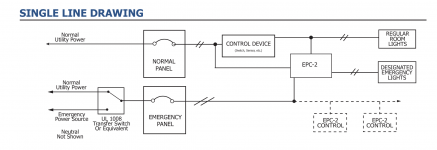
New residential Highrise in New York City – I went to replace damaged Lutron keypad and after few attempts of finding the CB (to save time and because this was still empty apartment), I decided to shut the main CB. I went back to the Kitchen grabbed the keypad and I got shocked! which confused the hell out of me…. After long investigation, turns out that in every apartment (per the design) two circuits -Kitchen lighting and fridge together with one convenience receptacles are also tied into the building’s emergency power though two EPC-2 (Emergency Power Control by LVS) relays located in apartment’s closet. Two 20A emergency feeders come from the EM CBP located two floors down in the electrical closet. I double checked and confirmed that currently those two circuits are constantly energized by the building’s EM power and not by this apartment’s CBP (regardless of the breaker position in the apt’s panel. ) Test button on each EPC device also does nothing ….

I reported this incident and my concerns to people who have hired me, explained that I think this is not right /dangerous that is should be checked and addressed ASAP before someone gets hurt etc. They reached out to resident manager and his response was “ there is nothing wrong! because it was designed this way by the engineers” and that “we should use tester before I touch any wiring” . I agree about the tester part but please … In my opinion besides the red tape warnings that should be posted at least at the house CBP those EM feeders/circuits should only be energized during the “blackout” and during normal conditions you should be able to de-energize those circuits and from apt’s CBP.

Your thoughts?

Attached is single line diagram of the EPC-2 relay
(apologies for grammar -English is not my 1st language )
 

Attachments

  • Screen Shot 2022-06-23 at 8.59.12 PM.png
    Screen Shot 2022-06-23 at 8.59.12 PM.png
    151 KB · Views: 20
I don't see anything wrong with there being an Article 700 circuit per that diagram, but it if it is energizing non-Article 700 type loads, that is wrong. If they have a separate Article 702 transfer switch upstream and related contactor/circuits then I agree, no problem.
 
I am sorry to be blunt, but you can’t idiot proof everything and this is one more example. If you had followed proper protocol you would not have been shocked. I am reminded of the recent discussions regarding the new, over the top, code about GFCI protection for AC units.
 
I am sorry to be blunt, but you can’t idiot proof everything and this is one more example. If you had followed proper protocol you would not have been shocked. I am reminded of the recent discussions regarding the new, over the top, code about GFCI protection for AC units.
I already acknowledged that I should have test it etc. and that is my fault. What about the installation ? you don't see any problem with that ??? Look, I would definitely be more carful in a commercial place because it is common to have EM or back-fed circuits etc. If you work in NYC you should know to expect anything and everything... I just did't expect to have energized circuit with my main off in the a brand new building/dwelling unit ... ..
 
Does the current arrangement comply with 240.24(B)? If an apartment has more than one source of supply, is there any requirement in the NEC to label the disconnects with the presence and location of the other disconnect(s), as is often required on single family dwellings?

Cheers, Wayne
 
I already acknowledged that I should have test it etc. and that is my fault. What about the installation ? you don't see any problem with that ??? Look, I would definitely be more carful in a commercial place because it is common to have EM or back-fed circuits etc. If you work in NYC you should know to expect anything and everything... I just did't expect to have energized circuit with my main off in the a brand new building/dwelling unit ... ..
Wayne has a good question. I meant to say that I am just as guilty as anyone else in my 63 years, of violating common sense safety. And paid more than once. However I am guessing that the building does comply with 240. Other designs would have been more practical but Architects are often unwilling to sacrifice their vision for sense.
 
I'm with you
New residential Highrise in New York City – I went to replace damaged Lutron keypad and after few attempts of finding the CB (to save time and because this was still empty apartment), I decided to shut the main CB. I went back to the Kitchen grabbed the keypad and I got shocked! which confused the hell out of me…. After long investigation, turns out that in every apartment (per the design) two circuits -Kitchen lighting and fridge together with one convenience receptacles are also tied into the building’s emergency power though two EPC-2 (Emergency Power Control by LVS) relays located in apartment’s closet. Two 20A emergency feeders come from the EM CBP located two floors down in the electrical closet. I double checked and confirmed that currently those two circuits are constantly energized by the building’s EM power and not by this apartment’s CBP (regardless of the breaker position in the apt’s panel. ) Test button on each EPC device also does nothing ….

I reported this incident and my concerns to people who have hired me, explained that I think this is not right /dangerous that is should be checked and addressed ASAP before someone gets hurt etc. They reached out to resident manager and his response was “ there is nothing wrong! because it was designed this way by the engineers” and that “we should use tester before I touch any wiring” . I agree about the tester part but please … In my opinion besides the red tape warnings that should be posted at least at the house CBP those EM feeders/circuits should only be energized during the “blackout” and during normal conditions you should be able to de-energize those circuits and from apt’s CBP.

Your thoughts?

Attached is single line diagram of the EPC-2 relay
(apologies for grammar -English is not my 1st language )
It does seem unsafe. It would be one thing if all the breakers/disconnects were in the same place. Someone at some point is going to get more than an unpleasant reminder.
 
What your saying and what the diagram showed does not match if I'm reading correctly.
Your saying the fridge is on em circuit and no over current device for that branch circuit is in the apartment (dewelling) with a kitchen ( cooking equipment). Is there utility metering for the apartment as well?
We're you under contract through building maintance ?


A few thing to look at. 2017 NEC
110.3 (8)
700.10 (A), (B)-(3) and (B)-(5)
210.5(C) (1) (b)
110.21 (B) (1)
As mentioned by other 240.24

I can see where this is compliant.
 
What your saying and what the diagram showed does not match if I'm reading correctly.
Your saying the fridge is on em circuit and no over current device for that branch circuit is in the apartment (dewelling) with a kitchen ( cooking equipment). Is there utility metering for the apartment as well?
We're you under contract through building maintance ?


A few thing to look at. 2017 NEC
110.3 (8)
700.10 (A), (B)-(3) and (B)-(5)
210.5(C) (1) (b)
110.21 (B) (1)
As mentioned by other 240.24

I can see where this is compliant.
I found this diagram on LVS website.
Two 20A feeders run from dwelling CBP and two EM feeders run from EM CBP (which is located two floors down in building's closet ) they all meet at the junction point. Junction point is the closet with the two EPC devices located in dwelling. On the dwelling side the fridge and one conv receptacle is protected by 20A CB (cr#1) and Kitchen lighting is protected by 20A AFCI (cr#2). EM feeders /circuits (cir#1E & cir#2E) are protected by 20A CBs Supposedly this set up is repeated throughout for all dwellings.

I am not sure if each dwelling is utility metered or on common risers.

No, I was hired by new owner of this apartment (condo) to install new lighting fixtures, TVs Audio system etc.
 
Does the current arrangement comply with 240.24(B)? If an apartment has more than one source of supply, is there any requirement in the NEC to label the disconnects with the presence and location of the other disconnect(s), as is often required on single family dwellings?

Cheers, Wayne
I would say no, not in current condition. There is no labels informing about that and there is definitely two different supply sources in this apartment.
 
Does the current arrangement comply with 240.24(B)? If an apartment has more than one source of supply, is there any requirement in the NEC to label the disconnects with the presence and location of the other disconnect(s), as is often required on single family dwellings?

Cheers, Wayne
I believe anyone injured from such unit wiring, not de-energized by unit fusebox, may collect medical or casualty claims by hiring an accident attorney.

Courts may prosecute "management supervision" for being non-responsive or relying upon laborers posing as qualified-maintenance persons.
 
I found this diagram on LVS website.
Two 20A feeders run from dwelling CBP and two EM feeders run from EM CBP (which is located two floors down in building's closet ) they all meet at the junction point. Junction point is the closet with the two EPC devices located in dwelling. On the dwelling side the fridge and one conv receptacle is protected by 20A CB (cr#1) and Kitchen lighting is protected by 20A AFCI (cr#2). EM feeders /circuits (cir#1E & cir#2E) are protected by 20A CBs Supposedly this set up is repeated throughout for all dwellings.

I am not sure if each dwelling is utility metered or on common risers.

No, I was hired by new owner of this apartment (condo) to install new lighting fixtures, TVs Audio system etc.
One thing I didn’t pick up before. Chapter 7 would not allow a refrigerator or a convenience receptacle to be fed from an article 700 panel or transfer switch. They would have to be bio scientists for a residential refrigerator to be fed from an article 701 panel. I apologize for my first reaction and totally agree there are code violations here.
 
Status
Not open for further replies.
Top