Sizing lightly-loaded high-leg service conductor

Status
Not open for further replies.

LarryFine

Master Electrician Electric Contractor Richmond VA
Location
Henrico County, VA
Occupation
Electrical Contractor
Let me ask this one separately.

I have a 200a, main-breaker, 3-ph hi-leg service, where the only 3-ph load is the existing roof-top AC unit somewhere around 30a. I plan to size A and C phases, as well as the neutral, as usual for the load.

The question is how to size the hi-leg service entrance and feeder conductors. Since the over-current protection will be the 200 main breaker, how small can the hi-leg conductor be and still be protected?

To go with a fusible main for the purpose of mixing sizes can get expensive, as can finding a 200/30/200 main breaker. I can't be the first one to come up with this situation, can I? As always, all input welcome.
 
Larry Fine:

let me try this theroy i am not sure if this will work well in this verison


do the load calauction on single phase side then do the load calauation on 3 phase side once you get this.

once you slect the cable size for 200 amp both legs i will chiose the 4/0 cu thhn but when you get to the 30 amp size i could use the #8 thhn for this appaction but please do correct me if i make a mistake on this one somewhere in the NEC i am not sure where i did rember if speak this correct it shall not be smaller than #8 conductor size expect for a single polyphase equiment then the wire shall be no smaller than #12 size


if this is correct then the tricky part is that you will have to use the fuseable disconnect switch 3ph verison but on one phase you use the fuse reducer to down size it or move one fuse holder clip to warn not to use oversize fuse

we do the almost the same thing in europe as well but senice they gone to breaker route now but get 200/200/30 size is a very instering challange there

i thought it might be fesibable but the cost will be very high


merci , marc
 
This is an interesting question. If you have less then 6 handles in the main would it matter what size the main disco is ?
 
LarryFine said:
As always, all input welcome.
Perhaps a little more input from you would help.

Is this a service upgrade? Since you used the phrase "existing roof-top AC unit", I have to assume this is not 100% new construction. Can you provide a bit more info on what is/was there, what gets/got removed, what is new? Are there any approved plans you have to adhere to?

My initial thought (the post I deleted, which then got removed entirely) was to use a multi-disconnect meter pan combo and split off 1? and 3? feeders...
 
Smart $ said:
Perhaps a little more input from you would help.
Input:

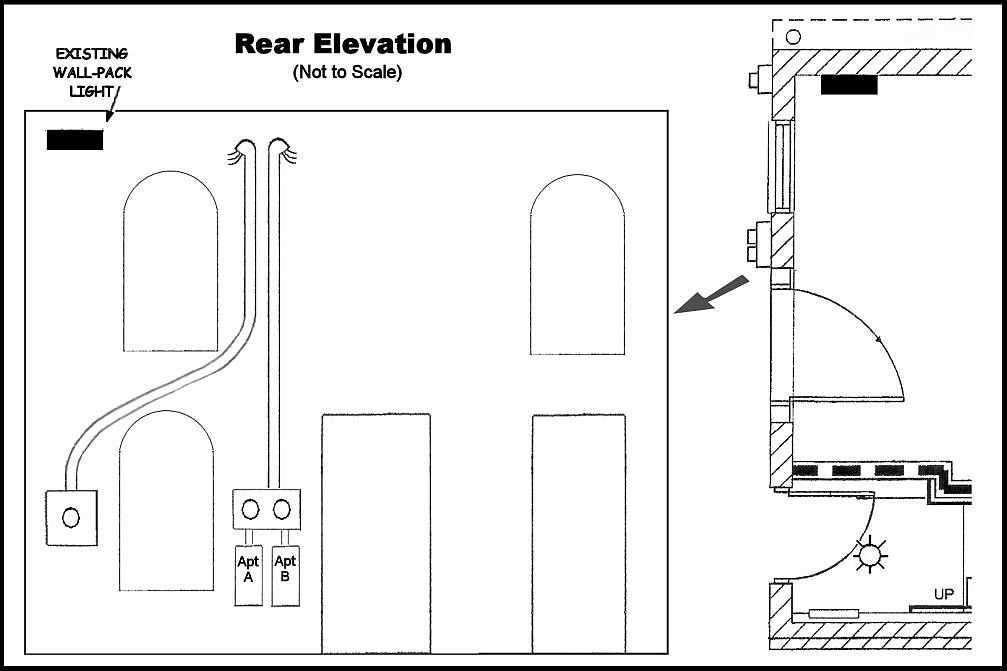
This is an old building, brick construction, two floors, effectively gutted except for the old natural-gas forced-air furnace w/ a 3-ph compressor unit on the roof. I haven't been up there yet, so I don't know the nameplate info. We're doing the drawings right now.

The upstairs space (was storage) will be two apartments, each with a 200a 1-ph panel. This part I have sorted out, with the help of several forum members (and you know who you are! :wink: Thanx!) It will get a 2-gang meter and a pair of 200a main disco's on the back of the building.

The downstairs space is going to be a store. With the exception of the existing HVAC, this space will have no other 3-ph loads, but I intend to use a 3-ph 200a panel, mounted directly behind the separate 3-ph meter. (See upper-right side of drawing, below.)

The present service is fed by an open-Delta 240/120v drop to an existing 1-ph 12-space panel (recent and temporary) and an older 3-ph 30a fusible switch (to be eliminated), both tapped from a hinged-door connection box back-to-back with the existing 3-ph meter (approx. where the 2-gang meter will be.)

Here's a click-to-enlarge drawing illustrating this installation:


This is my question: How do I size the high-leg condcutor in the service-entrance conduit (on the left, above)? The load on it will be minimal, only the AC compressor unit, but I can't simply base it on load, as it will be passing through the same 3-pole 200a main breaker in the panel.

Are the only options a fusible switch (to be able to mix fuse sizes) or two separate disco's and/or panels? Again, I had intended to use a 3-ph panel and not use the B bus for 1-pole breakers. I have orange tape and paint at the ready; will I not need them?


"As always, should you or any members of your IM Force be caught or killed, the secretary will dis-avow any knowledge of your actions. Good luck, Jim!"
 
Just my opinion as a customer who uses three phase power in my lab:

I would rather have a separate single phase panel and three phase disconnect than a three phase panel with one bus essentially unused. Additionally, if I had three phase power I would be really annoyed if spent lots of money on a three phase panel, but then had limited expansion capability because of a small service conductor.

-Jon
 
I agree with Winnie. It doesn't look like your that far from the PNL to be cost inefective to supply a full size conductor. Also avoids maintinace man from installing 200 A fufe on a #8.
 
[Prelude music]

I'm leaning in the same direction as Jon and Chris... with the additional reason of professional level workmanship. Any attempt equipment-wise to get around running a full boat 200A feeder is not going to be any more economical AFAICT.

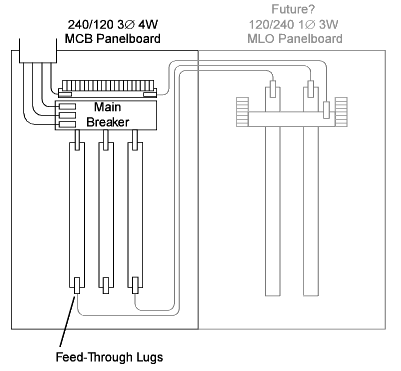
However, I would go with the 200A 3? MCB panel but with the stipulation that it have feed-thru capability for the addition of a 1? panel, either now or in the future...

31panels.gif
 
Last edited:
Okay, I'll need to full-size all three phases, and use a 3-ph main-breaker panel. While the HVAC compressor is the only 3-ph load presently, there will also be a few 240v, 1-ph loads (water heater, an in-wall space heater, a kiln) so the high-leg won't be quite so unused.

Most of the store load will be 120v loads, such as the furnace/air-handler, four fluorescent lighting circuits, one for utility room and bath lights and fans, one for common-area lights (4-6), and 8-10 receptacle circuits.

As long as I have to spring for a 3-ph panel, I see no advantage to using two panels over one large one. A 42-circuit panel will leave plenty of expansion room.

Since this isn't residential, nor 240/120v 1-ph, I have to use full-size conductors. However, I still have one un-sure-ity: service conductors need only be sized for the calculated load (230.42(A)), yet must be protected at not more than their ampacity (230.90(A)). Is there a contradiction?

If not, then the breaker determines the size. In this case, 3/0 cu or 4/0 al, right? Table C9 (and this handy-dandy calculator) tells me that, even with a full-sized neutral, I can use 2" PVC. Unless I'm missing something, this all looks right, yes? Thanx!
 
Larry,
As long as I have to spring for a 3-ph panel, I see no advantage to using two panels over one large one. A 42-circuit panel will leave plenty of expansion room.
You can get the panel made so only a few of the spaces have the "wild leg" and the rest only have the A or C phases. Not sure how much extra this costs, but I installed one like that about 15 years ago. For the 3 phase part of the panel the bus fingers for the breakers are like in a normal panel, A/B/C, but then for the "single phase" part the fingers are just A/C. The B main bus still runs the full length, but doesn't have any provisions for breaker connections on the "single phase" part.
Don
Don
 
Don Don :)grin:), I understand that, but we won't have anywhere near enough circuits for panel space to be an issue.

Can anyone see any case where a #1/0 cu would not be large enough for a neutral with 200a and 3/0 cu phases?
 
Sorry, I wasn't completely clear. Again, this is from 'customer using the space' perspective.

I would prefer to have three phase power available. I run motor loads. I would not want to pay for a 200A three phase panel, and then not have 200A three phase available.

I would prefer to have a separate single phase and 3 phase panel, especially with the 208V to neutral running around a high leg service.

IMHO best value would be having a small 3 phase panel or single 3 phase disconnect, and a 200A single phase panel, with the B leg conductor sized for the small panel, and A, C, and N sized for the service as a whole.

-Jon
 
I grok. This store is a place where customers come in and sit at work tables and make jewelry and such. Even with the expected single-pole circuits, there'll be room for any likely expansion, both 1-ph and 3-ph.

The only real loads (besides the lighting) are the AC, the kiln, the common-area wall heater (at the bottom of a stairwell), and the water heater. The heat is gas, and there won't even be a kitchenette or laundry.

But thanx for the info. Keep it comin'! :)
 
I would ensure that the water heater, and any electric heaters have at least one of their supply lines connected to the high leg, distributing the load more evenly.
 
kbsparky said:
I would ensure that the water heater, and any electric heaters have at least one of their supply lines connected to the high leg, distributing the load more evenly.
Absolutely my intent: 2-poles land on the high-leg. This will also reserve more 1-pole spaces. I'm also aware about the open side being a bit less stable under load.

Now, how to tell which side (A-B or B-C) that will be. Maybe I can ask the POCO guys if I'm there when they string the new drop, or maybe they'll color-tape the phases.
 
Sizing lightly-loaded high-leg service conductor

Remember any breakers on high leg will have to be 240 V. not standard 120/240 V. rated ones.(Hold on to your wallet).
 
kbsparky said:
I would ensure that the water heater, and any electric heaters have at least one of their supply lines connected to the high leg, distributing the load more evenly.

With a normal balanced 3 phase supply, balanced loading would be the ideal.

However with a high leg delta, especially an open delta, the power company has almost certainly made the 'stinger' transformer much smaller than the center tapped 'single phase' transformer.

-Jon
 
winnie said:
However with a high leg delta, especially an open delta, the power company has almost certainly made the 'stinger' transformer much smaller than the center tapped 'single phase' transformer.
I will be at the site in the next day or two, and I'll see if I can read the numbers on the transformers.
 
I have a thought
generally in commercial the meter box has test blocks and by pass.
Why not use 1 single phase panel fed from the meter and a 3 phase 30 amp switch fed from the same meter also. You can get stacking lugs if side by side will not fit.
Just an Idea
 
Last edited:
Status
Not open for further replies.
Top