sizing the bare copper counterpoise conductor

HANY

Member
Location
Egypt
Occupation
technical support
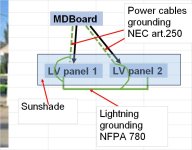
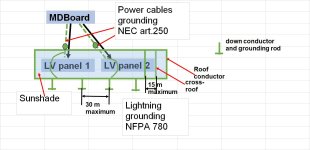
Considering a linear grounding counterpoise installed along a steel sunshade structure (300mt) , used for lightning air terminals and equipotential bonding, and noting that two local LV panels are supplied from a remotely grounded MDB,


what is the appropriate basis for sizing the bare copper counterpoise conductor:


  • when it is treated only as a lightning protection system, and
  • when the LV panels are bonded locally to this counterpoise?

Specifically, should the conductor size remain governed by lightning protection requirements, or should it be increased to account for possible power-system ground-fault current contribution?
 
I like to make these as large as possible. Spend as much of the client's money and waste as much copper as you can.

Seriously though, this will serve no purpose for the electrical system so don't even bother. If this is a component of a lightning protection system, what did the person who designed the lightning protection system say? If this wasn't designed by someone who is familiar with lightning protection systems, I wouldn't even bother.
 
Electrofelons comment is right on the mark. Counterpoise had no role in ground fault current for typical NEC but I don’t know what a 300 mt is
Lightning protection is not a a subject that most, maybe all, can answer. Best to get a professional and pay for a set of engineered drawings
 
the 300mt is the length of the sunshades (12 sunshade x 25 mt each) ,,, and this will be the length of the linear grounding counterpoise which will be connected to the air terminals down conductors along this 300mt
 
the 300mt is the length of the sunshades (12 sunshade x 25 mt each) ,,, and this will be the length of the linear grounding counterpoise which will be connected to the air terminals down conductors along this 300mt
Regional terminology gets in the way again.

In the US we abbreviate the measurement meters as simply the letter m, so we would say 25m.
the NEC uses the term 'ground ring' instead of 'counterpoinse' when discussing a buried conductor surround a structure. The last time I used counterpoint was when describing an arrangement of ground rods into a triangle.
 
Top